
Does Hebrews 11 on the Maccabees Show Stronger Alignment with 4 Maccabees than 2 Maccabees?
Hebrews 11 (the famous “Hall of Faith” chapter) does not explicitly mention the Maccabees by name, but many scholars and early Christian interpreters saw verses 35–38 as clear allusions to the martyrdom stories of the Maccabean era:
“Women received back their dead by resurrection. Some were tortured, refusing to accept release, so that they might rise again to a better life. Others suffered mocking and flogging, and even chains and imprisonment. They were stoned, they were sawn in two, they were killed with the sword. They went about in skins of sheep and goats, destitute, afflicted, mistreated—of whom the world was not worthy—wandering about in deserts and mountains, and in dens and caves of the earth.”
Short answer
Yes, Hebrews 11:35–38 aligns significantly more with 4 Maccabees than with 2 Maccabees, both in specific details and in overall theological emphasis.
Detailed comparison
| Detail in Hebrews 11 | 2 Maccabees (esp. ch. 6–7) | 4 Maccabees | Strength of connection |
|---|---|---|---|
| “Some were tortured (ἐτυμπανίσθησαν), refusing to accept release (ἄφεσιν), so that they might obtain a better resurrection” (11:35) | Eleazar is beaten and urged to eat pork to be “released” (2 Macc 6:18–31), but the exact Greek verb τυμπανίζω is not used. “Release in exchange for apostasy” is only implicit. | Repeatedly and explicitly uses τυμπανίζω (e.g., 4 Macc 6:6; 8:13; 9:26; 11:19). The entire argument is that the martyrs refused release to obtain “a better resurrection” and eternal life (4 Macc 9:8–9; 15:3; 17:12; 18:23). | Very strong – almost verbal identity |
| Emphasis on “reason” (λογισμός) mastering passion as the cause of victory | Present but minimal; focus is historical and on obedience to the Law. | The central thesis: “devout reason (ὁ εὐσεβὴς λογισμός) is absolute master of the passions” (1:1), applied constantly to the martyrs. | Very strong – theological DNA match |
| Vicarious, expiatory value of the martyrs’ deaths | Explicit (2 Macc 7:37–38; 8:3–5). | Even stronger and more philosophically developed: “ransom” (ἀντίψυχον), “propitiation” (ἱλαστήριον), purification for the nation (4 Macc 1:11; 6:28–29; 17:21–22; 18:4). | Strong in both, slightly stronger in 4 Maccabees |
| Future resurrection as the martyrs’ hope | Present and groundbreaking (2 Macc 7:9, 11, 14, etc.). | Present and more emphatic; repeated stress on “better resurrection” and eternal life vs. eternal torment for the tyrant. | Strong in both, motif stressed more in 4 Maccabees |
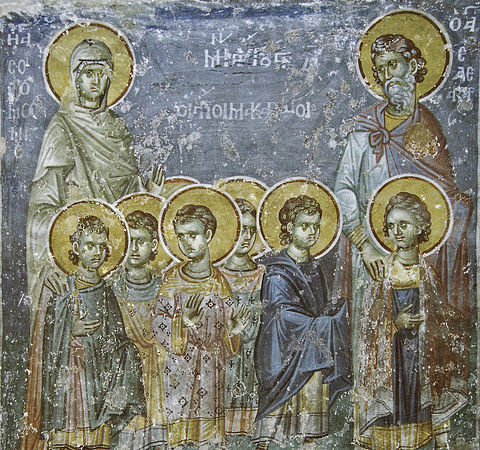
| Mothers encouraging sons / the mother of the seven brothers | Courage praised (2 Macc 7:20–29). | Role massively expanded; she is the supreme example of reason conquering maternal affection (4 Macc 14:11–17:6). | Much stronger in 4 Maccabees |
Patristic testimony
Early Christian writers almost unanimously treated 4 Maccabees as the primary background:
- Gregory of Nazianzus (Or. 15) cites 4 Maccabees extensively when commenting on Hebrews 11.
- John Chrysostom (Homily on the Maccabees) uses the version from 4 Maccabees.
- Augustine, Ambrose, and others quote or paraphrase 4 Maccabees in discussions of Hebrews 11.
Conclusion
While 2 Maccabees provides the basic historical narrative and the earliest clear Jewish statements of bodily resurrection, Hebrews 11:35–38 is far closer—both verbally and theologically—to 4 Maccabees. The rare word ἐτυμπανίσθησαν, the emphasis on reason mastering passion, the explicit language of refusing release for a better resurrection, and the highly developed doctrine of vicarious atonement all point decisively to 4 Maccabees as the primary allusion.
So yes — the alignment is real, and it is much stronger with 4 Maccabees than with 2 Maccabees.
“`
You can copy and paste this code into an `.html` file and open it in any browser.