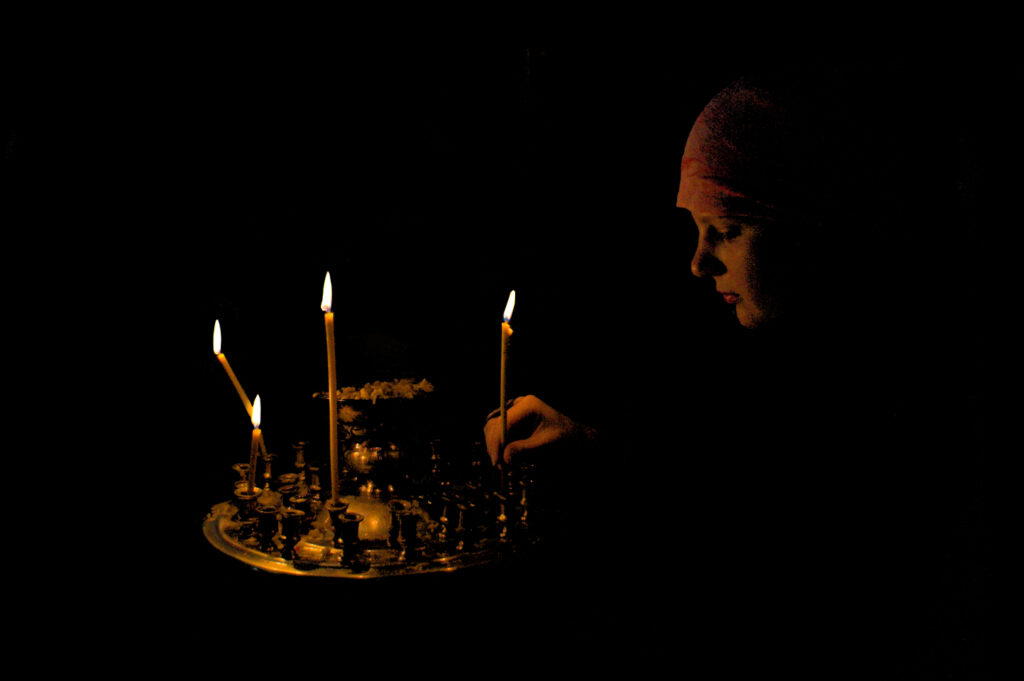

Great Vespers: A Funeral Ode of Thanksgiving for the Old Creation
and the Entrance into the Eighth Day
In the Eastern Orthodox Church (as in the Bible!), the liturgical day does not begin at midnight or at dawn, but at sunset. When the first three candles are lit on the solea and the royal doors are opened for Great Vespers, the Church is not simply starting “evening prayer.” She is enacting a profound mystery: the solemn burial of the Old and the rising of the New.
1. The Old Testament is laid to rest at Sunset (on the Lord’s Day)
From the very beginning of revelation, the Sabbath was the seal and crown of the first creation: “And on the seventh day God finished his work which he had made… and he rested on the seventh day” (Gen 2:2). The Old Covenant day therefore moved from evening to evening (Lev 23:32), and its consummation was the Sabbath—the day that looked back to the finished six-day work of creation.
At Great Vespers (Saturday being still the 7th day and Sabbath), the Church consciously stands at the “grave” of that finished creation and covenant. The structure of the service reminds us of an ancient Hebrew funeral rite, exactly as Scripture describes it after the deaths of Saul and Jonathan (2 Sam 1:17–27), Abner (2 Sam 3:31–38), and Josiah (2 Chr 35:25):
- A lamentation (kinē threnos) is sung: “Lord, I have cried unto Thee…” (Ps 140)
- The dirge is chanted in a minor tone: the slow, penitential melodies of the eight tones
- The lament is answered by thanksgiving for the life of the deceased: the doxastika and theotokion that praise the virtues of the saints of the Old Testament
- The lamentation is preserved forever in writing: the fixed texts of the Octoechos and Menaion
Just as David ordered that the “qinah” for Saul and Jonathan be taught to the children of Judah and written in the Book of Jashar (2 Sam 1:18), so the Church teaches her children the funeral odes of Vespers and writes them in her service books.
2. A Funeral for the Saints of the Old Covenant
On the anniversary of a saint’s repose (the Orthodox “name-day” or feast), Great Vespers becomes the Church’s great memorial service for that saint. But more deeply, it is the memorial for all the righteous of the Old Testament who “died in faith, not having received the promises” (Heb 11:13, 39).
The verses of “Lord, I have cried” are taken almost exclusively from the Psalms of lamentation and exile (Pss 140, 141, 129, 116). The Old Testament saints themselves sing through the Church:
“Out of the depths I have cried to Thee, O Lord”
“If Thou, O Lord, shouldest mark iniquities, Lord, who shall stand?”
“Let Thy compassions come quickly to meet us, for we are brought very low.”
These are the very words of the righteous who waited in Hades. The Church addresses the saintly departed in songs of hope and praise, echoing David and Jeremiah’s hymns which both praise the repose in the thirst person but also addressed the deceased loved one in the second person (“you”).
3. The Thanksgiving of the Burial
Yet Orthodox Vespers is never simply mourning. It is a funeral ode of thanksgiving. God is good, and the Old Covenant was a great blessing and preparation for something better (that is the theme of the letter to the Hebrews!) After the laments come the stichera that praise the virtues of the saint of the day and of all the righteous. This mirrors exactly the biblical pattern: David’s lament for Saul ends with “How the mighty have fallen… Saul and Jonathan, beloved and lovely! … “Your love to me was wonderful, surpassing the love of women…” (2 Sam 1:24–27). “Should Abner die as a fool dies? 34 Your hands were not bound Nor your feet put into fetters; As a man falls before wicked men, so you fell…” Grief is transfigured into doxology.
The climax of this transfiguration is the entrance with the censer and the singing of “O Gladsome Light” (Phōs hilaron)—the most ancient Christian hymn outside the Scriptures. At the moment the sun disappears, the Church lights the lamps and sings of Christ as the gentle light of the new creation. The old sun has set; the Sun of Righteousness has risen in the heart.
4. From the Seventh Day to the Eighth Day
When the priest proclaims “Wisdom! Let us attend!” and the prokeimenon of the day is sung, the Church crosses the eschatological threshold:
- The Great Prokeimenon on Saturday evening is always “The Lord is King; He has clothed Himself with majesty” (Ps 92)—the psalm of the eternal day that has no evening.
- The Old Testament readings (on major feasts) are from the Law and the Prophets, now read as prophecy fulfilled.
- The Aposticha verses explicitly speak of the Resurrection: “Thy Resurrection, O Christ Savior, has enlightened the whole universe…”
Thus Vespers is the liturgical enactment of Hebrews 12:22–24: we have come “to the spirits of the righteous made perfect” (the Old Testament saints now at rest), and at the same moment “to Jesus, the mediator of a new covenant.” The service buries the Sabbath of the old creation and awakens us into the first day of the week—the Day of Resurrection, the eighth day that has no evening.
5. The Meaning of the Day-Change at Sunset
Every Great Vespers therefore performs a cosmic and covenantal funeral and resurrection:
- We lay to rest the old creation with its Sabbath seal.
- We commemorate and honor the righteous of the Old Covenant who waited in hope (as well as those of the New Covenant).
- We give thanks for their faith and patience, seeking to be inspired by their example as “a great cloud of witnesses” and asking them to intercede for us.
- We rise with Christ into the new creation, where the Lamb is the lamp and there is no night.
This is why Orthodox Christians have always experienced Saturday evening Vespers as a most joyous service of the week—more peaceful, paradoxically, than the Sunday morning Liturgy. For here, at sunset, the Church sings the funeral of the old world and steps first into the unending light of the Kingdom.
“Blessed is the man who walks not in the counsel of the ungodly…”
Out of the depths the Old Testament saints cry to us.
And we answer with David and with all the Church:“Thy memory is blessed, O righteous one,
and thy repose is with the saints.
For the old things have passed away;
behold, all things have become new.”