
The Righteous Guardians of the Incarnate Word
In the Name of the Father, and of the Son, and of the Holy Spirit. Amen.
Today, as we gather to honor the memory of the righteous Joseph the Betrothed, James the Brother of the Lord, and the holy Prophet-King David, we are invited deeper into the mystery of the Incarnation. The eternal Word became flesh, entering our world in vulnerability, protected and nurtured by those whom God Himself chose—men marked by extraordinary righteousness. These guardians of the God-Man reveal to us the beauty of lives wholly surrendered to divine will, lives that shine as beacons in the Orthodox tradition.
We begin with a reflection on human divisions and divine unity. Rudyard Kipling once wrote, “Oh, East is East, and West is West, and never the twain shall meet.” But he continued: “But there is neither East nor West, Border, nor Breed, nor Birth, When two strong men stand face to face, though they come from the ends of the earth!” How much more true this is in Christ! In Him, as St. Paul teaches, there is neither Jew nor Greek, slave nor free—neither East nor West. All barriers dissolve before the Person of Jesus Christ, who is Truth uncontainable.
We who bear the name “Eastern Orthodox,” even dwelling in Western lands, understand this profoundly. The Eastern mind, shaped by the Scriptures and the Holy Fathers, does not confine God to rigid systems or “boxes” of human logic. Western theology has at times sought to enclose divine truth in neat frameworks—predestination, penal substitution, sola scriptura—yet often leaves truths protruding, unresolved. Orthodoxy, in contrast, embraces the mystery: “Christ in you, the hope of glory” (Colossians 1:27). Our worship reflects this, as St. Paul describes in Hebrews 12: not approaching a mountain of terror and darkness, but Mount Zion, the heavenly Jerusalem, with myriads of angels, the assembly of the firstborn, the spirits of the righteous made perfect, and Jesus the Mediator of the new covenant.
Many in the West cite Romans 3:10: “There is no one righteous, not even one.” This is true as hyperbole, emphasizing humanity’s fallenness. Yet the Eastern approach does not erect an entire doctrinal system upon it. For Scripture and Tradition affirm that some are indeed righteous—rare, but real—by God’s grace. Today we venerate two such men: Joseph and James.
St. Matthew calls Joseph a righteous man (Matthew 1:19), unwilling to expose the Theotokos to shame. Holy Tradition teaches that Joseph was an elder, a widower, chosen by God to guard the Ever-Virgin Mary in chaste betrothal. This illuminates the “brothers” of the Lord—not uterine siblings, but Joseph’s sons from his prior marriage, including James.
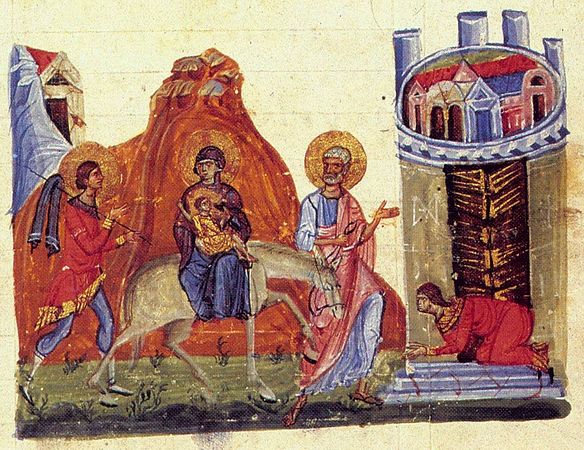
Behold the ancient icons of the Flight into Egypt: Joseph leading, the Theotokos with the Christ Child, and often young James walking beside them—an older stepbrother guiding the Holy Family through peril. When Christ was crucified at thirty-three, James, being older, was a mature man, prepared to lead the Jerusalem Church.
James the Just was holy from his mother’s womb. As the church historian Eusebius records in his Ecclesiastical History (Book II, Chapter 23), quoting the second-century writer Hegesippus:
“James, the brother of the Lord, succeeded to the government of the Church in conjunction with the apostles. He has been called the Just by all from the time of our Saviour to the present day… He was holy from his mother’s womb; he drank no wine nor strong drink, nor did he eat flesh. No razor came upon his head; he did not anoint himself with oil, and he did not use the bath. He alone was permitted to enter into the holy place [the Temple sanctuary]… His knees became hard like a camel’s, because he was constantly bending them in worship to God and asking forgiveness for the people. So from his excessive righteousness he was called the Just and Oblias, which means in Greek ‘Bulwark of the people and righteousness’…”
Eusebius further notes, drawing from Clement of Alexandria, that after the Ascension, Peter, James, and John—though honored by the Lord—did not strive for glory but chose James the Just as bishop of Jerusalem. And Clement adds: “The Lord after His resurrection imparted knowledge to James the Just and to John and Peter…”
To this day in Orthodoxy, bishops are ordained by three hierarchs, tracing back to this apostolic practice beginning with James.
James lived asceticism incarnate: Nazirite vows, ceaseless prayer, intercession for his people. His knees, calloused like a camel’s, witness to a life poured out in supplication.
Joseph, too, embodied righteousness through chaste guardianship and humble labor.
He received divine dreams, obeyed instantly, and saved the Theotokos and Child from Herod. In our fatherless age, Joseph’s example as protector and provider burns brightly.
Both men were chosen not merely by blood but by holiness, fulfilling Psalm 15: “He who walks blamelessly and does what is right.” Their ascetic lives prepared them for divine vocation: Joseph shielding the vulnerable Incarnate Word, James shepherding the Church born from the Resurrection.
James’s martyrdom, as Eusebius preserves from Hegesippus, moves the soul:
The scribes and Pharisees placed James on the Temple pinnacle, demanding he deny Christ. He proclaimed Jesus as the Son of Man seated at the right hand of Power, coming on the clouds. Enraged, they threw him down. Surviving the fall, he knelt and prayed: “I entreat Thee, Lord God our Father, forgive them, for they know not what they do.” They stoned him, and a fuller struck his head with a club. Thus he received the martyr’s crown.
Eusebius concludes: “James was so admirable a man and so celebrated for his justice that the wiser Jews believed the siege of Jerusalem… happened… immediately after his martyrdom… for their daring act against him.” With James removed—their righteous intercessor—the city fell under divine judgment.
James himself wrote: “The prayer of a righteous person avails much” (James 5:16). How powerfully do these saints intercede for us now!
In Joseph and James, we see Orthodoxy’s heart: not abstract theology, but living communion through righteousness, ascetic struggle, and prayer. Adoption by grace makes us God’s children; Joseph adopting Jesus prefigures our sonship. In the Eucharist, we share mystical blood, becoming true family.
Beloved, are we teachable by God, as Joseph in dreams? Do we seek righteousness with James’s fervor? In this distracted age, let us embrace ascetic discipline—fasting, vigilant prayer, devotion to family and Church. Let us guard our hearts for Christ, as these righteous ones guarded Him.
Through the prayers of the Most Holy Theotokos, righteous Joseph the Betrothed, and holy James the Brother of God, O Lord Jesus Christ our God, have mercy on us and save us.
Amen.