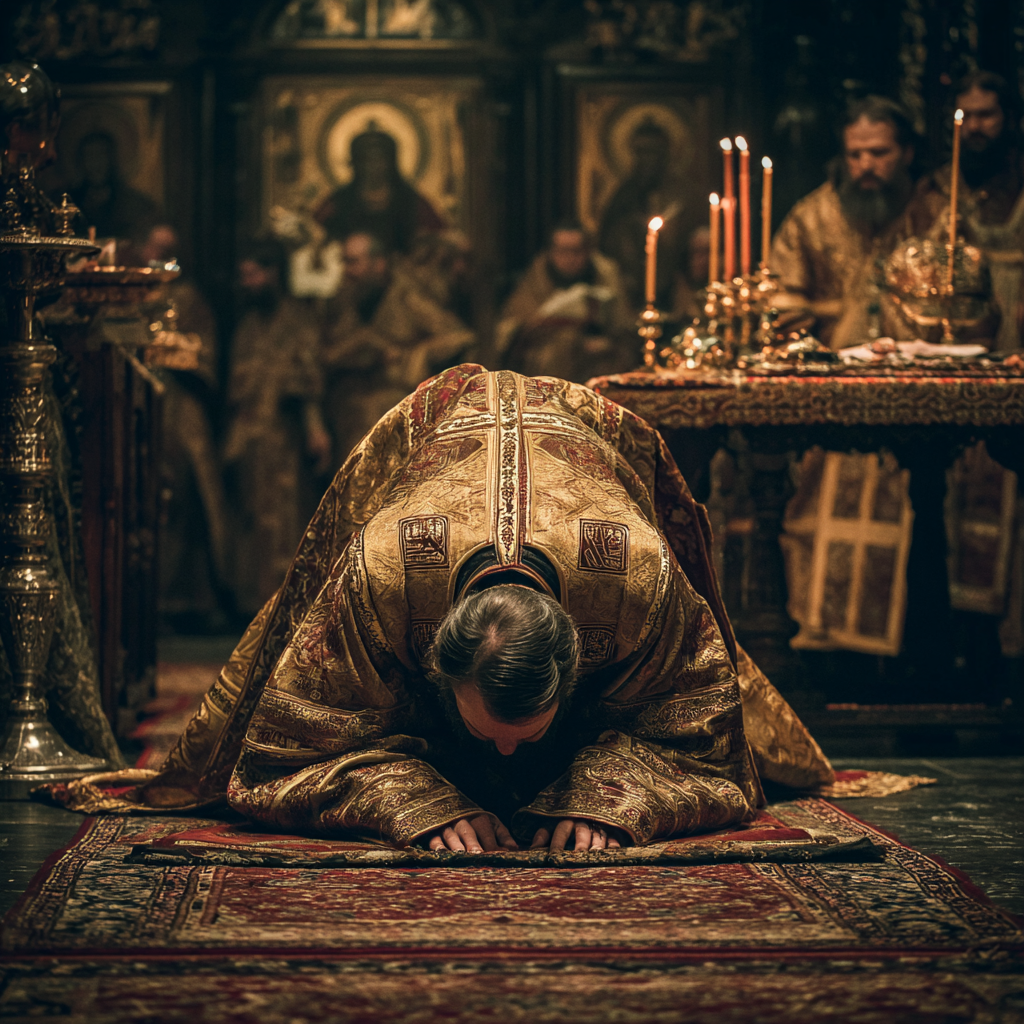

Postures of Prayer in the Eastern Orthodox Divine Liturgy: Kneeling, Prostration, and Local Variations
The Eastern Orthodox Church richly embodies prayer through physical postures, reflecting deep theology and participation in worship. Two key factors shape local practices regarding kneeling and full prostrations during the Divine Liturgy: (1) whether the Anaphora (Eucharistic prayers of consecration) is recited aloud, allowing the faithful to hear and respond with “Amen”; and (2) the longstanding confusion between prolonged kneeling (during prayer) and brief full prostrations (as acts of veneration).
The Early Church Practice: Anaphora Said Aloud
In the ancient Church, the Eucharistic prayers were proclaimed audibly so the entire assembly could participate actively. St. Justin Martyr (c. 100–165 AD), in his First Apology (Chapters 65 and 67), describes the 2nd-century Liturgy:
– Chapter 65: After the readings and sermon, “the president [bishop/priest] in like manner offers prayers and thanksgivings, according to his ability, and the people assent, saying Amen…”
– Chapter 67: On Sunday, “he who presides… reads the memoirs of the apostles or the writings of the prophets… Then we all rise together and pray… bread and wine and water are brought… Thereupon, the president likewise offers prayers and thanksgivings to the best of his ability, and the people assent, crying out ‘Amen’.”
This audible recitation enabled the congregation to join in the heavenly worship, responding with heartfelt “Amen” to the consecration of the Gifts—mirroring the angelic and elder adoration in Revelation 5:8–14, where living creatures and elders (=presbyters) fall down before the Lamb, holding harps and bowls of incense (prayers of the saints), proclaiming worthiness and saying “Amen!”
Over time, in many places (especially Byzantine-influenced), the Anaphora shifted to silent recitation, reducing lay participation. Today, many parishes are recovering this ancient practice of audible Anaphora, fostering greater awareness and reverential response at the epiclesis (invocation of the Holy Spirit).
Canonical Basis for Standing on Sundays
The Church mandates standing during prayer on Sundays and the Pentecost season to honor Christ’s Resurrection:
– Canon 20 of the First Ecumenical Council (Nicaea I, 325 AD): “Forasmuch as there are certain persons who kneel on the Lord’s Day and in the days of Pentecost… it seems good to the holy Synod that prayer be made to God standing.”
– Canon 90 of the Quinisext Council (Trullo, 692 AD): Expands this, prohibiting kneeling from Pascha to Pentecost, emphasizing joyful standing as a figure of the age to come.
– Canon 91 of St. Basil the Great: “Prayers are to be offered standing on the first day of the week [Sunday].”
These canons prohibit prolonged kneeling during prayer (gonyklisia), seen as penitential and unsuitable for resurrectional joy, while prescribing standing “aright.”
Clarifying the Confusion: St. Nikodemos the Hagiorite’s Authoritative Distinction
Much variation stems from conflating kneeling during extended prayer with brief full prostrations (great metanoias: falling to the knees and touching forehead to ground as veneration).
St. Nikodemos the Hagiorite (1749–1809), in his commentary on Canon 20 in The Rudder (Pedalion) (English trans., pp. 171–173), clarifies:
Note, however, that the present Canon is not referring to those genuflections which among us are more commonly called great metanoias/full prostrations, which, properly speaking, are called prostrations that are made before kissing the icons of the saints or before the awesome sacraments and are not prohibited neither on a Sunday nor on the days of the period of Pentecost… In my view the Canon does not refer to this kind of genuflection [brief reverential], but to the genuflection wherein while bending our knees we pray…”
Thus, the canons target prolonged penitential postures, not quick acts of awe before the Holy Gifts (e.g., at the epiclesis after the triple “Amen”).
Toward Recovery of Ancient Worship
When the Anaphora is proclaimed aloud—as in early Church practice and Justin’s description—the faithful hear the epiclesis, respond “Amen,” and naturally express reverence through a brief prostration, joining the heavenly liturgy of Revelation 5 (presbyters falling down in adoration before the Lamb). Many contemporary Orthodox parishes, across jurisdictions, are recovering both audible recitation and this participatory posture, allowing the people to fully engage in the mystery of consecration while honoring Sunday standing for all the prayers of the Divine Liturgy.
Local customs vary, guided by these factors (and the local bishop), but the movement reflects a return to communal worship where body and soul unite in praising the Lamb.