
In the name of the Father, and of the Son, and of the Holy Spirit. Amen.
Dear brothers and sisters in Christ,
Where are you going? Where are we going?
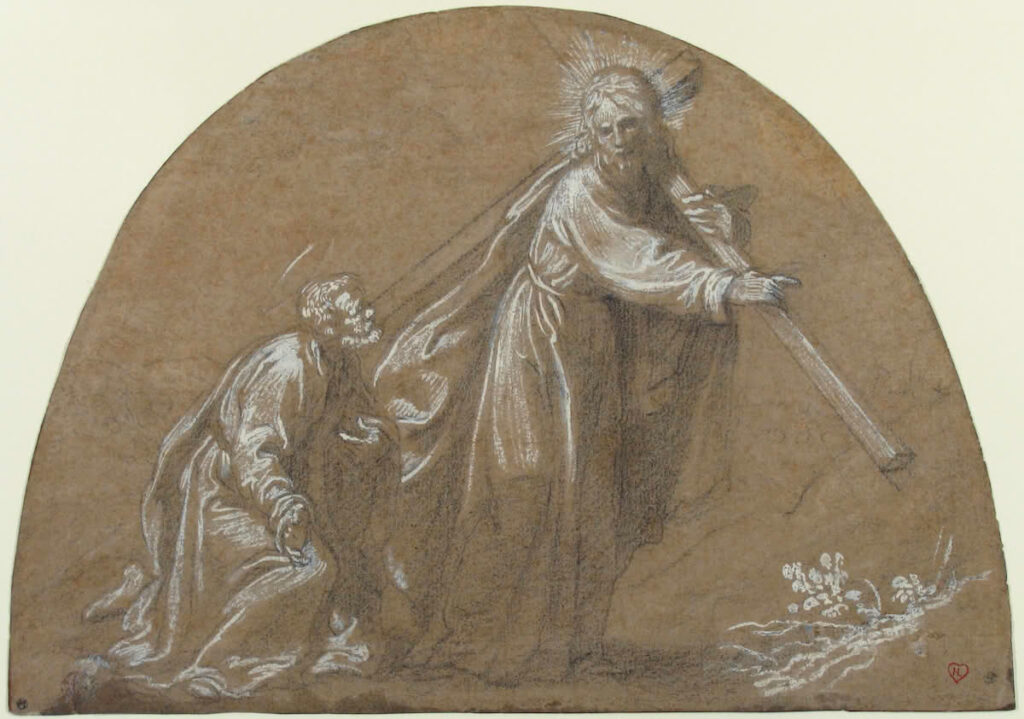
These are the questions the Lord places before us today, just as He once placed them before the Apostle Peter on the Appian Way outside Rome. According to the ancient tradition, Peter, fearing martyrdom, was fleeing the city when the risen Lord appeared to him walking in the opposite direction. Peter asked, “Domine, quo vadis?” “Lord, where are you going?” Jesus answered, “I am going to Rome to be crucified again.” Peter understood at once: Christ would be crucified again in the person of His followers, and especially in Peter himself. Strengthened by this vision, Peter turned around, returned to Rome, and stretched out his hands upon the cross.
This same Lord who met Peter on the road now meets us and asks each of us: “Where are you going?” He does not mean merely geographically—whether from California to France or to Idaho—but intellectually and spiritually. Where are you going? What is the destination? Do we even know? And above all, who is leading us?
We live in an amazing season when we can watch flocks of ducks flying overhead, always going somewhere, always in formation, always following someone. Yet we ourselves can sit perfectly still, staring into a phone, going nowhere physically, while being carried very far—often very far down—intellectually and spiritually. Human beings are always going somewhere: either from glory to glory or, tragically, from the worthless to the even more worthless.
Today the Church celebrates the memory of the Holy Apostle Andrew, the First-Called. Andrew was the younger brother of Peter, and he was first a disciple of John the Baptist together with John the Evangelist. Look again at the icon of the Lord’s Baptism. Where were these two friends going that day? They were going to the Jordan River to hear John the Baptist, led by the Spirit of God. And there they heard the Baptist cry out, “Behold, the Lamb of God who takes away the sin of the world!” At that moment they left everything and followed Christ. Andrew received the beautiful title “The First-Called” because he was the first to hear and follow.
Who was leading them? The Holy Spirit—the same Spirit who had led Jesus into the desert was now leading these young men into a life they could never have foreseen. They were simple fishermen. They probably never imagined that one day Peter would die crucified upside-down in Rome and Andrew would be crucified on an X-shaped cross in Greece—both for the sake of the eternal Kingdom of God.
This is what defines the Christian life. As Saint Paul teaches us, “All who are led by the Spirit of God are sons and daughters of God” (Romans 8:14). If we allow ourselves to be led by the Holy Spirit, God will surely take us on a very unexpected journey. We speak sometimes in our men’s group about “the unexpected journey,” like Bilbo Baggins in The Hobbit. We must stay alert to the gentle motions of the Holy Spirit, because we are created for an unexpected journey toward the Kingdom.
This church building itself speaks of that journey. The nave is a ship, and we are sailing together toward the east, toward the rising Sun of Righteousness, returning together to Eden. The wind that fills our sails is the Holy Spirit. We do not sail alone: the angels and the great cloud of witnesses surround us, and every one of them has traveled an unexpected journey led by that same Spirit.
The Apostle Andrew’s quest was no longer a bigger boat or a bigger catch of fish. From the moment he followed John the Baptist, his only quest was to do the will of God.
We see the same truth in the lives of the saints we remember today.
Saint Innocent traveled the globe in a way few have ever done: a young orphan in Siberia who became a priest in Alaska, then traveled to California and Hawaii, then to Saint Petersburg, back to Alaska as bishop, then to Siberia again, and finally to Moscow as its metropolitan. An utterly unexpected journey, yet every mile was guided by the Spirit.
Saint Olga, whom many of us knew personally, hardly traveled at all. She stayed in Alaska, knitting socks, raising children, praying without ceasing. Who would have guessed that this simple matuška would become a saint whose prayers and appearances after her death would reach New York and Arizona?
Saint John of Shanghai and San Francisco was born of Russian descent in Serbia, fled to China where things were terrible, then to Paris, and finally to San Francisco, where people from all over the world now come to his relics and receive healing and peace.
And today, together with the Apostle Andrew, we celebrate Saint Sebastian Dabovich, whose feast falls on this very day, November 30th. Born Jovan Dabović in San Francisco in 1863 to Montenegrin immigrant parents, he was the first Orthodox child born in that city and one of the very first Orthodox Christians born on American soil. At nineteen he traveled alone to Russia, was tonsured a monk at Valaam Monastery with the name Sebastian, studied in Kiev, and was ordained. He returned to America, became the first American-born Orthodox monk and priest to serve on American soil, founded the first Serbian parishes in Jackson, California, and Seattle, preached in English when almost no one else did, worked for the unity of all Orthodox in this land, and even dreamed of an autocephalous American Orthodox Church decades before most dared to imagine it. During the Great War he served as a chaplain with the Serbian army, endured the horrific retreat over the Albanian mountains in winter, and spent his last years at Žiča Monastery in Serbia, where he reposed on this day in 1940.
All these lives cry out the same message: We must listen to God, whose Spirit is our true guide on this earthly journey.
How do we listen?
First, through silence. The Prophet Habakkuk says, “The Lord is in his holy temple; let all the earth keep silence before him.”
Second, by being truly exposed to the living and active Word of God. Saint Anthony the Great entered church one day and heard the Lord say in the Gospel, “If you would be perfect, go, sell what you have and give to the poor.” He felt the words were spoken directly to him and immediately obeyed. Some time later he heard, “Do not be anxious for tomorrow,” and again he obeyed completely. The Russian Pilgrim heard Saint Paul’s words “Pray without ceasing” and they sank so deeply into his soul that they launched him on the journey of the Jesus Prayer.
Third, by trusting in the divine will. Saint Innocent once prayed with tears that his gravely ill son Gabriel would be spared, and the child miraculously recovered. Later, when that same son caused his parents continual grief, Saint Innocent repented of his earlier prayer and begged God’s forgiveness for his lack of submission. We may pray earnestly for what we desire—even three times, as our Lord did in Gethsemane—but in the end we must say with Christ, “Not my will, but Yours be done.”
Finally, we must accept both the ups and the downs, the times of refreshment and the times of cross-bearing, remembering the words “It is through many tribulations that we must enter the Kingdom of God.”
In the end, every human being is on a journey: either with God toward God, or without God and even against God. The saints we celebrate today chose the journey with God. The ruler of the synagogue in the Gospel chose the journey against God when he tried to silence the Holy Spirit and cancel the very meaning of God’s revelation, telling the Lord, “Come back later—or better, never.”
Where are we going? Each of us will arrive exactly where we choose to follow.
Social media makes this clear: we can follow or unfollow anyone with a single click. Let us choose wisely whom we follow in this life.
As a parish family, let us encourage one another to keep our eyes fixed on what is eternal, true, and beautiful: the love of God the Father and His becoming call to our souls, in the face of Jesus Christ and by the power of the Holy Spirit.
To the Holy Trinity—one God—be honor and worship, glory and power, now and ever and unto the ages of ages. Amen.