
Mary, Queen Mother (Gebirah) of David’s Eternal Kingdom
In the ancient Davidic kingdom, the role of the queen mother, or gebirah (גְּבִירָה), was one of profound influence and authority. Unlike the king’s wife, who might share his affections with others in a polygamous court, the queen mother held a unique position as the primary advisor and intercessor for the people. She sat at the king’s right hand, a place of honor symbolizing her elevated status. This biblical tradition finds its fulfillment in the Orthodox understanding of the Blessed Virgin Mary as the Theotokos—the Mother of God—and Queen Mother of Christ’s eternal kingdom. Drawing from Scripture and the wisdom of the Church Fathers, we see Mary not merely as a historical figure but as the exalted intercessor who crowns her Son’s reign and guides the faithful to Him.
The Biblical Roots of the Gebirah
The Hebrew Scriptures provide vivid examples of the gebirah‘s role. Perhaps the most striking is found in the story of King Solomon and his mother, Bathsheba. When Bathsheba approached Solomon with a request, the king rose from his throne, bowed before her, and placed a seat for her at his right hand (1 Kings 2:19). This act of reverence underscores the queen mother’s authority: she was not a subordinate but a co-ruler in counsel, her words carrying weight in the kingdom’s affairs. Solomon’s treatment of his mother exemplifies the honor due to the gebirah, a position that often involved advising on matters of state, family, and even cultic life.
Psalm 45, a royal wedding psalm, further illuminates this dynamic. Addressed to a king anointed by God (v. 7), the psalm describes a queen mother (šēgal, שֵׁגַל) standing at his right hand in robes of gold from Ophir (v. 9). She advises the foreign bride: “Forget your people and your father’s house, so that the king may desire your beauty. Since he is your lord, bow to him” (vv. 10-11). Here, the queen mother imparts wisdom, ensuring the continuity of the royal line and the bride’s integration into the kingdom. The psalm’s imagery of anointing with the “oil of gladness” (v. 7) evokes joy and divine favor, linking the king’s marriage to the prosperity of the realm.
Song of Solomon 3:11 offers another glimpse into the queen mother’s role at her son’s wedding: “Go forth, O daughters of Zion, and gaze on King Solomon with the crown with which his mother has crowned him on the day of his wedding, and on the day of the gladness of his heart.” In this poetic scene, Bathsheba (or the idealized queen mother) crowns Solomon, symbolizing her authority to confirm his kingship on this joyous day. This act parallels ancient Near Eastern traditions where the queen mother played a pivotal part in rituals of renewal and union. Typologically, it points forward to the eschatological Wedding Supper of the Lamb (Revelation 19:6-9), where Christ, the eternal King, weds His bride, the Church. Mary, as Queen Mother, “crowns” this feast through her intercession, her “gladness of heart” echoing the Magnificat (Luke 1:46-55), where she rejoices in God’s salvation.
These texts reveal the gebirah as more than a familial figure; she was integral to the kingdom’s stability, often linked to cultic roles. In ancient Israel and Judah, queen mothers like Maacah (1 Kings 15:13) held positions tied to sacred practices, reflecting a divine-human partnership that Orthodox theology sees perfected in Mary.
Mary as the Fulfillment of the Gebirah
In the New Testament, Jesus is proclaimed the eternal heir to David’s throne: “He will be great and will be called the Son of the Most High, and the Lord God will give Him the throne of His father David; and He will reign over the house of Jacob forever, and His kingdom will have no end” (Luke 1:32-33). If Christ is the Davidic King, then Mary, His mother, assumes the role of gebirah. The Church Fathers recognized this typology early on. St. Ephrem the Syrian (4th century) hailed Mary as “Majestic and Heavenly Maid, Lady, Queen,” emphasizing her royal dignity. St. Modestus of Jerusalem (7th century) called her “the Queen of the human race,” transported to heaven as the ever-Virgin Mother. Even Origen of Alexandria (3rd century) addressed her as “my Lady,” a title befitting her intercessory role.
This queenship is vividly depicted in Revelation 12:1-5, where a woman “clothed with the sun, with the moon under her feet, and on her head a crown of twelve stars” gives birth to a son who rules all nations. Orthodox tradition identifies this woman as Mary, the Queen Mother, standing in heaven as advocate for the Church. Her position at Christ’s right hand mirrors Bathsheba’s beside Solomon, but elevated eternally. As the Theotokos, Mary intercedes for us, not as a rival to Christ, but as the one who directs all to her Son: “Do whatever He tells you” (John 2:5).
The Wedding at Cana (John 2:1-11) echoes the queen mother’s advisory role. Mary notices the lack of wine and informs Jesus, prompting His first miracle. Like the šēgal in Psalm 45, she guides the proceedings, ensuring abundance and joy. This foreshadows the Wedding Supper of the Lamb, where Mary’s maternal care crowns the eternal banquet. St. John Damascene (8th century) in his homilies on the Dormition praises her as Queen, exalted by her Son to intercede for humanity.
Mary’s Eternal Queenship in Orthodox Tradition
Orthodox theology views Mary’s queenship as rooted in her divine maternity and perpetual virginity. She is the new Eve, the Ark of the New Covenant, bearing the Word of God. As Queen Mother, she pleads for her children, much as Bathsheba interceded before Solomon. The Akathist Hymn proclaims: “Rejoice, O Queen of all, who dost heal our infirmities by thy grace!” Her role is not one of independent power but of humble service, reflecting Christ’s kingship.
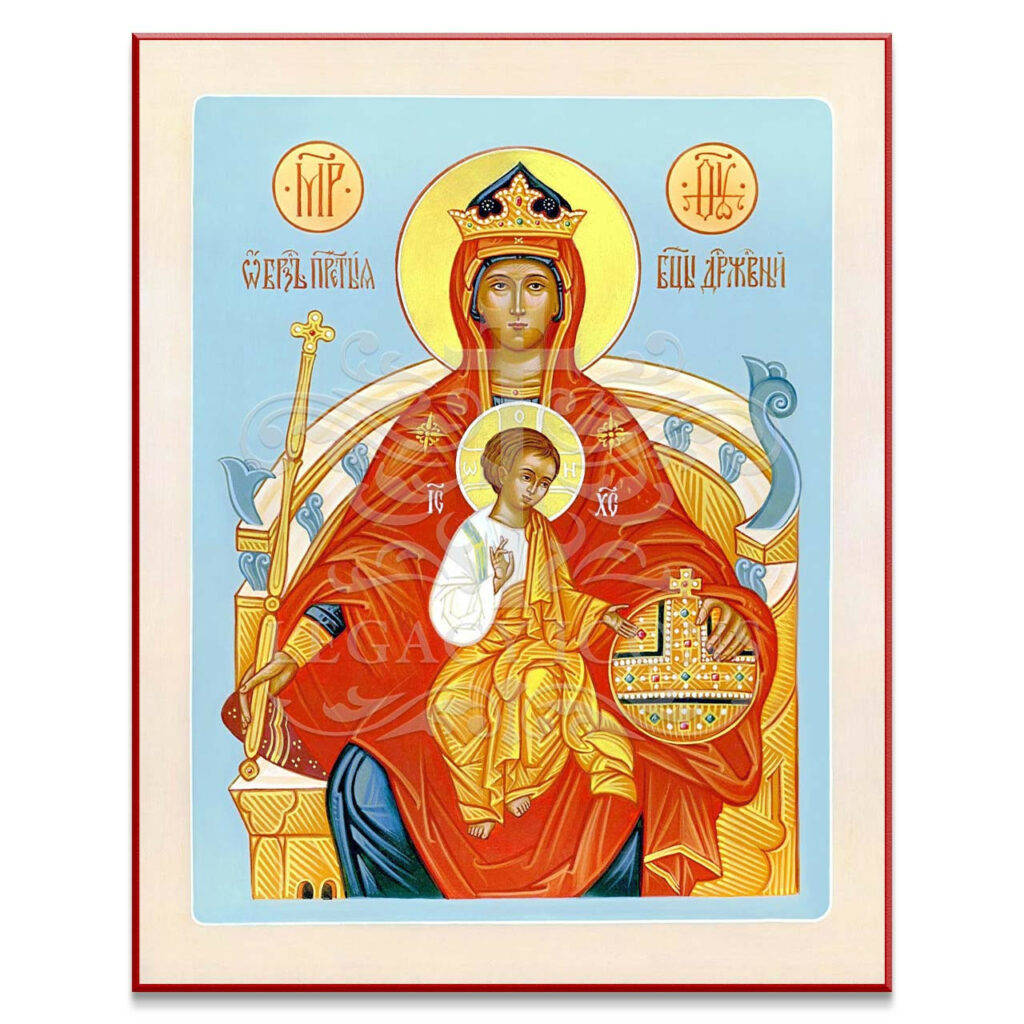
The Church Fathers affirm this. St. Ephraim sees her as the “Queen of mortal man,” while Patriarch Modestus declares her “Queen of the human race.” This veneration extends to icons like the “Enthroned Theotokos,” where Mary sits beside Christ, crowned in glory. In the eternal kingdom, Mary’s intercession invites us to the heavenly feast, where the gladness of Song 3:11 finds its fulfillment.
Conclusion
Mary, as Queen Mother of David’s eternal kingdom, embodies the biblical gebirah in its fullest sense. From Bathsheba’s throne at Solomon’s side to the crowning in Song of Solomon, Scripture foreshadows her role. The Fathers and Orthodox tradition honor her as intercessor, guiding us to Christ at the Wedding Supper of the Lamb. Let us, like the daughters of Zion, gaze upon her with reverence, seeking her prayers: “Holy Theotokos, save us!”