
Rector | Pastor | Parish Priest
Biography of Fr. Laurent Cleenewerck
Fr. Laurent Cleenewerck (legally Cleenewerck de Kiev), a dedicated presbyter of the Eastern Orthodox Church, serves as the founding priest of the Orthodox mission in Sandpoint, Idaho, ministering to the communities of Sandpoint, Ponderay, Priest River, Newport, and Athol. Born in 1969 in Montpellier, France, to a Flemish (French) family, Fr. Laurent spent part of his childhood in Connecticut before pursuing an extensive academic and spiritual journey.
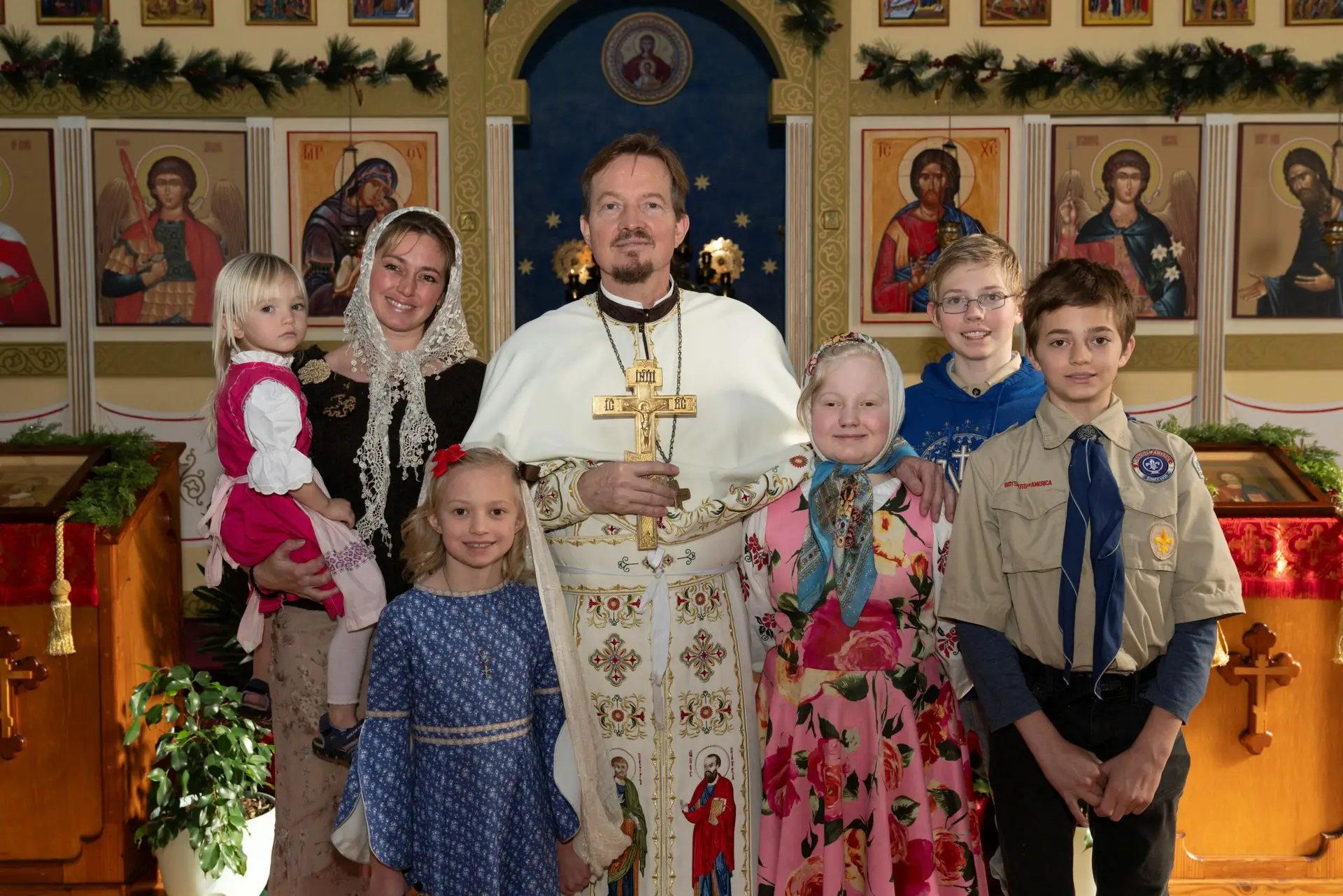
(Above: with family at St Innocent Orthodox Church, December 2023)
Ordained in the Ukrainian Orthodox Church of the USA (Ecumenical Patriarchate of Constantinople)(2004) and received into the Orthodox Church in America in 2007, Fr. Laurent served as rector of St. Innocent Orthodox Church in Eureka, California, from 2007 to 2024. In 2024, he moved to France and was released to the Archdiocese of Russian Orthodox Churches in Western Europe (Patriarchate of Moscow). He and family returned to the United States in June 2025 and was officially received by Bishop Maxim and assigned to Sandpoint, Idaho in September 2025. His pastoral work emphasizes catechesis, Bible-centered preaching, and fostering a vibrant Orthodox community and worship rooted in apostolic tradition.
Fr. Laurent holds a Licentiate in Sacred Theology from the St. Sergius Orthodox Theological Institute in Paris, a Master’s in Ecumenical Studies from the Ukrainian Catholic University, and a Doctorate of Science in the Study of Religion from the St. Gregory Nazianzen Institute as well as a PhD in Public Health. He also completed 2 years of studies at St Tikhon’s Orthodox Theological Seminary for additional pastoral and liturgical training. A widely published academic, he teaches theology, international administration, and global health at EUCLID University, Euler-Franeker Memorial University and the Ukrainian Catholic University. He is the author of His Broken Body: Understanding and Healing the Schism between the Roman Catholic and Eastern Orthodox Churches and editor of the Eastern/Greek Orthodox New Testament.
Fr. Laurent brings to Sandpoint a deep passion for sharing the unchanging truth of Orthodoxy, offering spiritual guidance through liturgical worship, educational classes, and community outreach.

Diocesan Bishop
Biography of His Grace Bishop MAXIM (Vasiljević) of the Western American Diocese
Early Life and Education
His Grace Bishop Maxim (secular name: Milan Vasiljević) was born on June 27, 1968, in Foča, a town in what was then Yugoslavia (now Republika Srpska, Bosnia and Herzegovina). From a young age, he demonstrated a deep commitment to the Orthodox faith, which would shape his lifelong vocation as a scholar, teacher, and hierarch.
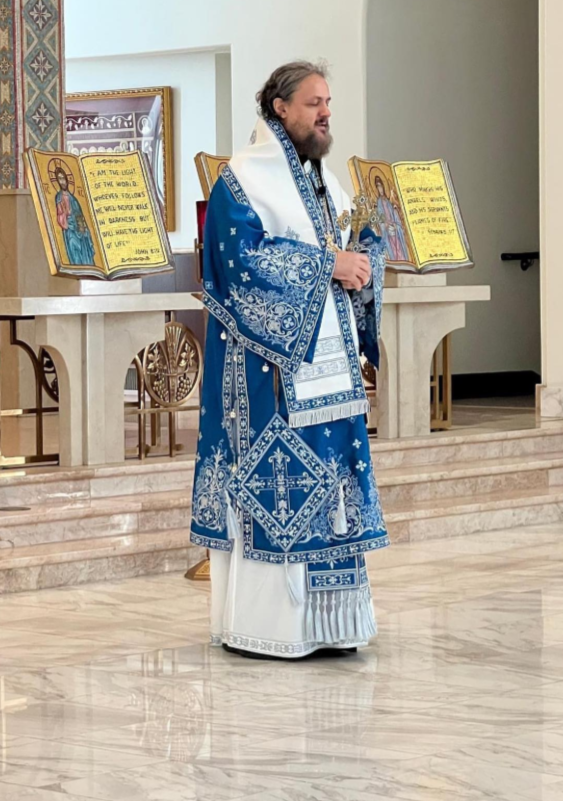
Bishop Maxim’s formal theological education began at the Faculty of Orthodox Theology of the University of Belgrade, where he graduated in 1993. He pursued advanced studies in Greece, earning a Master of Theology from the University of Athens in 1996. In 1999, he completed his doctoral degree at the same institution, specializing in dogmatics and patristics. His dissertation focused on profound themes in early Christian theology, reflecting his passion for the Church Fathers. Between 2003 and 2004, he undertook post-doctoral research in Byzantine history at the Sorbonne in Paris, France, and served as a visiting professor at the French Academy of Fine Arts, where he explored the theory and practice of painting, particularly in relation to iconography.
Monastic and Priestly Formation
Following his ordination to the diaconate and priesthood, Bishop Maxim embraced the monastic life, taking the name Maxim in honor of early Church saints. Prior to his elevation to the episcopate, he served as Bishop of Hum, a vicar bishopric in the Metropolitanate of Dabro-Bosna in Bosnia and Herzegovina. In this role, he worked tirelessly amid the challenges of post-war reconstruction, fostering spiritual renewal in a region scarred by the 1990s conflicts. His pastoral ministry emphasized education, liturgical revival, and the preservation of Orthodox heritage.
Election and Enthronement as Bishop of Western America
On May 25, 2006, at the regular session of the Holy Assembly of Bishops of the Serbian Orthodox Church in Belgrade, Bishop Maxim was elected to lead the Diocese of Western America (also known as the Eparchy of Western America). This diocese encompasses Serbian Orthodox parishes across the western United States, from California to the Pacific Northwest and beyond, serving a vibrant diaspora community.
He was enthroned on July 30, 2006, in the Cathedral Church of St. Steven the First-Crowned (also known as St. Sava Cathedral) in Alhambra, California, by His Grace Bishop Longin of the New Gračanica Metropolitanate. Succeeding Bishop Longin as administrator, Bishop Maxim inherited a diocese rich in history but facing modern challenges such as assimilation, youth engagement, and inter-Orthodox collaboration. Under his leadership, the diocese has grown in spiritual depth, with new church constructions, educational programs, and cultural initiatives that bridge Serbian Orthodox spiritual heritage (of St Nikolaj of Zica for instance) with American life.
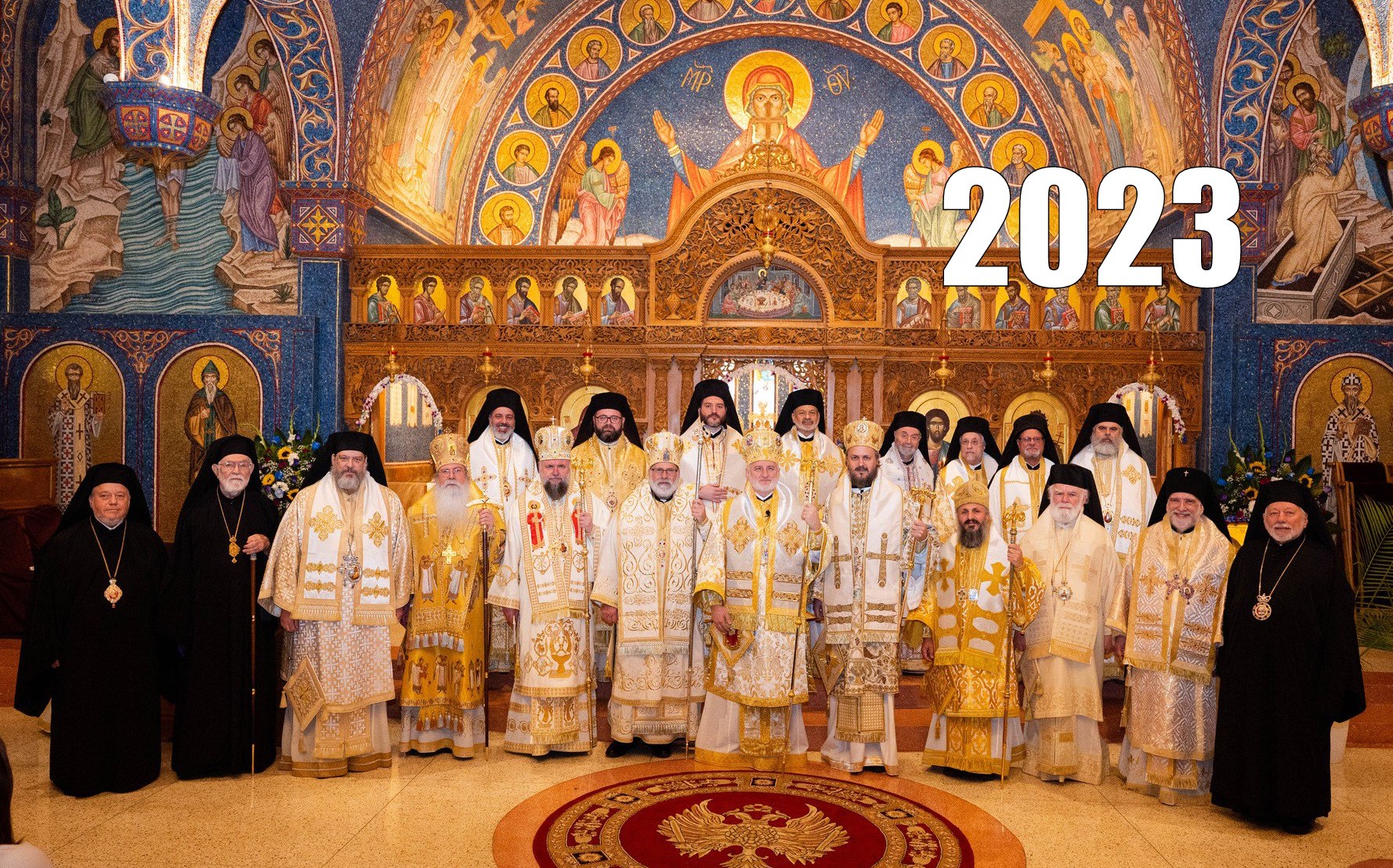
Photo above: our bishop Maxim at the Assembly of Bishops (Assembly of Canonical Orthodox Bishops of the United States of America) in 2023.
Academic and Scholarly Contributions
Bishop Maxim is a distinguished theologian and patristics scholar, renowned for bridging Eastern Orthodox tradition with contemporary discourse. He holds professorial positions at several institutions, including:
– Professor of Patristics at the Faculty of Orthodox Theology, University of Belgrade (since 2004).
– Professor of Dogmatics at St. Sava School of Theology, Libertyville, Illinois (2014–2017).
– Professor of Canon Law at the same institution (2011–2014).
– Lecturer in Hagiography at the University of Belgrade (2000–2005).
– Lecturer in Christian Anthropology and Byzantine Philosophy at the University of East Sarajevo (2000–2006).
He served as editor of Theology, the journal of the Faculty of Orthodox Theology in Belgrade. Fluent in Greek, French, Russian, and English (in addition to his native Serbian), Bishop Maxim has authored and edited numerous works that explore the intersections of theology, history, and art. His bibliography includes over a dozen books, such as:
– Wonder as the Beginning of Faith (Holy Cross Orthodox Press, 2022).
– Theology as Surprise: Patristic and Pastoral Insights* (St. Vladimir’s Seminary Press, 2018).
– History, Truth, Holiness: Studies in Theological Ontology and Epistemology (Sebastian Press, 2011).
– The Christian Heritage of Kosovo and Metohija: The Historical and Spiritual Heartland of the Serbian People (editor, 2015).
– The Serbian Christian Heritage of America: The Historical, Spiritual, and Cultural Presence of the Serbian Diaspora in North America 1814–2019 (editor, 2019).
His writings often delve into patristic exegesis, ecclesiology, and the role of icons in spiritual life, earning acclaim in both academic and ecclesiastical circles.
Ecclesiastical Roles and Initiatives
As Bishop of Western America, Bishop Maxim has been a dynamic shepherd, emphasizing liturgical beauty, youth formation, and missionary outreach. He leads the Diocesan Iconographical School, inspired by Byzantine and medieval Serbian fresco traditions, where he teaches icon painting as a form of prayerful theology.
On the broader Orthodox stage, he holds significant leadership positions:
– President of the Committee for Theological Education of the Assembly of Canonical Orthodox Bishops of the United States.
– Spiritual father of the Orthodox Inter-Seminary Movement (OISM).
– Official representative of the Serbian Orthodox Church to the Diaspora Assembly and the Commission for Faith and Order of the World Council of Churches (WCC).
– Founder and editor of Serbica Americana (a foundation and website promoting Serbian Orthodox culture in America), Holy Icon (dedicated to sacred art), and The Poetics of the Icon (an electronic magazine on contemporary iconography).
– Co-developer of OrthoPrax, a comprehensive Orthodox mobile app for iOS and Android, providing liturgical texts, calendars, and resources.
Bishop Maxim’s tenure has seen the diocese host major events, including the 2016 Holy and Great Council reflections and inter-Orthodox dialogues.
Legacy and Personal Life
Now in his mid-50s, Bishop Maxim embodies the patristic ideal of a bishop as theologian, pastor, and artist. His life reflects a seamless integration of scholarship and service, fostering a diocese that is both rooted in Serbian tradition and open to the multicultural fabric of the American West. As a painter and iconographer, he often describes theology as “surprise”—an encounter with the divine that transforms the ordinary.
Bishop Maxim resides in Alhambra, California, near the diocesan center, where he oversees approximately 50 parishes and missions. His vision for the future emphasizes synodality, education, and theosis—the deification of humanity through Christ—as the heart of Orthodox witness in a secular age. Through his writings, teachings, and leadership, he invites the faithful to “embody the living truth” in a world hungry for authentic spirituality.
Patriarch: A Bridge Between East and West: The Life and Leadership of Patriarch Porfirije of the Serbian Orthodox Church
For American readers, the Serbian Orthodox Church might seem like a distant echo of ancient Christianity, rooted in the Balkans amid centuries of empires, wars, and migrations. Yet, under the guidance of its current leader, Patriarch Porfirije (born Prvoslav Perić), it stands as a vibrant thread in the global tapestry of Eastern Orthodoxy—a family of 14 autocephalous churches sharing the same faith, sacraments, and commitment to the apostolic tradition. Elected in 2021 as the 46th Patriarch, Porfirije has emerged not just as a spiritual father to over eight million Serbian Orthodox faithful worldwide (including thriving communities in the U.S. and Canada), but as a key architect of unity in a fractured Orthodox world. His emphasis on dialogue, reconciliation, and canonical solidarity has positioned the Serbian Church as a mediator between ancient traditions and modern challenges, from the streets of Belgrade to the halls of interfaith forums in New York.
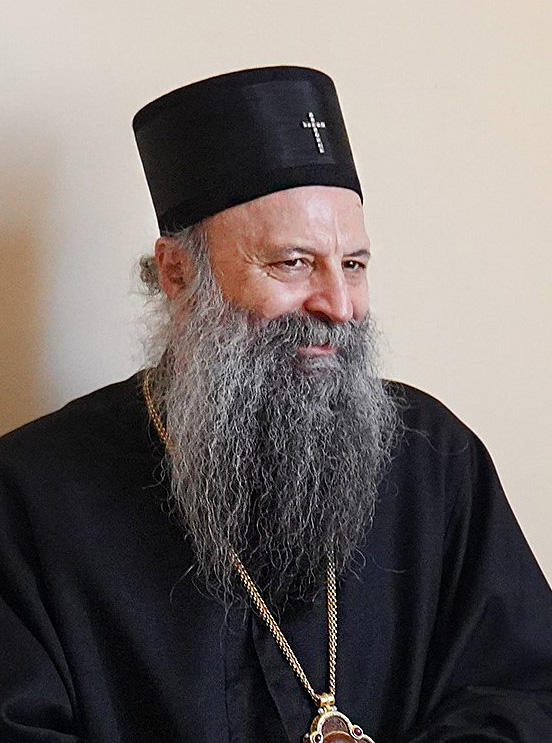
Humble Beginnings in a Turbulent Land
Born on July 22, 1961, in Bečej, a small town in the northern Serbian province of Vojvodina (then part of socialist Yugoslavia), Porfirije grew up in a modest family as the eldest of three children to Radivoje and Radojka Perić. Vojvodina, with its multi-ethnic mosaic of Serbs, Hungarians, and Croats, shaped his early worldview—one attuned to coexistence amid diversity. He completed primary school in Čurug and secondary education at the prestigious “Jovan Jovanović Zmaj” Grammar School in Novi Sad, where his intellectual curiosity blossomed.
In 1982, Porfirije entered the Faculty of Orthodox Theology at the University of Belgrade, graduating in 1986 with a bachelor’s degree in theology. That same year, under the mentorship of the future Patriarch Pavle (then Bishop of Raška-Prizren), he was ordained a hierodeacon at the Holy Trinity Monastery in Mušutište, Kosovo—a region steeped in Serbian Orthodox heritage but already foreshadowing the ethnic tensions that would erupt in the 1990s. Drawn to monastic life, he took vows at the renowned Visoki Dečani Monastery on April 21, 1985, receiving the name Porfirije in honor of St. Porphyrius of Gaza, the fourth-century bishop known for his compassion and miracles.
Porfirije’s academic pursuits deepened his connection to the broader Orthodox tradition. He pursued postgraduate studies in Athens, Greece, immersing himself in the patristic heritage shared across the Orthodox East—from Byzantine hymnography to the writings of the Cappadocian Fathers. This Greek sojourn not only honed his scholarly edge but also introduced him to the pan-Orthodox ethos, where local churches collaborate as “sister” bodies under the Ecumenical Patriarchate of Constantinople’s primacy of honor.
Scholar, Pastor, and Peacemaker: Rising Through Service
Ordained a hieromonk (priest-monk) in 1986 and elevated to archimandrite in 1990, Porfirije balanced academia and pastoral care. He earned a master’s and doctorate in theology from the University of Athens, focusing on pastoral psychology and the therapeutic role of faith—a theme that would define his ministry. Back in Belgrade, he joined the Faculty of Orthodox Theology as a professor of pastoral psychology in 1990, succeeding the renowned psychiatrist Vladeta Jerotić. For over two decades, he lectured on integrating Orthodox spirituality with modern mental health, publishing works in Serbian, Greek, English, and other languages that resonated far beyond Serbia’s borders.
His episcopal journey began in 1999 when he was consecrated as Titular Bishop of Jegra, serving as vicar to the Bishop of Šabac. In this role, he pioneered Orthodox drug rehabilitation programs, drawing on his psychological expertise to establish the first faith-based recovery center in Serbia. These initiatives, inspired by Orthodox monastic traditions of healing, earned him international acclaim and foreshadowed his global outreach.
From 2010 to 2011, Porfirije served as Bishop of the Serbian Armed Forces, coordinating church-army relations during a period of national reflection post-Yugoslav wars. His calm, empathetic style bridged military rigor with spiritual solace. In 2005, he represented Orthodox communities on Serbia’s Regulatory Body for Broadcasting, advocating for religious media freedom—a nod to Orthodoxy’s historical role in preserving cultural identity under Ottoman and communist rule.
A pivotal chapter unfolded in 2014 when Porfirije was elected Metropolitan of Zagreb-Ljubljana, overseeing Serbian Orthodox faithful in Croatia and Slovenia—lands scarred by the 1990s Balkan conflicts. Enthroned in Zagreb’s Cathedral of the Transfiguration by Patriarch Irinej, he inherited a diocese of healing: many Serbs had been displaced, churches destroyed, and communities fractured. Porfirije’s tenure here showcased his peacemaking gifts. He fostered interfaith dialogue with Croatian Catholics and Muslim leaders, earning the 2019 Award for Religious Freedom from Croatia’s Association for Religious Freedom for promoting “a culture of dialogue.” His pastoral visits to Kosovo’s ancient monasteries, like Dečani, symbolized resilience, while his media presence—hosting a radio show on forgiveness—reached divided families across the region.
Ascension to the Patriarchate: A Youthful Voice for Renewal
The death of Patriarch Irinej from COVID-19 in November 2020 thrust the Serbian Church into mourning and transition. On February 18, 2021, at the Holy Assembly of Bishops in Belgrade’s Church of Saint Sava, Porfirije—then 59, the youngest candidate—was elected the 46th Serbian Patriarch through the Church’s ancient, divinely guided process: names drawn from the Gospel after secret ballots. His full title: Archbishop of Peć, Metropolitan of Belgrade-Karlovci, and Serbian Patriarch. Enthroned the next day in St. Michael’s Cathedral and formally in the Patriarchal Monastery of Peć in October 2022, Porfirije inherited a Church navigating secularism, diaspora challenges, and geopolitical strife.
For American audiences, Porfirije’s election resonates as a story of renewal: like the young bishops of early Christianity, he brings fresh energy to a 800-year-old institution founded by St. Sava in 1219.
A Global Shepherd: Porfirije’s Embrace of World Orthodoxy
What sets Patriarch Porfirije apart—and why he matters to global Orthodoxy—is his fervent commitment to unity amid division. The Orthodox world, often strained by nationalisms and schisms (e.g., the 2018 Ukraine autocephaly crisis), finds in him a conciliator who prioritizes “conciliarity”—the synodal spirit of the first seven Ecumenical Councils.
Porfirije’s ties to Moscow are profound yet balanced. In April 2025, he visited Patriarch Kirill in the Kremlin, affirming the “fraternal bonds” between the Serbian and Russian Churches as a “model for pan-Orthodox unity.” Meeting Russian President Vladimir Putin, he stressed shared spiritual heritage while advocating for Serbia’s Kosovo stance, echoing centuries of Slavic Orthodox solidarity. He has steadfastly supported the canonical Ukrainian Orthodox Church under Metropolitan Onuphry, critiquing Constantinople’s 2019 grant of autocephaly to a rival body as “geopolitically influenced” and canonically irregular. This stance aligns Serbia with Moscow and Antioch, bolstering the “traditionalist” bloc.
Yet Porfirije transcends alliances. In May 2022, he orchestrated a historic milestone: the Serbian Holy Synod’s recognition of the Macedonian Orthodox Church’s autocephaly, ending a 55-year schism and restoring full communion. This act of grace, announced during a joint liturgy in Skopje, healed intra-Balkan wounds and modeled forgiveness for the Orthodox commonwealth.
His ecumenical outreach extends further. In September 2024, he welcomed a Coptic Orthodox delegation from the U.S., led by Metropolitan Serapion of Los Angeles, highlighting shared martyrdoms and ancient Egyptian roots in Orthodox spirituality. Congratulated by Ecumenical Patriarch Bartholomew and World Council of Churches leaders upon his election, Porfirije has engaged Rome through dialogues on peace-building. As a professor, he contributed to pan-Orthodox symposia, and as Patriarch, he leads Serbia’s delegation to the Assembly of Canonical Orthodox Bishops in the U.S., fostering ties with American Orthodox jurisdictions like the Orthodox Church in America (OCA) and Greek Archdiocese.
In the U.S., where Serbian Orthodox parishes dot the map from California to Chicago, Porfirije’s message of “peace within” resonates. His 2025 Nativity encyclical called for global solidarity, urging Orthodox diaspora to embody Christ’s light in pluralistic societies.
A Legacy of Mercy in a Divided World
At 64, Patriarch Porfirije continues to serve from Belgrade’s Patriarchal Palace, overseeing dioceses from Montenegro to the Americas. His vision—rooted in St. Porphyrius’s words, “The heart prays”—seeks an Orthodoxy that heals divisions, from Balkan borders to global schisms. For American Orthodox Christians, he embodies the Church’s universal call: a Serbian shepherd whose open hand invites all to the Eucharistic table of unity.
In a world of echo chambers, Porfirije reminds us that true faith bridges nations, just as it did for the Apostles. As he often says, “The Church does not adapt to the spirit of the times; it transforms them with the peace of God.” Through his leadership, the Serbian Orthodox Church—and world Orthodoxy—shines brighter for it.