
When Americans think of Christianity arriving on their shores, they usually picture the English Puritans landing at Plymouth in 1620 or Spanish Franciscans planting crosses in California and the Southwest. Few realize that, almost simultaneously with the Lewis and Clark expedition, another ancient Christian tradition was quietly putting down roots on the opposite end of the continent—in the frozen subarctic islands of Alaska. From that improbable foothold, Orthodox Christianity would eventually spread across the entire United States, carried by Russian monks, priests, and native Alaskan converts who never imagined their faith would one day flourish in California, New York, and everywhere in between.
1794: The First Missionaries Arrive on Kodiak Island
In September 1794, eight monks and two novices from Valaam Monastery in northern Russia stepped ashore on Kodiak Island after a 9,000-mile journey across Siberia and the North Pacific. They had been sent by Empress Catherine the Great at the request of Grigorii Shelikhov, the Russian fur trader who effectively controlled the Alaskan coast. The monastic mission was led by Archimandrite Joasaph, but the man who would leave the deepest imprint on American soil was the gentle, humble monk Herman.

St. Herman of Alaska (†1837): The First North American Saint
Herman was neither a bishop nor a learned theologian. He was a simple monk who loved silence, prayer, and the poor. After the other monks were either drowned in a shipwreck, recalled to Russia, or elevated to the episcopate, Herman remained alone on Spruce Island, a tiny speck off Kodiak. The local Alutiiq (Koniag) people called him “Apa” (grandfather). He defended the native people against exploitation by the Russian-American Company, built an orphanage and school, taught agriculture, and baptized thousands. He lived in a tiny hermitage, worked miracles of healing, and died in 1837. In 1970 the Orthodox Church in America glorified him as the first saint of North America. To this day, pilgrims—native and non-native—visit his shrine on Spruce Island, and his icon hangs in Orthodox churches from Anchorage to Los Angeles.
St. Innocent Veniaminov (†1879): The Apostle to America
If St. Herman was the heart of the Alaskan mission, St. Innocent was its mind and hands. Born Ioann Popov in a remote Siberian village in 1797, he was a brilliant priest, linguist, mechanic, and builder who arrived on Unalaska Island in 1824 with his wife, children, and elderly mother. Over the next decades he:
– Learned six native languages and created alphabets for Aleut and Tlingit
– Translated the Gospel, catechism, and liturgy into Aleut-Fox
– Built churches with his own hands
– Invented practical devices (clocks, barrel organs for churches)
– Traveled thousands of miles by kayak and dogsled to reach remote villages
– Became the first resident bishop of Alaska (consecrated in 1840 as Bishop Innocent of Kamchatka, the Kurile and Aleutian Islands)
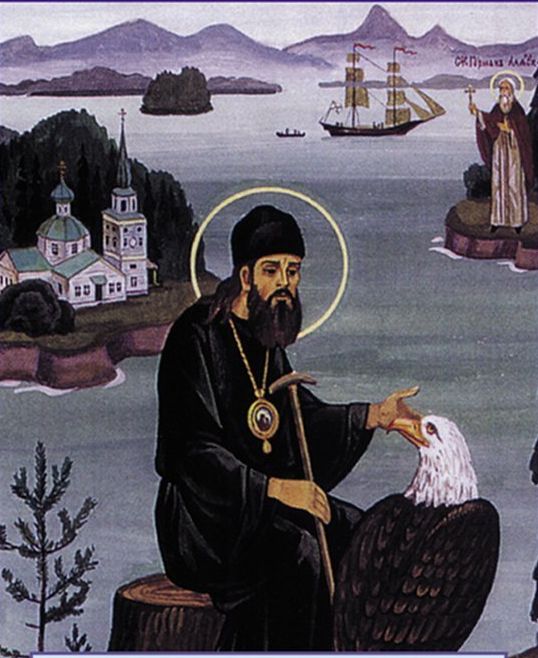
After his wife died, he took monastic vows and in 1868 was elected Metropolitan of Moscow—the highest office in the Russian Church. Yet he never forgot Alaska. From the Kremlin he continued to raise money for Alaskan missions and ordained native priests. Canonized in 1977, he is known as “Enlightener of the Aleuts and Apostle to America.”
From Alaska to California: The Unexpected Leap South
By the 1860s the Russian-American Company was bankrupt, and Russia sold Alaska to the United States in 1867. Many assumed Orthodoxy would disappear. Instead, the opposite happened.
In 1872, the diocesan see was moved from Sitka to San Francisco—yes, San Francisco—at the insistence of Bishop John Mitropolsky, who recognized that California’s climate and growing Russian/Slavic population made it a better administrative center. The cathedral of the diocese (Holy Trinity Cathedral, still standing on Van Ness Avenue) was consecrated in 1872, making San Francisco the first Orthodox episcopal see on the American mainland.
From this modest beginning in the American West, Orthodoxy began to spread eastward rather than westward:
– Carpatho-Rusyn and Galician immigrants arriving in the 1880s–1890s in Pennsylvania and the Midwest discovered that their Uniate (Greek-Catholic) churches were being forcibly Latinized by the Roman Catholic hierarchy. Thousands returned to Orthodoxy under priests sent from San Francisco and Alaska.
– Arab immigrants from the Middle East, fleeing Ottoman oppression, began arriving in the early 20th century and established parishes under the Russian diocese.
– Alaskan native clergy (the first ordained by St. Innocent) traveled as missionaries to the lower 48 states.
– After the 1917 Bolshevik Revolution, waves of Russian refugees—nobles, intellectuals, and White Army officers—brought their faith to New York, Los Angeles, and everywhere in between.
The Quiet Triumph
Today, Orthodox Churches in America trace their lineage directly to that 1794 mission on Kodiak Island. The Antiochian, Serbian, Romanian, and other jurisdictions also have deep American roots, but the original Russian mission remains the mother church for millions of Orthodox Christians in the United States.
What began with ten monks on a windswept island in 1794—farther west than almost any European had ever traveled—has grown into more than 2,000 parishes and monasteries coast to coast. The faith that St. Herman defended against fur-company officials in the 1790s is the same faith chanted today in converted warehouses in Atlanta, former Episcopal churches in Washington, D.C., and the magnificent new St. Seraphim Cathedral in Dallas.
The Orthodox came to America not through Ellis Island or Plymouth Rock, but through the back door of the Bering Sea. And from that forgotten corner of the continent, the ancient Church of Constantinople, Kiev, and Moscow quietly made its way to every state in the Union—proving once again that God often chooses what the world considers weak and foolish to accomplish His purposes.