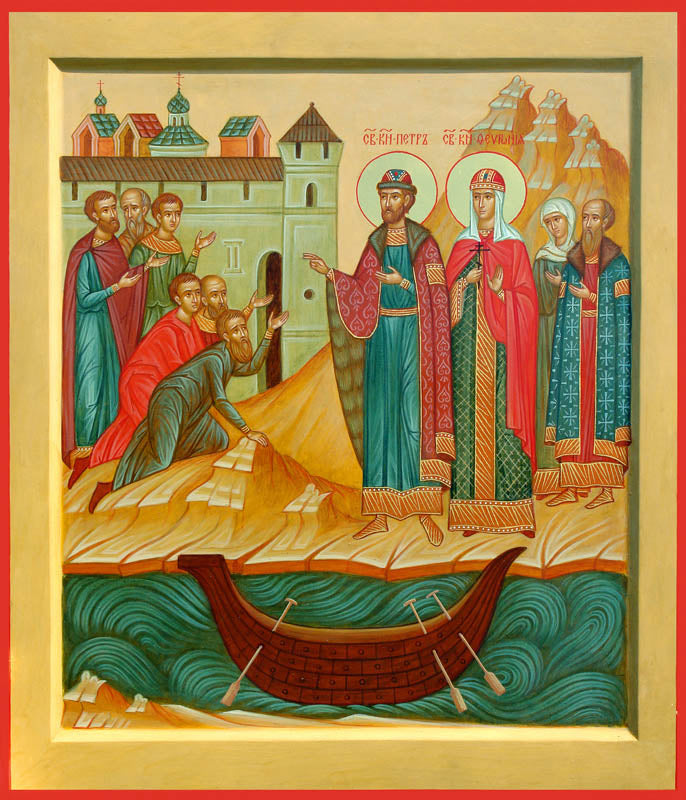

In this post, we will provide an updated translation of the story of Saints Peter and Fevronia from the Primary Russian Chronicle.
We will also provide (right here) a link to PDF of the beautiful Akathist (in English, adapted from the Romanian) and to the YouTube video of the Russian animation film.

Peter and Fevronia of Murom
In Russian medieval literature, the story of *Peter and Fevronia of Murom* stands out because it includes some romantic elements. Their love is deeply spiritual, though, and focuses on their complete faithfulness to each other in this life and the next. In that way, it is like the tale of Tristan and Iseult, but without any sexual passion.
The story can be divided into clear parts, as this translation does. The first part, “The Evil Serpent,” is the most fantastic. It uses a common folk motif about the deadly power of a serpent’s blood, the same idea found in the German epic *The Nibelungenlied*. The second part tells how Prince Peter is miraculously healed by a wise young woman—a theme that appears in many Eastern and European legends and fairy tales. The third part, “The Intrigues of the Boyars,” is more political. It argues that a single strong ruler is better than a group of nobles who end up destroying each other through constant fighting. The ending has the style of a saint’s life. Peter and Fevronia are shown as kind, devout rulers who care for their people, help the poor, and support the Church.
What makes this story unusual for a saint’s life is their final wish: to be buried together in one coffin after death. The holiness of married love is placed above the usual emphasis on strict self-denial.
The tale clearly comes from Russian folklore. Its language, symbols, and the clever riddles Fevronia uses all show this. Even the name “Agrica” comes from old Russian epics about a mighty warrior with a magic sword that killed serpents and monsters.
We do not know the exact history behind the story. Peter and Fevronia had been honored in Murom since the mid-1400s, and they were officially made saints in 1547 by a national Church council in Moscow. This particular story, however, was never added to the official collection of saints’ lives and was never read in church services. Some scholars believe it is based on the real life of Prince David of Murom, who ruled from 1203 to 1228.
I. THE EVIL SERPENT
In the Russian land there is a city called Murom. It was once ruled by a good prince named Paul. The devil, who hates everything good, sent an evil serpent to tempt and ruin Paul’s wife. When the princess was with the serpent, she saw its true form, but everyone else who visited her chambers thought they were seeing Prince Paul himself. After some time, the princess could no longer keep the secret. She told her husband what had happened.
Prince Paul did not know how to kill the creature, so he told his wife, “When you talk with the serpent, ask it in a clever way how it is fated to die. Once you learn the answer, tell me. That way we will be free of this disgusting evil, and you will also earn God’s mercy in the life to come.”
The princess was glad to hear this plan. The next time the serpent came, she chatted with it and then asked humbly, “You know everything, so surely you know what kind of death awaits you.”
The serpent was tricked by the faithful wife and answered, “My death will come from Peter’s hand and Agrica’s sword.” The princess hid the words in her heart. After the serpent left, she repeated them to her husband.
Prince Paul called his brother Peter and told him everything. Peter was ready to fight the serpent but did not know what “Agrica’s sword” meant.
One day Peter went alone to the Church of the Elevation of the Holy Cross outside the city walls. A young man approached him and asked if he wanted to see Agrica’s sword. Peter said yes. The youth showed him the sword hidden in the church wall. Peter took it and went home.
Later, Peter entered his brother’s chambers and saw the serpent in the shape of Prince Paul. He drew the sword and struck it. The creature revealed its true form and died. But drops of its blood splashed on Peter, and his body broke out in painful sores and ulcers.
II. THE HEALING OF PRINCE PETER
Peter sent servants to the land of Riazan to find doctors. One young soldier came to a village and entered the house of a man who collected pine pitch. Inside he found a beautiful young woman weaving. A hare was jumping and playing at her feet. She said to the soldier, “It is sad when a yard has no ears and a house has no eyes.”
The soldier did not understand, so he asked where the master of the house was. She answered, “My father and mother have gone to weep ahead of time to pay their debt early, and my brother has gone to look at death between his feet.”
Still confused, the soldier asked her to explain. She smiled and said, “If we had a dog, it would have barked when you arrived, so the yard would have had ears. If my brother had been home, he would have seen you coming, so the house would have had eyes. My parents went to a funeral and cried there. When death comes for them, others will cry, so they are paying their tears in advance. My brother is up in a tree collecting pitch; he must watch his feet so he does not fall and die. That is what I meant.”
The soldier was impressed. “You are very wise,” he said. “What is your name?” She told him it was Fevronia. He explained that Prince Peter of Murom was covered in sores from killing an evil serpent and needed a doctor.
Fevronia replied, “Only the person who orders the prince brought here can heal him.”
The soldier asked who that was. Fevronia said, “Bring the prince to me. If he is kind and answers my questions without pride, he will be cured.” The soldier hurried back and told Peter everything.
Peter had himself carried to Fevronia’s house. He sent a servant to ask who could heal him and promised a rich reward. Fevronia answered, “I can heal him, but I want no money. I will only do it if I become his wife.”
When the servant repeated this, Peter thought it impossible for a prince to marry the daughter of a pitch collector. Still, he told the servant to promise marriage if she healed him. Fevronia took some leaven from a barrel and said, “Heat a bath for the prince. After the bath, spread this on all his sores except one. He will be well.”
While the bath was being prepared, Peter tested her wisdom. He sent her a small bundle of linen and asked her to sew him a shirt, towel, and pants while he bathed. A servant brought the linen and repeated the order. Fevronia told the man to fetch a small block of dry wood from the stove, cut off a one-foot piece, and ask the prince to make a spinning wheel and loom from it while she prepared the linen.
The servant brought the wood to Peter, who laughed and said it was impossible. When Fevronia heard the answer, she replied, “If the prince cannot make a spinning wheel and loom from such a small piece of wood so quickly, how can I sew a full set of clothes from a tiny bundle of linen while he takes a bath?” Peter was amazed by her clever reply.
Peter took the bath, the ointment was applied (leaving one scab uncovered), and by morning his body was completely clear except for that one spot. He marveled at the cure but still did not want to marry a woman of such low birth. He sent her expensive gifts instead, but she refused them.
Peter returned to Murom healed except for the one scab. Soon new sores spread from it until his whole body was covered again. He went back to Fevronia, ashamed that he had broken his earlier promise. She was not angry. She said she would heal him only if he truly agreed to marry her. This time Peter promised sincerely.
She gave him the same treatment. Once he was healed, he married her. Fevronia became princess of Murom. They lived there piously, following God’s commandments. When Prince Paul died, Peter became the sole ruler.
III. THE INTRIGUES OF THE BOYARS
The noblemen of Murom disliked Princess Fevronia because she came from a simple family. Their wives especially resented her. Yet ordinary people loved her for her kindness and prayed for her.
One courtier tried to cause trouble. He told Peter, “The princess gets up from the table at the wrong time and gathers crumbs as if she is hungry.”
Peter tested this himself. At dinner he watched Fevronia collect the crumbs in her hand as she always had since childhood. When he asked her to open her hand, they found fragrant myrrh and incense instead. After that, Peter never doubted her again.
Years later the boyars came to Peter again and said, “We want to serve you, but we will not accept Fevronia as our princess or let her rule over our wives. Keep your throne and take a new wife. Let Fevronia take her wealth and go wherever she wants.”
Peter was gentle and did not get angry. He said he would speak with Fevronia. The boyars held a drunken banquet and began to insult her, even denying the healing power God had given her.
They went to Fevronia and said, “Give us Prince Peter back. We want him as ruler.”
She answered, “You may have him, but first talk to him.”
The boyars told her the same demand. Fevronia said she would leave but asked one favor in return. The boyars quickly agreed, thinking they would be rid of her. She said, “I ask for nothing except my husband, Prince Peter.”
The boyars were trapped. They knew Peter would never break God’s commandment against divorce. So Peter gave up his throne and left Murom with Fevronia.
The boyars gave them boats on the Oka River. On Fevronia’s boat, one courtier began to have shameful thoughts about her even though his own wife was there. Fevronia saw his thoughts and told him to drink river water from one side of the boat, then from the other. She asked if the water tasted different. He said no. “Then why,” she asked, “do you want to leave your wife for another woman when all women are the same?” Ashamed, the man gave up his evil thoughts.
That evening, as they camped, Peter began to doubt whether he had done the right thing by leaving his city. Fevronia comforted him: “Do not worry. God, who guides our lives, will not abandon us.”
While servants cut branches to make a cooking spit, Fevronia saw them and said, “Bless these branches, for by morning they will grow into tall trees with full leaves.” And it happened exactly as she said.
The next morning a messenger arrived from Murom. He said the boyars had fought among themselves, many had died, and the survivors begged Peter and Fevronia to return and rule again. The people now loved Fevronia and wanted her back. So Peter and Fevronia returned to Murom and ruled wisely according to God’s laws.
IV. THE PASSING AWAY OF PETER AND FEVRONIA
Peter and Fevronia always gave generously to the poor, fed the hungry, clothed the naked, and sheltered strangers. They treated everyone like their own children and ruled with fairness and humility. They stored up their treasure in heaven, not on earth.
When they felt death approaching, they prayed to die at the same hour. They also asked to be buried together in one coffin, with only a thin partition between their bodies. They took monastic vows: Peter became Brother David, and Fevronia became Sister Euphrosinia.
Just before her death, Euphrosinia was sewing a cover for the cathedral chalice with images of the saints. A messenger came from David: “I am ready to die and wait only for you.”
She answered, “Wait a little longer while I finish this cover.”
Soon another messenger arrived: “I can wait only a short time.” Then a third: “I am leaving now.”
Euphrosinia stuck the needle in the cloth, wound the thread, and sent word that she was ready. They prayed together and gave their souls to God on Friday, June 20.
After their deaths, some people decided a man and woman who had taken monastic vows should not lie in the same coffin. They buried Peter inside the city in the Cathedral of the Holy Virgin and Fevronia outside the walls in the Church of the Elevation of the Holy Cross. A stone coffin they had ordered for both of them stood empty in the cathedral yard.
The next morning both coffins were empty. The saints’ bodies were found lying together in the stone coffin. The people moved them back to the separate coffins, but the following day the bodies were once again together in the stone one. After that, no one dared separate them again. They remain side by side in the common tomb in the Cathedral of the Holy Virgin in Murom. Anyone who touches the tomb with a sincere heart receives healing and comfort.