
Before offering any assessment, I want to begin with a word of sincere appreciation for Craig Truglia. His labors as an Orthodox apologist, through his platform Orthodox Christian Theology and his missionary work in Cambodia, are a genuine service to the Church, and his book on the papacy is a very good one: carefully sourced, honest with the evidence, and valuable for Orthodox and non-Orthodox readers alike. It took real courage to stand, by his own admission as a first-time debater, opposite Dr. James White, a veteran of more than two hundred moderated debates. Both men deserve thanks for a civil and substantive exchange on a question that matters. What follows is offered in that same spirit: not as a scorecard for a “rhetorical blood sport,” to borrow Craig’s own phrase, but as a theological evaluation meant to serve the truth.
What the resolution required
The resolution contained three load-bearing terms: veneration, as defined by Nicaea II, and apostolic. The debate turned less on evidence than on the fact that the two sides never argued the same resolution. Mr. Truglia demonstrated, quite convincingly, that Christian images existed from the earliest period and were used devotionally: the catacombs and Dura-Europos, the signet ring showing Daniel praying toward the Good Shepherd, the fourth-century icon of St. Lawrence bearing a written prayer, hundreds of invocation inscriptions, and behind all of this the Jewish matrix of commanded images, the cherubim of the mercy seat, the bronze serpent, prayer toward the temple (1 Kings 8:30; Psalm 99:5). Dr. White demonstrated, also convincingly for his audience, that the specific conciliar definition of 787, with its anathemas, cannot be documented as explicit apostolic teaching by the evidentiary standard he demanded. Each man largely declined to fight on the other’s ground.
The decisive structural fact is that the affirmative never read or expounded the Horos, the actual definition, of Nicaea II. Dr. White saw the opening within his first two minutes (“we never heard how it was defined”) and occupied the vacant ground, characterizing the council by its anathemas and by an alleged misuse of St. Basil. From that point forward, one side was defending a practice while the other prosecuted a definition. Mr. Truglia won most of the evidentiary exchanges, and his cross-examination on the biblical canon exposed a real double standard: Dr. White could not produce an early, complete, explicit 66-book canon list on the same standard of explicitness he demanded for icons. But a cumulative case for the antiquity of images is not yet a demonstration of the doctrine, and the doctrine is what the resolution named.
The heart of the matter: St. Basil and the honor that passes to the prototype
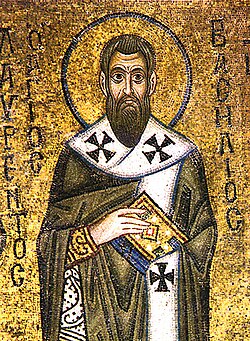
The doctrinal center of Dr. White’s case was his treatment of St. Basil, On the Holy Spirit 18.45, the source of the famous principle that “the honor paid to the image passes over to the prototype.” His limited point is sound: the context is Trinitarian, not iconological. Basil is defending the single glorification of Father, Son, and Holy Spirit, and the Image in view is the Son (Colossians 1:15). But Dr. White’s actual argument went further: that the principle works only because the Son is consubstantial with the Father, that “an icon is not consubstantial with anything, it is a painted piece of wood,” and that Nicaea II’s use of the sentence is therefore a complete misuse of Basil.
This gets Basil’s logic exactly backwards, and the refutation sits in the very next sentence of the passage, which, remarkably, neither debater quoted all day:
“What the image is in the one case by imitation (mimētikōs), the Son is in the other by nature (physikōs); and as in works of art the likeness is according to the form, so in the divine and uncompounded nature the union is in the communion of the Godhead.” (St. Basil, On the Holy Spirit 18.45)
Three things follow. First, Basil states the honor-transfer principle precisely of the emperor’s painted, wooden, utterly non-consubstantial image. That is the premise of his analogy, drawn from a Roman institution everyone understood: honors rendered to the imperial image counted as rendered to the emperor himself. If honor-transfer required shared essence, the analogy would be unintelligible, since its entire force depends on the hearer already granting that honor passes through a mere likeness to a prototype with which it shares no substance at all. Basil argues from the mimetic case to the natural one, and Dr. White has taken the conclusion of that argument and used it to delete its premise. Second, Basil himself supplies, in that one sentence, the very distinction on which the later theology of icons is built: the natural image, the Son, one in essence with the Father, versus the artificial image, a likeness of form only. St. Theodore the Studite’s teaching that veneration is relative and terminates on the hypostasis depicted, not on the wood, is a formalization of Basil’s mimētikōs, not a violation of it; and the Horos of Nicaea II says exactly this: he who venerates the icon venerates in it the hypostasis of the one depicted. Hypostasis, not essence. The council was not confused about the wood.
Third, and most seriously, the objection proves too much against Dr. White’s own faith. The humanity of Christ is not consubstantial with the Godhead; yet the Fifth Ecumenical Council, which every Chalcedonian Protestant implicitly confesses, anathematizes “two adorations” and requires one adoration of God the Word made flesh together with his own flesh. Honor crossing the line between essences to terminate on a single hypostasis is therefore a dogma Dr. White already relies upon every time he worships Jesus of Nazareth. One may still dispute whether this logic extends to the painted image, but one cannot dispute it on the ground that honor never passes between non-consubstantial terms. It may also be noted that the imperial-image analogy is a patristic commonplace rather than a Nicene novelty: St. Athanasius uses it in nearly identical words (Against the Arians III.5, “he who venerates the image, in it venerates the emperor”).
What survives of Dr. White’s objection is a fair and limited kernel: Basil’s sentence describes a civic custom and, by itself, establishes the intelligibility of relative honor rather than the obligation of icon veneration. The obligation rests on the dogmatic judgment of the Church. That is an authority question, not a question of Basil’s exegesis, and it deserved to be debated as such.
The road not taken
Here I will say plainly what I missed in the affirmative case, with full respect for the enormous research behind it. Mr. Truglia argued archaeology and witnesses to practice; what was absent was the classical dogmatic argument, the theology of iconic relationships. The Son is the natural, consubstantial Image of the Father. Man is the created image of God, which is why honor and dishonor given to man pass to God himself (Genesis 9:6; James 3:9; Matthew 25:40). Scripture everywhere shows relative veneration, proskynesis, lawfully given to persons and holy things that are not God: Abraham before the Hittites, Jacob before Esau, Nathan before David, and above all 1 Chronicles 29:20 in the Greek, where Israel in a single verb “made proskynesis to the LORD and to the king.” The idol, by contrast, is condemned not because it is an image but because of its false relation: it depicts what is not God, or pretends to circumscribe the invisible divine essence. That is why the same Torah that thunders against idols also commands images: the sculpted cherubim over the mercy seat, the woven cherubim of the veil, the bronze serpent, and the lions, oxen, and cherubim of Solomon’s temple, received without censure. Within this theology, the refusal to venerate the image of the incarnate Christ is not a quibble of etiquette; it quietly denies either that the Word truly became depictable flesh or that the saints are alive in him.
To this belongs, finally, the authority of the bishops assembled in council to discern and define how the apostolic deposit applies (Matthew 18:18; Acts 15:28), an authority vindicated by the reception of the whole Church. This is the same organ, received in the same way, that gave Dr. White his table of contents. Indeed, Dr. White told us how he defends the Trinity: from the Scriptures, then from the Fathers. That is exactly how Nicaea II should be defended, for homoousios is not in Scripture either; it is the Church’s binding articulation of what Scripture compels. Nicaea II stands to the biblical theology of the image precisely as Nicaea I stands to the biblical theology of the Son. Had the debate been framed this way, with the material evidence then presented as corroboration that the Church always lived this theology, the two halves of the case would have carried each other.
Counsel for both sides
To my brother Craig, with gratitude: read the Horos first, and let every exhibit be tied to an element of the definition; lead with the theology and let the archaeology corroborate it; quote Basil’s next sentence, which was the one-line answer to the central attack; answer the claim that veneration equals worship from 1 Chronicles 29:20 rather than from analogy; and prune the overclaimed evidence, for the early dating of the Dionysian corpus and a flatly literal crucifix in Galatians 3:1 are minority positions that, asserted as certainties, tax the credibility of the genuinely strong material. And never decline cross-examination time.
To Dr. White, with respect: the material record deserves an account, not a wave of the hand, for “images existed but were not venerated” does not explain a ring depicting prayer toward an image or an icon inscribed with a prayer to its subject. The political history of the Empress Irene, however colorful, is a genetic fallacy as to the truth of a doctrine, and it was answered. The consubstantiality version of the Basil argument should be retired before it meets a prepared opponent. And the serious iconoclast case was always the Christological one argued at Hieria; engaging it would force both sides to do real theology, where this question has always belonged, and where, I am confident, the faith of the Seventh Council stands.
In the end, each man persuaded his own. The deeper question, whether the Second Council of Nicaea is the Church’s faithful, authoritative articulation of an apostolic theology of the image, enacted in a practice whose traces are early and real, was barely joined. It remains, as it has always been, a question answered not by rhetoric but by the whole mind of the Church: in her Scriptures, her Fathers, her councils, and her unbroken prayer before the icon of the Word made flesh, through whom, with the Father and the Holy Spirit, be all glory, honor, and veneration, now and ever and unto ages of ages. Amen.