
by Fr. Laurent Cleenewerck
A Sympathy That Must Be Stated Plainly
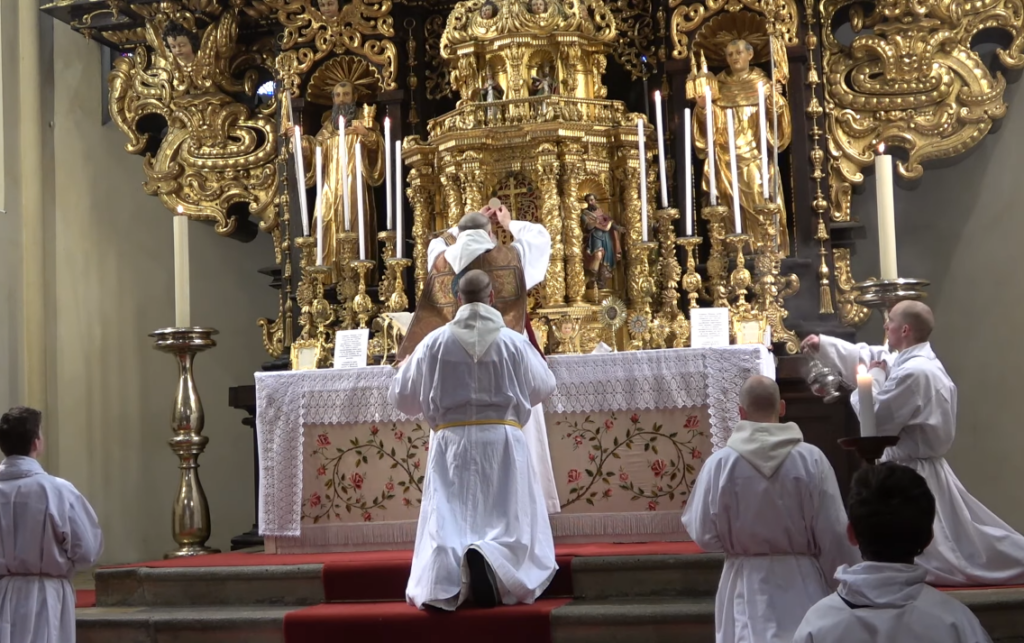
Before any critique is offered, something needs to be said plainly, and said first, because it is too often skipped by writers eager to score a confessional point: the instinct that produced the Society of St. Pius X was not a foolish one. When Archbishop Marcel Lefebvre and the priests who gathered around him in the years after 1970 recoiled from the wholesale liturgical demolition that followed the Second Vatican Council — the vernacular collapse of a millennium-old Roman rite, the disappearance of ad orientem worship, the flattening of a theology of sacrifice into a theology of meal-fellowship, the loss of Latin, chant, and the whole sacral grammar that had formed Western sanctity for fifteen hundred years — they were responding to something real. They were not nostalgics clinging to lace and rubrics for their own sake. They sensed, correctly, that the lex orandi forms the lex credendi, that how a people prays teaches them, at a level deeper than any encyclical, what and Whom they believe in. When the way of praying is deliberately re-engineered, the faith itself does not stay in place. An Orthodox Christian, whose entire theological method rests on the inseparability of worship and doctrine, should be the last person on earth to dismiss this instinct. We recognize it because it is, in its origin, our instinct too.
So this essay is not written to mock the SSPX faithful, still less to enjoy their difficulty. It is written because their difficulty is real, because it is not going to resolve itself on the terms in which they have framed it, and because there is a door in the room they have not yet been shown.
The Trap Built at Vatican I
The tragedy of the Society is not, at bottom, a liturgical tragedy. It is an ecclesiological one, and it was constructed almost exactly a century before Lefebvre needed it — at the First Vatican Council in 1870, in the constitution Pastor Aeternus. That document did something no council of the first millennium had ever attempted: it defined that the Bishop of Rome possesses, by divine right and not merely by ecclesiastical concession, “full and supreme power of jurisdiction over the whole Church,” a jurisdiction that is ordinary (not delegated), immediate (reaching every diocese and every soul without mediation), and episcopal in character over every local church simultaneously — and further, that when the pope speaks ex cathedra on faith and morals, his definitions are irreformable of themselves, and not by virtue of the consent of the Church.
This was, from an Orthodox vantage point, already a departure from the ecclesiology of the “undivided Church” — an ecclesial communion that knew Rome as first among the patriarchates, honored for its apostolic foundation and its historic fidelity, but not as the possessor of ordinary jurisdiction over Alexandria, Antioch, Constantinople, or any other (local) church, and certainly not as an organ of personal, self-sufficient infallibility apart from the reception of the whole body of bishops. St. Cyprian’s principle — that the episcopate is one, held in solidum by each bishop as his share of an undivided whole — and the constant conciliar practice of the seven Ecumenical Councils, where Rome’s legates carried great weight but Rome’s judgment was still received, tested, and sometimes corrected by the wider Church, stand at some remove from what 1870 defined.
But that is a separate argument, made at length elsewhere. What matters for the SSPX story is this: Vatican I was not resisted by Lefebvre. It was, for him and for the Society he founded, part of the settled and non-negotiable patrimony of the Faith. The SSPX has never been sedevacantist in its founding self-understanding; it has insisted, often at real personal cost to its priests, that the men sitting in the Chair of Peter after 1958 were true and legitimate popes, validly possessed of exactly the supreme, universal, immediate jurisdiction and the charism of infallibility that Vatican I described.
The Contradiction That Cannot Be Outrun
Here is the trap closing. If the pope really holds the authority Vatican I says he holds — an authority so total that it does not require the consent of the Church to be binding, an authority so immediate that no bishop, synod, or local tradition can stand as a check upon it — then by what principle can a priest, however learned, however holy, however liturgically conservative, simply decline to receive an ecumenical council that this same pope convoked, presided over (through his legates), and formally promulgated? Vatican II was not a rogue gathering. It was ratified, session by session, by Pope John XXIII and Pope Paul VI, exercising precisely the supreme magisterial authority that Pastor Aeternus had defined eighty-nine years earlier. The New Mass of Paul VI was promulgated by the very authority the SSPX considers the highest instrument of doctrinal security in Christendom. So too were the later magisterial acts — the Assisi gatherings, the revised catechism, the whole trajectory of the post-conciliar decades — carried out by men the Society has always confessed, formally and canonically, to be true popes.
This is the cognitive dissonance the reader has named correctly, and it is not a peripheral awkwardness in the SSPX position; it is the structural fault line running under the entire house. One cannot coherently hold both that the pope possesses an authority so supreme that it needs no ratification by the wider Church to bind consciences, and that this same pope’s most solemn and public acts of teaching authority — an ecumenical council, no less — may be set aside by the private judgment of a French archbishop and the priestly society he founded. Either the maximal papal claims of 1870 are true, in which case the SSPX’s resistance to the actual popes who have exercised that very authority is, on Rome’s own terms, indefensible — a form of the private judgment Catholic apologetics has spent five centuries condemning in Protestants. Or the maximal papal claims of 1870 are not true in the unqualified way they were defined, in which case the entire theological scaffolding the Society has built its identity upon — “we are the ones who kept the whole Faith, including Vatican I, while Rome abandoned tradition” — collapses from the inside, because the very dogma they cite as bedrock is the dogma whose logical entailments they must, in practice, refuse.
This is why the SSPX orbit has fractured repeatedly into smaller and smaller circles trying to relieve the pressure: sedevacantists who conclude that the post-conciliar popes were never popes at all, since no true pope could do what these men did (a move that at least restores logical consistency, at the price of leaving the Roman see empty for six decades and counting, an ecclesiological vertigo of its own); “recognize and resist” moderates who hold the tension the reader has identified without ever fully naming it; sedeprivationists distinguishing between the “material” and “formal” papacy in a scholastic move so fine it persuades almost no one outside its own circle; and the Society’s own decades-long, still-unresolved negotiations with Rome, which lurch forward and stall precisely at the point where this contradiction has to be confronted rather than managed. None of these is a solution. Each is a different way of living with a fracture that Vatican I itself created and that only a different ecclesiology — not a cleverer argument within the same one — can actually heal.
What Orthodoxy Actually Offers, and What It Does Not
It would be a form of spiritual predation to tell a grieving traditional Catholic, “come to Orthodoxy, and all your difficulties dissolve, and you keep everything you loved.” That is not quite honest, and love of the truth forbids it. What is true, and worth saying with real precision, is narrower and in some ways more remarkable than a marketing pitch: the Orthodox Church is not offering the SSPX faithful a new answer to their dilemma. It is offering them the historical continuation of the very ecclesial reality that existed before the dilemma was created.
The Western liturgical patrimony the SSPX guards so fiercely — the Roman canon, chant, the ad orientem posture, the theology of sacrifice, the discipline and gravity of pre-modern Latin worship — is not foreign to Orthodoxy. It is, in its roots, patristic and pre-schism, formed by the same undivided Church that gave the East its own liturgical families. St. Gregory the Great, whose name is attached to the very chant SSPX choirs labor to preserve, is venerated as a saint in the Orthodox Church, his relics and memory honored, his authentic Western liturgy never regarded by the East as anything but a legitimate expression of the one Faith. St. Benedict, St. Martin of Tours, St. Leo the Great — the whole company of Western fathers whom the pre-Vatican-I Roman Church claimed as her own — are Orthodox saints, because the West itself was Orthodox for the first thousand years of Christian history, before the very structure of unilateral papal supremacy that would later be codified at Vatican I began driving it toward schism.
This is not merely a historical curiosity. It has a living, present form. Since the mid-twentieth century, the Orthodox Church — through the Antiochian Western Rite Vicariate, and through parishes of the Russian Orthodox Church Outside Russia and other jurisdictions — has received Western Christians, including former Anglo-Catholics and former Roman Catholics, as Western Christians, celebrating restored pre-schism Latin liturgical forms (the Divine Liturgy of St. Gregory, adaptations of the Sarum use, the Roman rite purified of later medieval and post-Tridentine accretions) under Orthodox bishops, in full sacramental and doctrinal communion with the wider Orthodox world. This is not an experiment in nostalgia. It is a standing, canonical, sacramentally real option: the ancient Western liturgical soul, held within an ecclesiology that never generated the Vatican I problem in the first place, because it never asserted that any single bishop possesses immediate jurisdiction over every altar in Christendom, or that any single man’s teaching is self-sufficiently infallible apart from its reception by the whole body of the faithful — the sensus fidelium that Orthodoxy has always understood as essential to how truth is recognized and guarded in the Church.
To put it as directly as the reader’s question deserves: a Catholic formed by SSPX piety does not have to choose between the liturgical reverence he was right to love and the ecclesiological coherence he has never quite been able to find. He does not have to become sedevacantist to keep his integrity, nor swallow a doctrine of papal supremacy whose actual exercise he spends his life resisting. He can find, in Orthodoxy, a Church that never took the 1870 turn at all — one that preserves the conciliar, patristic model of authority the early Western Church itself lived by, and that can receive, without contradiction, the very liturgical treasures he has been defending in isolation and often in canonical limbo.
The Grief That Should Not Be Minimized
None of this should be said breezily. Leaving the Roman Catholic Church, even a Roman Catholicism one already regards as compromised, is a real grief for people who have built their whole spiritual lives, their families, their ordinations, their friendships, around the Society and its chapels. There is loss in it — of familiar faces, familiar Latin cadences learned as a child, a hard-won identity forged in decades of feeling embattled and misunderstood by the very hierarchy they wished to obey. Orthodoxy does not erase that grief, and any Orthodox Christian who approaches a struggling traditional Catholic with triumphalism rather than kindness and understanding has not grasped both St. Paul’s charity and the actual pastoral stakes involved.
But grief is not the same as impossibility. What Orthodoxy can offer the SSPX Catholic honestly wrestling with the reader’s diagnosis — the impossibility of squaring a maximal, post-1870 doctrine of the papacy with the same papacy’s actual, promulgated exercise of that authority at and after Vatican II — is not a compromise or a lesser Rome. It is the far older thing: an ecclesiology that kept the ecumenical, conciliar, patristic form of unity that the whole Church (or more exactly, the whole “Common Union”), East and West, once shared, before one church came to claim for itself an authority the fathers had never granted to any single see. For a soul exhausted by holding together contraries that will not finally cohere, that older thing is not a retreat. It may be, quite simply, home.