
Scripture Alone? A Review of the Sorin-Menard Debate
On Bible, church, and the Spirit who unites them
Fr. Laurent Cleenewerck · Holy Apostles Orthodox Church, Sandpoint · October 2026
Few questions have divided Christians more deeply over the last five centuries than this one: is Holy Scripture the only infallible rule of faith, or is it given to us within a living Tradition that the church keeps and confesses? Recently, Modern Day Debate hosted a friendly and serious exchange on exactly this question between Jordan Menard, an evangelical Christian who is honestly exploring Orthodoxy, and Alex Sorin, an Orthodox apologist. Both men deserve our thanks. The tone was charitable, the questions were real, and at the end each speaker invited the other to continue the conversation. We wish more public theology looked like this.
In what follows, we offer a review of the debate, an assessment of what each side did well, and a few reflections on why debates of this kind so often generate more heat than light. We close with a short account of how our parish catechism addresses this important topic.
The resolution
The question was framed as follows: Scripture is the final and infallible norm for Christian doctrine, and no post-apostolic authority possesses equal or superior authority to it. Mr. Menard defended this proposition; Mr. Sorin opposed it.
We should notice at once that this wording is not quite the classical Reformation doctrine. Mr. Menard was careful to say that he did not deny the authority of the church; he denied only that anything after the apostles stands on the same level as Scripture. Mr. Sorin, for his part, argued mainly against the Protestant principle of private judgment as taught by Luther, Turretin and Hodge. As a result, the two speakers often answered positions the other did not hold. This is not a criticism of either man. It is a lesson about resolutions, to which we will return.
Jordan Menard's case
Mr. Menard made an unusual and commendable choice: he brought no Protestant sources at all. Every witness he quoted came from the Orthodox shelf, and he invited his audience to be like the Bereans of Acts 17:11, who checked even an apostle against the Scriptures.
His first argument was a syllogism. Whatever needs correcting cannot be the infallible norm. Patriarchs and councils have needed correcting, while Scripture never has. Therefore, Scripture alone is the infallible norm. His second argument was historical: for many centuries, the Fathers spoke with one voice about the supremacy of Scripture, and only in 1672, at the Synod of Jerusalem, did an Orthodox council declare the witness of the church to be "not of inferior authority" to the Scriptures.
The quotations he gathered are real and they are beautiful. St Gregory of Nyssa calls the inspired Scripture our "umpire." St Augustine places Scripture above all later writings of bishops. St Athanasius says the Scriptures are sufficient to declare the truth. St Cyril of Jerusalem insists that not even a casual statement of the faith should be delivered without the Scriptures. Orthodox Christians love these texts, and we should be grateful that an evangelical brother read them so carefully.
The difficulty is that almost every one of these Fathers says something more in the same work. St Athanasius continues his sentence by pointing to "our blessed teachers" as the guides to its interpretation. St Vincent of Lérins, after calling the canon of Scripture "more than sufficient," immediately asks why we still need the church's interpretation and answers: because Scripture is read in as many ways as there are readers.1 St Basil, whose rule that hearers should test their teachers by Scripture Mr. Menard cited, also wrote that the apostolic traditions handed down without writing have "the same force" for piety.2 St John Chrysostom, commenting on 2 Thessalonians 2:15, says plainly: "It is a tradition, seek no farther."3 The Seventh Ecumenical Council in 787 anathematized anyone who rejects "any written or unwritten tradition of the church." In other words, the Fathers did not experience Scripture and Tradition as rivals. The same Fathers who exalted Scripture also received it within the church's rule of faith.
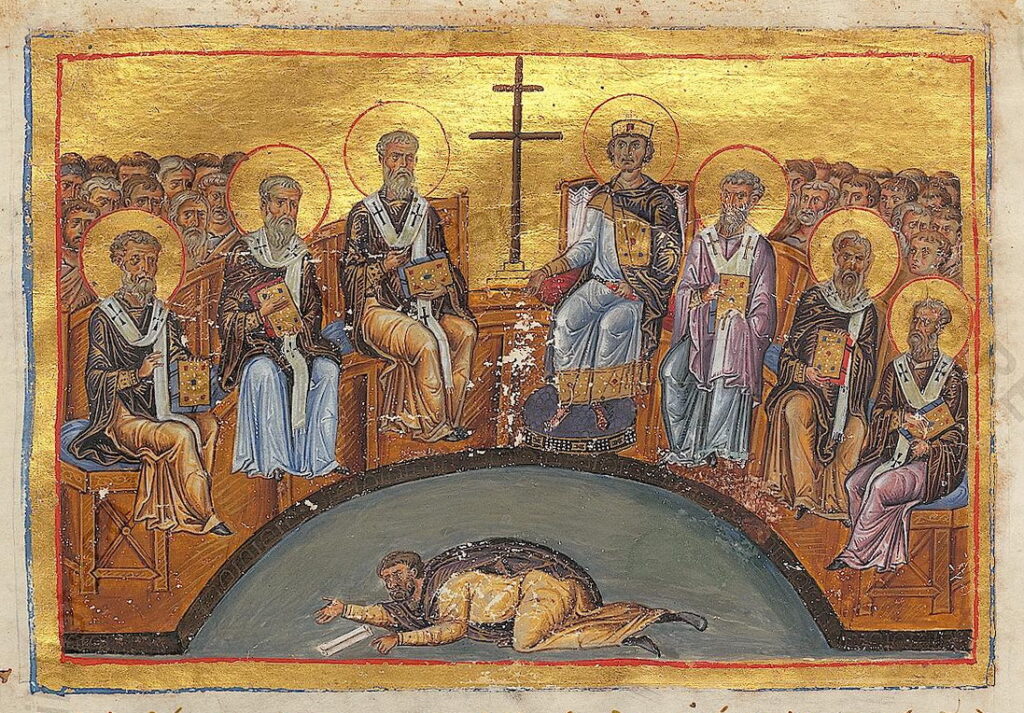
The first argument also rests on an ambiguity. The councils that were "corrected," such as the iconoclast synod of Hieria in 754, were never received by the church as ecumenical councils. The church did not correct herself; she refused to recognize an assembly that falsely claimed to speak for her. When she did so, at Nicaea II, she appealed to Scripture and Tradition together.
Still, Mr. Menard raised points that Orthodox Christians should take seriously. His observation that the valid succession of "Moses' seat" (Matthew 23:2) also condemned Christ reminds us that succession alone is not enough. St Irenaeus already said that we follow those presbyters who, with the succession of the episcopate, have received "the certain charism of truth."4 His example of King Josiah (2 Kings 22), whose rediscovery of the book of the law reformed a corrupted practice, is also worth pondering, though we would add that the book was kept by the priest Hilkiah, confirmed by the prophetess Huldah, and read to the assembled people. The written word worked within the community and through the Spirit of prophecy.
Alex Sorin's case
Mr. Sorin built his case on the shape of God's dealings with His people. From Moses onward, God's commands were interpreted and applied by appointed judges and elders whose rulings were binding (Deuteronomy 17:8-12). Christ Himself told the people to do what those who sat in Moses' seat taught them. The apostles then established successors, as St Clement of Rome and St Ignatius of Antioch testify. Most powerfully, he cited St Athanasius and some ninety bishops of Egypt and Libya, who declared that "the word of the Lord which came through the ecumenical synod at Nicaea abides forever."5
His central insight is sound and deeply Orthodox: Scripture is given to a people, and a reading that every individual may reopen at will cannot bind anyone. His strongest moment came when he asked who, in his opponent's church, has the authority to bind and loose. Mr. Menard admitted honestly that this is a real difficulty for his position. Late in the evening, Mr. Sorin also offered the image that we believe settles much of the question: after the Resurrection, Christ "opened their mind to understand the Scriptures" (Luke 24:45). The apostolic deposit is not a second book beside the Bible; it is the right way of reading the one Bible.
Some of his arguments were less persuasive. Calling Korah "the first Protestant" made for a memorable line, but Korah rebelled against the priesthood, not against an interpretive office. In cross-examination, Mr. Sorin also said that "the church breathed out the Scriptures." We know what he meant: the Scriptures were written within the church and received by her. The phrase nonetheless gave the impression that the church, rather than God, is the author of Scripture, and his opponent understandably seized on it. Finally, when asked whether Scripture stands above all later writings, Mr. Sorin readily agreed without explaining why this agreement does not grant the resolution. On points, then, we would score the debate for Mr. Menard. On substance, we believe the Orthodox position stands.
The importance of a sound resolution
This debate illustrates a problem that is far older than YouTube. When Christians argue about "Scripture alone" or "Scripture and Tradition," they often use the same words in different senses, and they often react against the worst version of the other side. Two dangers deserve our attention: equivocation and over-reaction.
Equivocation
Nearly every key term in this debate has more than one meaning:
- Bible
- Which Bible? The question of the canon is itself a post-apostolic matter. The Orthodox Church reads the Old Testament in the Septuagint and receives the deuterocanonical books as part of it; many Protestants do not. Mr. Menard admitted that he had not yet decided whether books such as Tobit or the Maccabees are Scripture. A norm whose extent cannot be determined without the church cannot easily function as a norm apart from the church.
- Church
- Does "church" mean the local eucharistic community gathered around its bishop, the communion of Churches throughout the world, an institution, or the invisible company of the elect? Mr. Menard understood it mainly in the last sense, Mr. Sorin in the first two. For the Fathers, the church is the visible body of Christ, fully present in each local church that keeps the apostolic faith and lives in communion with the others.
- Sola Scriptura
- Does it mean that Scripture is the supreme written authority, which the Fathers affirmed? Or does it mean that each believer may interpret Scripture independently of the church's consensus, which the Fathers denied? Much of the debate was spent on the gap between these two meanings.
- Tradition
- Does "tradition" mean human customs that may be good, indifferent or corrupt, or the one apostolic deposit, the life of the Holy Spirit in the church? Vladimir Lossky distinguished "Tradition" from "traditions" for exactly this reason.6 Our Lord condemned the traditions of men that nullify the word of God (Mark 7:13), while St Paul commanded the Thessalonians to hold the traditions they had received (2 Thessalonians 2:15).
Over-reaction
Over-reaction is the second danger. The Reformers reacted, often with good reason, to real abuses in the late medieval Western church: forged documents, false relics, and doctrines with little ancient support. In reaction, many of them separated Scripture from the community that had received, copied, read and interpreted it for fifteen centuries. Orthodox writers have sometimes over-reacted in turn, speaking as if Scripture and Tradition were two independent sources of revelation, or discouraging the faithful from reading the Bible, which St John Chrysostom urged every household to own and read. Neither reaction is faithful to the ancient church.
A sound resolution would avoid both traps. It might ask, for example: "Is Holy Scripture rightly understood apart from the church's apostolic Tradition and the illumination of the Holy Spirit?" A question framed in that way would force both sides to define their terms and would bring the real disagreement into the open.
Three things held together
We believe the biblical and patristic answer requires three things to be held together. The first is Scripture, the inspired and unerring witness to Christ (2 Timothy 3:16; John 5:39). The second is the church, the context in which Scripture was written, received and interpreted, and in which the apostolic faith is handed on (1 Timothy 3:15; 2 Timothy 2:2). The third is the Holy Spirit, who alone opens our minds to perceive what is true (John 16:13; 1 Corinthians 2:14). As the Wisdom of Solomon asks, "Who has learned Thy counsel, unless Thou give wisdom and send Thy Holy Spirit from on high?" (Wisdom 9:17).
Each of these, taken alone, goes astray. Scripture without the church becomes private exegesis, as with Arius, who quoted the Bible abundantly. The church without the Spirit becomes mere office, as with the Sanhedrin. A claim to the Spirit without Scripture and the church becomes enthusiasm, as with the Montanists of the second century. St Irenaeus joined all three in a single sentence: "Where the church is, there is the Spirit of God; and where the Spirit of God is, there is the church and every grace."7
Seen in this light, the question "Which authority is higher?" is not quite the right question. The Spirit who inspired the prophets and apostles is the same Spirit who guides the church into all truth and who illumines the faithful. That is why the Synod of Jerusalem in 1672, so often quoted against the Orthodox, gave this reason for its teaching: "one and the same Holy Spirit" is the author of both.8
How our catechism addresses the question
Our Revised and Expanded Catechism treats this topic in its opening section on Revelation, Scripture and Tradition. Its teaching may be summarized in five points:
- One deposit, not two sources. God's revelation in Christ is handed down as one apostolic deposit. Scripture and Tradition are never "two sources," but one Tradition received in written and unwritten form (Q016-Q017).
- The primacy of Scripture. The Holy Scriptures contain all that is necessary for the proclamation of the Gospel of salvation in Jesus Christ, and church traditions are measured by their harmony with the written Word of God (Q017-Q018). Here the catechism gladly affirms everything true in the quotations Mr. Menard gathered.
- Scripture within the church. At the same time, Scripture is not self-sufficient when isolated from the life of the church. Its meaning is discerned in the church, by the Holy Spirit, according to the mind of the Fathers, following canon 19 of the Council in Trullo and the rule of St Vincent: what has been believed everywhere, always and by all (Q018, Q023).
- The canon and the Septuagint. The Old Testament of the church is the Septuagint, including the books sometimes called deuterocanonical, which the catechism receives as genuine parts of Scripture (Q035).
- Councils and reception. The Ecumenical Councils express the mind of the church without error, and their authority is confirmed by their reception in the communion of Churches. This is why a gathering such as Hieria, though it called itself ecumenical, was never received (Q069).
In this way, the catechism avoids both over-reactions. It honors Scripture as the supreme written witness to Christ, and it honors the church as the household in which that witness is rightly heard. Above all, it confesses that the same Holy Spirit is at work in both, and in each believer who reads with the church.
We are grateful to Mr. Sorin and Mr. Menard for a debate conducted in charity and in earnest. We were especially moved to hear that Mr. Menard planned to visit an Orthodox parish the following week. Our prayer is that every Christian who loves the Scriptures, as he so evidently does, may find in the church the place where those Scriptures were first written, first read, and are still sung every day.
- Vincent of Lérins, Commonitorium 2, in Nicene and Post-Nicene Fathers, 2nd ser., vol. 11, ed. Philip Schaff and Henry Wace (New York: Christian Literature, 1894).
- Basil of Caesarea, On the Holy Spirit 27.66, in Nicene and Post-Nicene Fathers, 2nd ser., vol. 8 (New York: Christian Literature, 1895).
- John Chrysostom, Homily 4 on 2 Thessalonians, in Nicene and Post-Nicene Fathers, 1st ser., vol. 13, ed. Philip Schaff (New York: Christian Literature, 1889).
- Irenaeus of Lyons, Against Heresies 4.26.2, in Ante-Nicene Fathers, vol. 1, ed. Alexander Roberts and James Donaldson (Buffalo: Christian Literature, 1885).
- Athanasius of Alexandria, Letter to the Bishops of Africa 2, in Nicene and Post-Nicene Fathers, 2nd ser., vol. 4 (New York: Christian Literature, 1892).
- Vladimir Lossky, "Tradition and Traditions," in In the Image and Likeness of God (Crestwood, NY: St Vladimir's Seminary Press, 1974).
- Irenaeus, Against Heresies 3.24.1.
- The Acts and Decrees of the Synod of Jerusalem, Decree 2, trans. J. N. W. B. Robertson (London: Thomas Baker, 1899).