
Memory Eternal
The Commemoration of the Saints at Orthodox Vespers, Its Roots in the Biblical Lament, and Why It Is Not Necromancy
Fr. Laurent Cleenewerck
Introduction
For many Protestant Christians, a first experience of Orthodox Vespers on the eve of a saint's feast is puzzling, and at times troubling. The hymns praise a person who died centuries ago, speak of him or her in the third person, and then, often within the same verse, turn to address the saint directly: "O holy martyr, entreat Christ God to save our souls." To a reader formed by the clear prohibitions of Deuteronomy against consulting the dead, such language may sound uncomfortably close to necromancy. The concern is serious, and it deserves an answer drawn from the same Scriptures that issue the prohibition.
Our purpose here is to show that the liturgical commemoration of the departed saints is not a foreign growth grafted onto biblical faith. It stands in direct continuity with the way Israel mourned, remembered and even addressed its dead, as we see in David's laments over Jonathan and Abner, in the statutory laments for Josiah, and in the annual fast for Gedaliah. We will then describe the shape of Vespers for a saint and, finally, set out as precisely as we can why this form of worship differs in kind from the necromancy that both the Old Testament and the Orthodox canonical tradition condemn.
1. The Biblical Lament: Speaking of the Dead and to the Dead
The Books of Kingdoms (1-2 Samuel in Protestant Bibles) preserve some of the oldest funeral poetry in Scripture. When the news of the death of Saul and Jonathan reaches David, he composes a lament (qinah), commands that it be taught to the sons of Judah, and has it recorded in the Book of Jashar (2 Kgdms [2 Sam] 1:17-18). A lament that is written down and taught is a lament meant to be sung again. From the outset, then, we are dealing with commemoration and not merely with spontaneous grief.
The poem does not remain in a single register. It speaks of Saul and Jonathan in the third person, "beloved and lovely in their lives, and in their death they were not divided" (1:23). It then turns to the mountains of Gilboa (1:21) and to the daughters of Israel, summoning them to weep (1:24). At its climax, it addresses Jonathan himself: "I grieve for you, my brother Jonathan; very dear have you been to me; your love to me was wonderful" (1:26).1
The lament over Abner follows the same pattern. After Joab's murder of Abner, David orders a full public rite: torn garments, sackcloth, the king walking behind the bier, weeping at the tomb, and a fast until sunset (2 Kgdms 3:31-35). The qinah opens with a question in the third person, "Should Abner die as a fool dies?" and turns at once to the second person: "Your hands were not bound, your feet were not put in fetters" (3:33-34). We find the same movement, in its rawest form, in David's cry over Absalom: "My son Absalom, would that I had died instead of you" (2 Kgdms 19:1 [18:33]).
These are not personal idiosyncrasies of David. The mourning cry hoy, "alas," was spoken over the body as an address to the dead as kin: "Alas, my brother!" (3 Kgdms [1 Kgs] 13:30; cf. Jer 22:18). The prophets imitate the form in their dirges over kings and nations, which constantly alternate between describing the fallen and speaking to them (Isa 14:4-21; Ezek 19; 27-28), and the Book of Lamentations moves in the same way between describing Zion and addressing her. In her classic study of the Hebrew funeral song, Hedwig Jahnow identified the fixed elements of the genre: the opening exclamation "How" (ʾêk), the contrast between former glory and present loss, the summons to the mourners, and the direct address to the deceased.2 Saul Olyan has shown how thoroughly ritualized the mourning scenes of Kingdoms are, with recognized gestures, periods and speech forms.3
Why the two modes of speech? The biblical dirge served more than one audience. The third person proclaims and praises the dead before the community; it is the public, commemorative voice. The second person bids farewell to the deceased, and in doing so it presupposes that the dead has not simply ceased to be. Rabbinic tradition drew this conclusion explicitly. The Talmud teaches that the dead hear what is said in their presence until the grave is closed, and it records a sage who asked his disciples to be fervent in his eulogy, "for I shall be standing there."4 The Mishnah describes the professional lament of women as structured in two forms, inui, sung by all together, and qinah, in which one leads and all respond, which shows that the form was customary and liturgical.5
We now reach the decisive observation for our argument. The same canon that forbids necromancy (Deut 18:10-12) preserves, teaches and sings laments that speak directly to the dead. Scripture itself, therefore, distinguishes between addressing the departed and consulting them. David addresses Jonathan; he does not inquire of him. Everything that follows turns on this distinction.
2. From Lament to Statute: Recurring Commemoration in Israel
The Old Testament knows fixed periods of mourning: seven days for Saul and his sons (1 Kgdms [1 Sam] 31:13), the seven days that Sirach names as the norm of mourning for the dead (Sir 22:12) and that are observed for Judith (Jdt 16:24), and thirty days for Aaron and for Moses (Num 20:29; Deut 34:8). These periods are the ancestors of the Jewish shiva and sheloshim, and also of the Christian memorials on the third, ninth and fortieth days.
Scripture also attests commemorations that were repeated year after year. After the death of Josiah at Megiddo, Jeremiah composed a lament, and "all the singing men and singing women spoke of Josiah in their laments to this day, and they made it a statute in Israel" (2 Par [2 Chr] 35:25; cf. 1 Esd 1:32). This is the strongest biblical text for an institutionalized memorial: a lament for a righteous king that became an ordinance, sung by appointed singers, long after his death. The Talmud and the Targum read Zechariah's "mourning of Hadadrimmon in the plain of Megiddo" (Zech 12:11) as this ongoing mourning for Josiah.6
The case of Gedaliah is even more striking. Zechariah mentions a fast of the seventh month that had been kept for seventy years (Zech 7:5; 8:19). The rabbis identified it as the anniversary of the murder of Gedaliah, the governor of Judah (Jer 41:1-3 [LXX 48:1-3]), and they drew a theological principle from it: the death of the righteous is weighed as heavily as the burning of the house of God.7 Here we have an annual liturgical commemoration of a righteous man, held on the date of his death, already in the Persian period. It is still kept in the synagogue today as the Fast of Gedaliah.
The deuterocanonical books of the Old Testament carry this witness further. Tobit commends bread laid at the tomb of the righteous (Tob 4:17); Sirach urges that kindness not be withheld from the dead (Sir 7:33) and that the departed be honored with fitting mourning (Sir 38:16-17). Judas Maccabeus offers prayer and sacrifice for fallen soldiers, in the hope of the resurrection (2 Macc 12:43-45). Most important for our subject, Judas sees in a vision the high priest Onias praying with outstretched hands for the whole people, together with the prophet Jeremiah, described as a lover of his brethren who prays much for the people and the holy city (2 Macc 15:12-16). We have here the clearest Old Testament witness to the intercession of the departed righteous, which the canonical prophets already presuppose when the Lord says that even if Moses and Samuel stood before Him, He would not relent (Jer 15:1).
Rabbinic literature confirms that the anniversary of a death was a recognized day. The Talmud treats "the day on which my father died" as a day on which a person might vow to fast each year, and it speaks of people gathering at the grave of a great teacher on the anniversary of his death.8 The term yahrzeit belongs to the medieval Ashkenazi world, but the practice is Talmudic. Modern scholarship debates how far ancient Judah went in caring for its dead: Elizabeth Bloch-Smith and Theodore Lewis argue for a continuing care of the dead in Israelite practice, while Brian Schmidt argues that much of this belongs to later polemic.9 For our purpose, the debate need not be settled. The texts we have cited, Kingdoms, Paralipomenon, Zechariah and Maccabees, are enough to show that Israel remembered its righteous dead publicly, liturgically and periodically.
3. The Christian Inheritance: The Day of Death as Birthday
The earliest Christians inherited this practice and transformed it in the light of the Resurrection. After the martyrdom of Polycarp of Smyrna, around the middle of the second century, the faithful gathered his bones, which they valued above precious stones, and resolved to assemble each year to celebrate the "birthday" of his martyrdom, both to remember those who had already contended and to prepare those who would contend in the future.10 The day of death has become a day of birth into life.
The same practice appears across the early church. Tertullian, at the end of the second century, mentions offerings made for the dead on their anniversary, which he too calls their "birthday."11 Cyprian of Carthage asks that the days on which confessors die in prison be recorded, so that their commemorations may be kept, and he speaks of offerings made each year on the anniversaries of the martyrs.12 The Apostolic Constitutions prescribe psalms, readings and prayers for the departed on the third, ninth and thirtieth days, and on the anniversary.13
The line of continuity is plain. The seven and thirty days of Israel stand behind the memorials of the third, ninth and fortieth days in the Byzantine tradition. The annual commemoration of Josiah and Gedaliah, and later the Jewish yahrzeit, stand behind the annual memorial of every departed Christian and behind the feast of every saint. The calendar of saints is, in essence, a calendar of anniversaries of death.
What changed was not the form but the horizon. Before Christ, the lament mourned one who had gone down to Hades. After Christ, the church remembers one who has passed from death to life (John 5:24), who lives to God (Luke 20:38), and whom nothing, not even death, can separate from the love of God in Christ (Rom 8:38-39). The dirge becomes a hymn of victory, the lament becomes "Memory eternal," and the farewell becomes a request for prayer. Augustine stated the boundary clearly: at the Eucharist, the martyrs are named in their place and order as men of God, yet the sacrifice is offered to God alone and not to them.14
4. The Shape of Vespers for a Saint
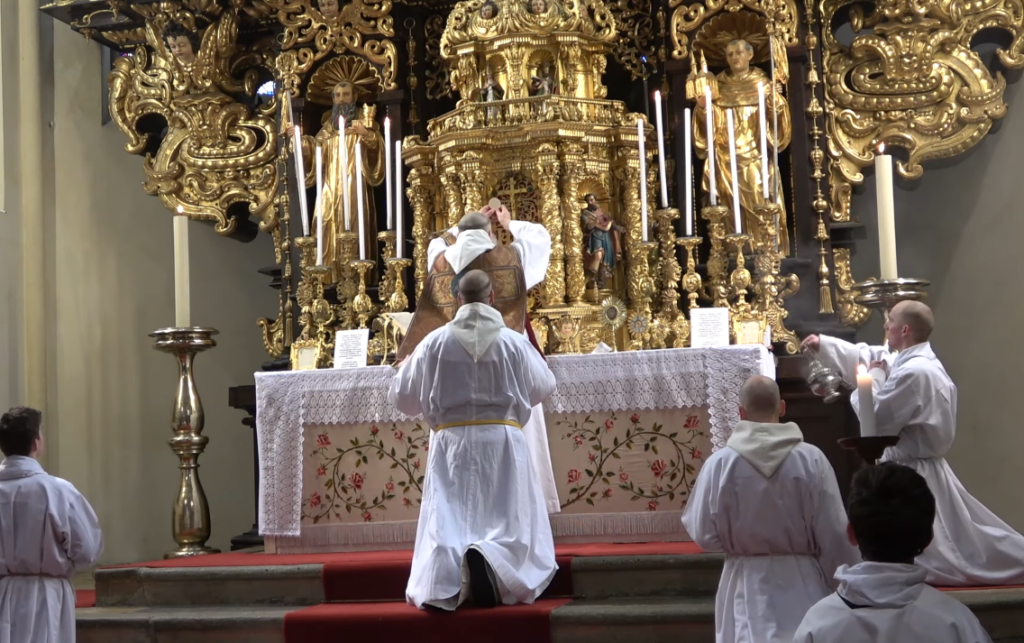
Because the liturgical day begins at evening, "and there was evening and there was morning, one day" (Gen 1:5), the commemoration of a saint opens with Vespers on the eve of the feast.15 The service is not composed for the saint; the saint is placed within a service whose frame is the praise of God. We may follow its main movements.
Vespers begins with Psalm 103 (104), the great hymn of creation. Before any word is said about the saint, the assembly confesses the Creator, so that the holiness of the saint is set from the start within God's work and providence. The evening psalms follow, "Lord, I have cried unto Thee" (Pss 140, 141, 129, 116 [141, 142, 130, 117]), sung as incense is offered: "Let my prayer be set forth before Thee as incense" (Ps 140:2 [141:2]). The Book of Revelation shows the same image of incense rising with the prayers of the saints before the throne (Rev 5:8; 8:3-4).
Between the final verses of these psalms, the church sings stichera, hymns proper to the saint of the day. It is here that the pattern of the biblical lament reappears with remarkable fidelity. A typical sticheron narrates the saint's life and contest in the third person, then turns to address the saint directly, often with a rhetorical question of wonder, such as "What shall we call you, O blessed one?", and finally turns to Christ with a petition, asking that through the saint's prayers our souls be saved. Praise, proclamation, address and intercession follow one another exactly as in David's lament, where narration of Jonathan's life gives way to "I grieve for you, my brother," and where the whole lament is spoken before God. The hymn at "Glory" is usually dedicated to the saint; the hymn at "Both now" is always addressed to the Theotokos and proclaims the Incarnation, which is the ground of every sanctity.
After the entrance and the ancient hymn "O Gladsome Light," the church sings a prokeimenon and, at Great Vespers for a major saint, reads three lessons from the Old Testament. The choice of these lessons tells us how the church interprets a saint's death. For martyrs and righteous ones, they are frequently taken from the Wisdom of Solomon: "The souls of the righteous are in the hand of God, and no torment shall touch them. In the eyes of the foolish they seemed to die... but they are at peace" (Wis 3:1-3); "The righteous live forever, and their reward is with the Lord" (Wis 5:15). For holy hierarchs, the lessons often include Proverbs: "The memory of the righteous is with praises" (Prov 10:7). This last verse could serve as the charter of the entire service. We should notice that the church reads the deuterocanonical Wisdom of Solomon precisely as Old Testament Scripture interpreting the death of the righteous; the commemoration of the saints rests on the Old Testament itself.
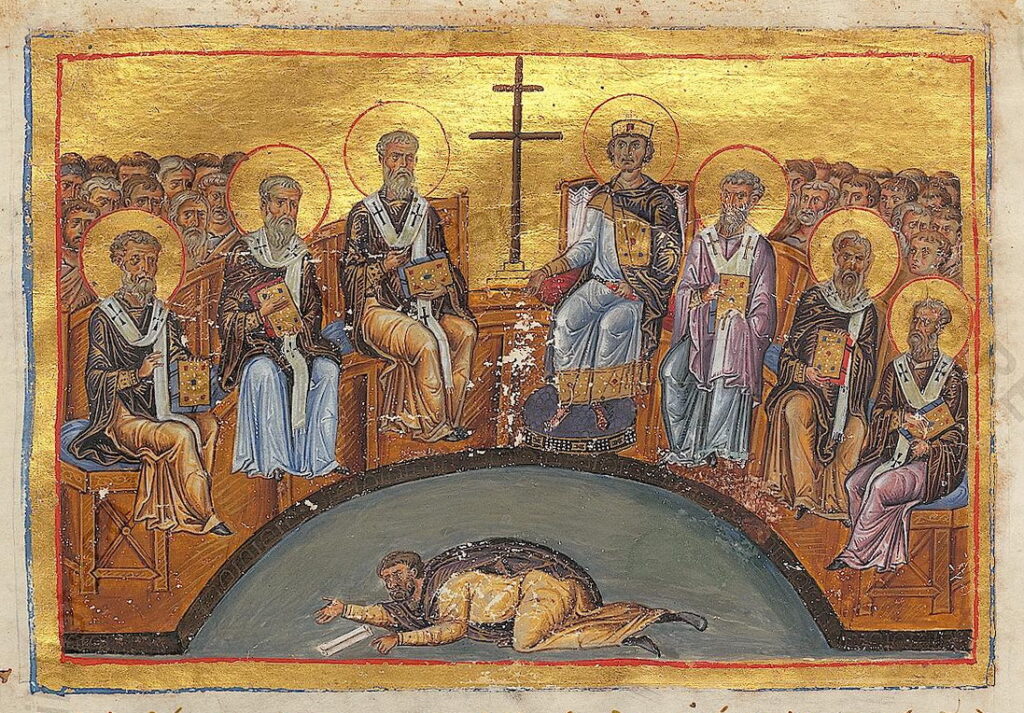
On major feasts, the litia follows, a procession with extended intercessions in which the saints are named and the living and the departed are commended to God. The aposticha then interleave hymns with psalm verses such as "God is wonderful in His saints, the God of Israel" (Ps 67:36 [68:35]) and "Precious in the sight of the Lord is the death of His saints" (Ps 115:6 [116:15]). After the Song of Simeon and the Trisagion, the troparion of the saint is sung, and the dismissal concludes with Christ our true God having mercy on us "through the prayers" of His Theotokos and of the saint of the day.
The order of the service is itself an argument. Every address to the saint is enclosed within address to God. Vespers begins with God the Creator and ends with Christ who saves, and the Theotokos and the saints appear between these two as those in whom God has shown His glory. The saint is never the terminus of worship. The saint is the occasion for glorifying God and a fellow intercessor with the church.
5. Why This Is Not Necromancy
We must first state clearly what Scripture forbids. Deuteronomy lists, among the abominations of the nations, the one who consults a ghost (ʾôb), the one who consults a familiar spirit (yiddeʿōnî), and the one who "inquires of the dead" (dōrēš ʾel-hammētîm), which the Septuagint renders as one who questions the dead (Deut 18:10-12; cf. Lev 19:31; 20:6, 27).16 Isaiah gives the theological reason: should a people not seek their God? Why should they seek the dead on behalf of the living (Isa 8:19-20)?
The paradigmatic case is Saul at Endor (1 Kgdms 28). Having received no answer from God by dreams, by Urim or by the prophets, Saul goes by night and in disguise to a woman who controls a spirit, and he asks her to bring up Samuel, so that he may learn the outcome of the coming battle. The Chronicler's verdict is decisive: Saul died because he consulted a medium, "and did not inquire of the Lord" (1 Par [1 Chr] 10:13-14). Necromancy, in biblical terms, is a technique practiced by a specialist to bring up the spirit of a dead person in order to obtain hidden knowledge or power, as a substitute for inquiring of God. Each element of this definition is absent from the liturgical commemoration of the saints, as the following comparison shows.
| Criterion | Necromancy (Deut 18:10-12; 1 Kgdms 28) | Liturgical commemoration of the saints |
|---|---|---|
| Primary addressee | The spirit of a dead person, summoned through a medium | God, at the beginning and end of every hymn; the saint is addressed within prayer to God |
| Purpose | To obtain hidden knowledge, especially of the future, or power over events | To glorify God for the saint, to give thanks, and to ask for the saint's prayers |
| Method | A technique performed by a specialist (ʾôb, yiddeʿōnî) to bring up the dead | Psalms, Scripture readings and hymns sung by the assembly; no technique, no summoning |
| Expected response | A voice, an apparition, an oracle | None; no reply is sought or awaited |
| Setting | Private and concealed (Saul goes by night, in disguise) | Public worship of the gathered church, with the bishop or priest presiding |
| Relation to God | A substitute for inquiring of the Lord (1 Chr 10:13-14) | An act of inquiring of the Lord, through Christ, in the Holy Spirit |
| Status of the dead | Shades in Sheol, cut off from the living | Alive to God in Christ (Luke 20:38); the spirits of the righteous made perfect (Heb 12:23) |
Three points deserve emphasis. First, the church does not inquire of the saints. Nothing in Vespers seeks information about the future, the location of lost things or the outcome of events. The only "request" made of a saint is the one we make of any fellow Christian: pray for us. Second, the direction of the act is reversed. Saul turned to the dead because God was silent to him; the church addresses the saints in the very act of addressing God, within psalms and prayers that begin and end with Him. Third, and most fundamentally, the saints are not "the dead" in the sense of Deuteronomy. Christ Himself answered the Sadducees that God is not the God of the dead but of the living, for all live to Him (Luke 20:38). At the Transfiguration, Moses and Elijah speak with Christ (Matt 17:3), and no apostle is rebuked for seeing them. The Epistle to the Hebrews places the church in the company of a great cloud of witnesses and of the spirits of the righteous made perfect (Heb 12:1, 22-24). The Book of Revelation shows the departed martyrs aware of events on earth and crying out to God (Rev 6:9-10), and the elders offering the prayers of the saints (Rev 5:8).
If asking a fellow member of the Body of Christ on earth to pray for us is not idolatry (Jas 5:16), asking a fellow member of the same Body who is alive in Christ is not necromancy, unless death separates believers from Christ and from one another, which the Apostle explicitly denies (Rom 8:38-39; cf. 1 Cor 12:26). This was the reasoning of the early church. Origen taught that the saints who have fallen asleep pray together with those who pray on earth.17 Jerome answered Vigilantius that if the apostles and martyrs could pray for others while still in the body, they could do so all the more after receiving their crowns.18
We should also remember that the Orthodox tradition condemns necromancy as firmly as any Protestant confession. The canons impose severe penance on those who resort to soothsayers, diviners and similar practitioners,19 and Orthodox pastoral practice treats spiritism, séances and every attempt to contact the dead through mediums as grave sin. The Seventh Ecumenical Council, at Nicaea in 787, drew the governing distinction between the honor shown to the saints and to holy images, and the worship (latreia) that belongs to God alone.20 The same tradition that sings the stichera of the saints forbids the medium of Endor.
6. Common Ground with Protestant Christians
The distance between Orthodox and Protestant practice is narrower than it first appears. Protestants also remember their dead publicly. The funeral sermon and the eulogy are the direct descendants of the qinah and the rabbinic hesped. The roll of the faithful in Hebrews 11 is read and preached as a commemoration of the righteous. A beloved hymn such as William Walsham How's "For All the Saints" (1864) gives thanks to God for the saints who rest from their labors. Lutheran and Anglican calendars still keep the feasts of apostles, evangelists and martyrs, and mourners at a graveside often speak directly to the one they are burying, exactly as David spoke to Jonathan.
The Lutheran confessions themselves commend the remembrance of the saints, so that we may give thanks to God for them, be strengthened in faith and imitate their example. The Apology of the Augsburg Confession goes further and concedes that the saints in heaven pray for the church in general, while rejecting their invocation.21 The disagreement, then, does not concern whether we should remember the saints, nor even whether the saints pray for us. It concerns only whether we may ask them to do so. On this point, the Orthodox answer rests on the unity of the one Body across death, and on the biblical pattern by which the living speak to the righteous dead without consulting them.
Conclusion
Vespers for a saint is the Christian form of the biblical qinah and of Israel's annual commemoration of its righteous dead, transfigured by Pascha. Like David's lament, it speaks of the saint, proclaiming and praising a life given to God. Like David's lament, it speaks to the saint, though farewell has become fellowship and grief has become a request for prayer. Above all, it speaks to God, who is "wonderful in His saints" (Ps 67:36 [68:35]). Necromancy seeks the dead in place of God; the church seeks God together with the saints.
When the Orthodox sing "Memory eternal," the memory in question is not finally our own. We ask that the departed be remembered by God, as the thief on the cross asked to be remembered by Christ in His kingdom (Luke 23:42). The saints are those of whom we are already confident that this prayer has been answered, and for that reason the church does not only pray for them but rejoices in them, and asks them, as living members of the one Body, to pray with us and for us.