
A homily by Fr Laurent Cleenewerck for the Synaxis of the Archangel Michael and All the Bodiless Powers, Holy Apostles Orthodox Church, Sandpoint, November 8, 2026.
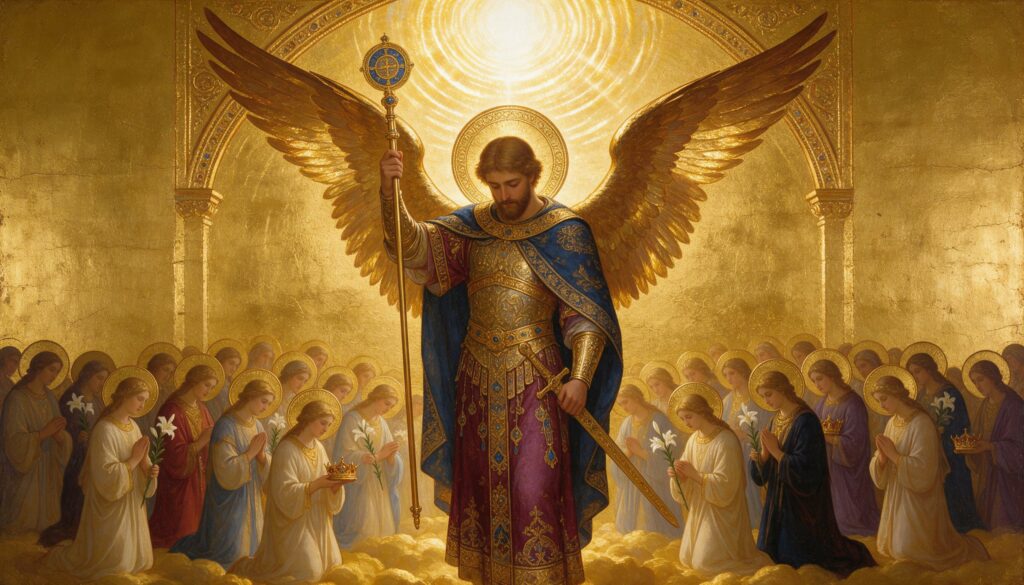
Today, we celebrate the Synaxis of the Archangel Michael and all the bodiless powers of heaven. Let us begin by listening to an ancient story. Adam and Eve have been driven out of Paradise, and Adam asks the devil why he pursues them with such hatred. The devil answers him:
“Adam, all my hostility, envy and sorrow is because of you. It is for your sake that I was cast out of my glory, which I had in heaven among the angels.
When God breathed into you the breath of life, and your face and likeness were made in the image of God, Michael brought you and made us venerate you in the sight of God. The Lord God said, ‘Behold Adam! I have made you in Our image and likeness.’
Then Michael went out and called all the angels, saying, ‘Venerate the image of the Lord God, as the Lord God has commanded.’ Michael himself venerated first. Then he called me and said, ‘Venerate the image of God, the Lord.’ I answered, ‘I have no need to venerate Adam.’ When Michael kept urging me, I said to him, ‘Why do you press me? I will not venerate one who is lower and younger than I am. I was created before him. Before he was made, I already existed. He ought to venerate me.’
When the angels under me heard this, they too refused. Michael said, ‘Venerate the image of God. If you will not, the Lord God will be angry with you.’ I said, ‘If He is angry with me, I will set my throne above the stars of heaven, and I will be like the Most High.’
Then the Lord God was angry with me, and He banished me and my angels from our glory. Because of you, we were driven from our dwellings into this world and cast down upon the earth. When we saw you in such joy and delight, we were filled with grief. So by deceit I ensnared your wife, and through her I had you driven out of the joys of Paradise, as I had been driven out of my glory.”
(Life of Adam and Eve 12-16)
The Image and the Firstborn
These are not the words of Holy Scripture. They come from an ancient Jewish book, the Life of Adam and Eve, which preserves what many Jews believed about the fall of the angels around the time of the apostles. We do not read it as the word of God. We read it because it tells us something true about the devil, and about ourselves.
The story was known all over the ancient world. Syriac Christians told it in a book called the Cave of Treasures, where Satan says that he is fire and spirit, while Adam is only dust. It appears seven times in the Qur’an, where Iblis refuses to bow before Adam and says, “I am better than he. You created me from fire, and him from clay.” Jews, Christians and Muslims alike remembered that the first rebellion in creation was a refusal to honor the image of God in a creature of dust.
According to this story, the devil did not fall by refusing to serve God in the abstract. He fell by refusing to venerate God in His image, in a creature made of dust, younger, weaker and lower than himself. Holy Scripture says the same in the Wisdom of Solomon: “God created man for incorruption, and made him the image of His own eternity; through the envy of the devil, death entered the world” (Wis 2:23-24). This is still the oldest temptation. It is easy to say that we love God. It is much harder to serve the person in front of us, especially one we consider beneath us.
The Epistle to the Hebrews takes us one step further. “When He again brings the Firstborn into the world, He says, ‘Let all the angels of God worship Him’” (Heb 1:6). The Apostle is quoting the Song of Moses in the Greek Old Testament: “Rejoice, O heavens, with Him, and let all the angels of God worship Him” (Deut 32:43). In the old story, the angels were called to venerate the image of God in Adam. In Hebrews, they are called to worship the Son, who is Himself “the image of the invisible God” (Col 1:15) and “the express image of His person” (Heb 1:3). Adam was made according to the Image. Christ is the Image. As St Basil teaches, the honor shown to the image passes to its prototype, and the whole dignity of the human person rests on the One in whose likeness we were made.
The same Song of Moses tells us that when the Most High divided the nations, “He set the boundaries of the peoples according to the number of the angels of God” (Deut 32:8). From the beginning, the angels were placed over the nations as guardians. Daniel calls Michael “the great prince who stands watch over the sons of your people” (Dan 12:1). The angels were not created to rule over humanity, but to serve it. The Apostle says it plainly: “Are they not all ministering spirits sent forth to serve those who will inherit salvation?” (Heb 1:14).
In Greek, they are leitourgika pneumata, liturgical spirits, sent out eis diakonian, for service. In one verse, we have the whole mystery of the angels. They stand before the throne in worship, and they are sent out to serve. They face God, and they turn toward us.
The readings of the feast frame this mystery for us. In the Gospel, the Lord says, “I saw Satan fall like lightning from heaven” (Luke 10:18). In the Epistle, we see Jesus “made a little lower than the angels” and crowned with glory “for the suffering of death” (Heb 2:9). One fell because he would not serve. The other descended in order to serve, all the way to the Cross. Between these two movements, let us consider what it means to be created to serve: to serve God, and to serve those who bear His image.
I. Serviam and Non Serviam: The Choice Before the Angels
The name of the Archangel is itself a sermon. Mi-ka-El means “Who is like God?” It is a question, and it is an answer to another voice. The Prophet Isaiah gives us that voice in his lament over the morning star: “I will ascend into heaven, I will set my throne above the stars of God… I will be like the Most High” (Isa 14:13-14). The prince of Tyre says the same in Ezekiel: “I am a god” (Ezek 28:2). The Fathers heard in these oracles the fall of the one who had been created as a bearer of light.
We should notice the difference. Lucifer said, “I will be like God,” and he tried to seize it. Michael asked, “Who is like God?” and he bowed. The first grasped at likeness to God and lost it. The second refused to grasp, and he became the commander of the heavenly hosts.
In the reading we heard at the beginning, the devil says the very same words: “I will set my throne above the stars of heaven, and I will be like the Most High.” The Prophet Jeremiah puts the rebel’s motto in a single phrase. Israel, says the Lord, has broken the yoke and said, “I will not serve” (Jer 2:20). The Latin Bible renders it non serviam.
The Christian West has remembered St Michael by the opposite word. In Western piety, the Archangel answers the devil with Serviam, “I will serve,” or with Quis ut Deus?, the Latin of his own name, often written on his shield in Western art. Neither phrase comes from Scripture or the Fathers, yet the instinct behind them is sound. Western painters show Michael with his foot on the dragon, holding a sword and the scales of judgment. In many Roman Catholic parishes, the faithful still pray the prayer of Pope Leo XIII: “St Michael the Archangel, defend us in battle.” Even modern literature took up the devil’s motto. In James Joyce’s A Portrait of the Artist as a Young Man, a preacher describes Lucifer’s sin as non serviam, and the young hero later makes “I will not serve” his own creed. The two words still divide the world: serviam or non serviam.
The Book of Enoch tells another version of the fall. The Watchers, angels set to guard humanity, left their station and used human beings instead of serving them. They took wives for themselves and taught men the arts of war and sorcery (1 Enoch 6-8). St Jude recalls these angels “who did not keep their proper domain, but left their own dwelling” (Jude 6). The angels were placed as guardians. When they began to use rather than to serve, they became demons.
Even Michael’s victory is marked by humility. When he disputed with the devil over the body of Moses, he did not dare to pronounce judgment himself, but said, “The Lord rebuke you” (Jude 9). When war broke out in heaven, Michael and his angels fought against the dragon, and the dragon was cast out (Rev 12:7-9). The strength of Michael is not his own. His power is the power of one who knows exactly who he is, and who is like God.
In today’s Gospel, right after the Lord speaks of Satan’s fall, He rejoices in the Spirit that the Father has hidden these things “from the wise and prudent” and revealed them “to babes” (Luke 10:21). The one who would be great falls like lightning. The little ones see the Kingdom.
II. Angels Everywhere: Messengers, Guardians and Fellow Servants
The Greek word angelos, like the Hebrew malakh, simply means “messenger.” St Augustine puts it well: “angel” is the name of their office, not of their nature. If we ask what they are, they are spirits. If we ask what they do, they are angels (Enarrationes in Psalmos 103.1.15). Their very name is a word of service. An angel is one who is sent.
Once we begin to look for them, we find the angels everywhere in Scripture, from the first pages to the last.
- Cherubim guard the way to the tree of life at the gate of Eden (Gen 3:24).
- Jacob sees a ladder set up between earth and heaven, with the angels of God ascending and descending on it (Gen 28:12). Christ tells Nathanael that this ladder is Himself (John 1:51).
- The Lord tells Moses, “I send an angel before you, to keep you on the way” (Exod 23:20).
- “The angel of the Lord encamps around those who fear Him, and delivers them” (Ps 33:8 LXX; 34:7).
- “He shall give His angels charge over you, to keep you in all your ways” (Ps 90:11 LXX; 91:11).
- Raphael tells Tobit that he brought the memory of his prayers before the Holy One (Tob 12:12), and in the Apocalypse, an angel offers incense with the prayers of the saints (Rev 8:3-4).
- When Peter knocks at the door after his release from prison, the disciples say, “It is his angel” (Acts 12:15). Each of the seven churches of Asia has its angel (Rev 2-3).
The Church has never forgotten them. In the litanies, we ask for “an angel of peace, a faithful guide, a guardian of our souls and bodies.” At the Little Entrance, the priest prays that “with our entrance there may be an entrance of holy angels, serving with us.” In the Cherubic Hymn, we ourselves “mystically represent the Cherubim.” St John Chrysostom tells of an old man who saw the sanctuary filled with angels in shining robes during the Divine Liturgy, bowing around the altar (On the Priesthood 6.4). When we come to church, we are never a small congregation.
These mighty beings do not stand above us as masters. When St John falls down before the angel of the Apocalypse, the angel says, “I am your fellow servant” (Rev 19:10). The Greek word is syndoulos, “fellow slave.” The angels belong to God as we do, and they serve beside us.
III. The Power of the Angels
We should not imagine the angels as gentle children with little wings. Scripture names many ranks among them: Seraphim (Isa 6:2), Cherubim (Ezek 10:1-22), thrones, dominions, principalities and powers (Col 1:16; Eph 1:21), archangels (1 Thess 4:16; Jude 9), and angels. St Dionysius the Areopagite gathered them into nine orders in three choirs (The Celestial Hierarchy 6-9), and the Archangel Michael is the Archistrategos, the commander in chief of them all.
Their power is fearsome. A single angel struck down the army of Sennacherib in one night (2 Kgs 19:35). David saw the angel of the Lord standing between earth and heaven, with a drawn sword stretched out over Jerusalem (1 Chr 21:16). When an angel rolled back the stone from the tomb of Christ, the hardened Roman guards shook with fear and became like dead men (Matt 28:2-4).
We should notice how human beings react when an angel appears. When Gabriel came to Daniel, the prophet says, “I was afraid and fell on my face” (Dan 8:17). When another heavenly messenger appeared to him by the Tigris, Daniel lost all his strength, fell into a deep sleep with his face to the ground, and could not speak until the angel touched his lips. “How can the servant of my lord talk with my lord?” he asked (Dan 10:8-17). Manoah, the father of Samson, said to his wife, “We shall surely die” (Judg 13:22). In the Temple, when Gabriel appeared to the priest Zechariah beside the altar of incense, “he was troubled, and fear fell upon him” (Luke 1:12). He doubted the angel’s word, and Gabriel answered, “I am Gabriel, who stands in the presence of God,” and struck him mute until the birth of his son (Luke 1:19-20).
Six months later, the same Gabriel was sent to a young girl in Nazareth. Here, everything is reversed. It is the archangel who greets her first: “Rejoice, you who are full of grace, the Lord is with you!” (Luke 1:28). She is troubled, St Luke tells us, not at the sight of the angel, but “at his saying,” and she considers “what manner of greeting this might be” (Luke 1:29). Daniel could not speak, and Zechariah doubted and was silenced. Mary asks a question of faith, “How shall this be?” (Luke 1:34), and then she gives her answer: “Behold the handmaid of the Lord; let it be to me according to your word” (Luke 1:38).
The Greek word for “handmaid” is doulē, the female form of doulos, a slave. The devil had said, “I will not serve.” The Virgin says, “Behold the servant of the Lord.” At that word, the Son of God took flesh in her womb, and the Image Himself came into the world, the Firstborn before whom all the angels of God had been commanded to bow.
In the Akathist hymn, the Church sings that the archangel was amazed and stood still before her. Every day, we call her “more honorable than the Cherubim, and beyond compare more glorious than the Seraphim.” How did a young girl of Nazareth come to stand above the highest powers of heaven? Not by grasping at glory, as the devil did, but by calling herself a servant. The Theotokos is the living proof of the words of her own song: “He has put down the mighty from their thrones, and exalted the lowly” (Luke 1:52).
IV. Servants of God, Servants of His Images
Let us come back to the choice the holy angels made at the beginning. They serve God, and for His sake, they serve the images of God. The whole of Scripture is full of their humble service.
- When Hagar and her son were dying of thirst in the desert, the angel of God called to her and showed her a well of water (Gen 21:17-19).
- When Elijah lay under the broom tree and asked to die, an angel touched him, set bread and water beside him, and said, “Arise and eat, because the journey is too great for you” (1 Kgs 19:5-7). The angel did not lecture the prophet. He fed him.
- When the three youths were cast into the furnace, the angel of the Lord came down into it with them and made the midst of the fire like a cool, whistling breeze (Dan 3:49-50).
- In the Book of Tobit, the Archangel Raphael, one of the seven who stand before the glory of the Lord (Tob 12:15), hired himself out as a traveling companion to young Tobias for a drachma a day (Tob 5:15). He walked the road with him, taught him how to catch a fish, healed old Tobit’s blindness, and freed Sarah from the demon. One of the great princes of heaven worked as a day laborer for a family of exiles.
- In the Gospel, angels ministered to Christ in the wilderness (Matt 4:11). An angel strengthened Him in His agony in Gethsemane (Luke 22:43). An angel opened the prison for Peter (Acts 12:7-10). Angels carried poor Lazarus to Abraham’s bosom (Luke 16:22). The Lord warns us not to despise the little ones, “for their angels always see the face of my Father” (Matt 18:10).
We should notice something precise in the language of Scripture. The angels offer latreia, true worship, to God alone. To us, they offer diakonia, service. When Raphael revealed himself, Tobit and Tobias fell on their faces in fear. Raphael did not accept their gratitude for himself. “Bless God,” he said, “and give thanks to Him” (Tob 12:17-18). When St John fell at the feet of the angel in the Apocalypse, the angel lifted him up: “I am your fellow servant… Worship God” (Rev 22:9).
The angels refuse our worship, and they offer us their service. This is the exact opposite of the devil, who demands worship from us and refuses to serve. Satan said to Christ, “All these things I will give You, if You will fall down and worship me” (Matt 4:9). The true servants of God never seek to be served. They point beyond themselves, and they make themselves small so that God may be great.
V. The Lord of the Angels Becomes the Servant
The service of the angels is beautiful, yet it is not the last word. The angels serve without suffering. The Lord of the angels came to serve by suffering.
Isaiah had foretold Him: “Behold, My Servant” (Isa 42:1; 52:13). He is “a man of sorrows and acquainted with grief… He was wounded for our transgressions, He was bruised for our iniquities” (Isa 53:3, 5). Today’s Epistle tells us that the One through whom all things were made was “made a little lower than the angels” so that “by the grace of God He might taste death for everyone,” and that the Author of our salvation was made “perfect through sufferings” (Heb 2:9-10).
The devil, in the old Jewish story, refused to bow before Adam because Adam was lower than he. The eternal Son did the very opposite. Being in the form of God, He “emptied Himself, taking the form of a servant” (Phil 2:7). On the night He was betrayed, the Creator of the angels rose from supper, laid aside His garments, girded Himself with a towel, and knelt to wash the feet of His disciples (John 13:4-5). He washed the feet of Peter, who would deny Him. He washed the feet of Judas, who would betray Him. Lucifer would not bow before the image of God. Christ, who is the Image of God, knelt before His own images in the dust.
The same Cave of Treasures preserves an old tradition that many of us have seen without knowing it. Before he died, Adam asked to be buried at the center of the earth. Noah carried his body in the ark, and after the Flood, Shem and Melchizedek laid it to rest on a hill near Jerusalem, called Golgotha, “the place of the skull.” Origen already knew that Adam was said to be buried there. When we look at the icon of the Crucifixion, we see a small cave beneath the Cross, and in it a skull. That skull is Adam. The blood of the Servant flows down from the Cross into the earth and reaches the head of the first man. The devil would not bow before Adam. The Son of God went lower than Adam, down into death and into the grave, in order to raise him up.
Then He gave His commandment: “If I then, your Lord and Teacher, have washed your feet, you also ought to wash one another’s feet” (John 13:14). He told His disciples, who were quarreling about which of them was the greatest, “Whoever desires to become great among you shall be your servant… For even the Son of Man did not come to be served, but to serve, and to give His life a ransom for many” (Mark 10:43, 45). “I am among you as the One who serves” (Luke 22:27).
We should not miss one detail in St Luke. In Gethsemane, when the Suffering Servant was in agony and His sweat became like great drops of blood, “an angel appeared to Him from heaven, strengthening Him” (Luke 22:43). The angel served the Servant. Here is the whole order of heaven: the angels serve Christ, Christ serves us unto death, and we are called to serve one another in Him.
This means that our service will not always be bright and easy, like the flight of an angel. To serve as Christ served is to accept the share of suffering that love brings. St Peter writes that Christ suffered for us, “leaving us an example, that you should follow His steps” (1 Pet 2:21). We are not only called to be angels to one another. We are called to be suffering servants with the Suffering Servant.
At the Last Judgment, the Son of Man will come in His glory, “and all the holy angels with Him” (Matt 25:31). The angels will witness what the King will say: “Inasmuch as you did it to one of the least of these My brethren, you did it to Me” (Matt 25:40). The one question asked of us on that day will be the question the devil failed at the beginning: did we serve God in His images?
VI. The Prince Who Became a Peacock
Let us hear a story from Georgia. Four hundred years ago, in the royal city of Kutaisi, there lived a young prince named Aleksandre. His father the king was sick, the Turks were demanding tribute, and the prince was very tired of being a prince. Every day, there were tutors, quarrels to judge, and lords to please. The only place he was happy was the palace garden, where the king’s peacocks lived.
One night in Great Lent, under the full moon, the greatest of the peacocks spoke to him. His name was Lazhvardi, “lapis blue,” and he was very proud of his tail. “I have often wished I were you,” said the peacock. “Everyone bows when you pass. You can sit on a throne. A peacock can only sit on a wall.” So the two of them drank from the fountain at midnight and wished the same wish, and for one month, the prince became a peacock and the peacock became a prince.
We should notice what the peacock wanted. He did not want to serve the people. He wanted mirrors, silk robes, and bows. He wanted to sit on the throne. This is the very wish of the morning star in Isaiah: “I will set my throne above the stars of God.” The peacock-prince was a disaster. He settled a quarrel between two farmers by giving the field to the one with the brighter coat. When the Turkish envoy flattered his robe and demanded a double tribute, with fifty boys and fifty girls of Imereti to serve in the houses of Constantinople, the peacock answered, “Of course. Anything for a man with such good taste.” The one who wants to be served will always sell the people he was meant to protect.
Meanwhile, the prince who was now a peacock was happier than ever. He had no duties at all. He made friends with the sparrows, and he fell in love with a gentle brown peahen named Ia. When the month was over, he refused to change back. “I am happy,” he said. “I will stay a peacock.” He flew away in the night, up the hill to the monastery of Gelati.
There, in the gate of the monastery, lies the grave of the holy King David the Builder, the greatest king of Georgia. He asked to be buried in the gate itself, so that every pilgrim would walk over him. That night, St David appeared on his own tombstone and spoke to the runaway prince. When he was sixteen, he said, his father had laid the crown on his head. Georgia was in ruins, and he did not want the crown.
“You took the crown,” said the peacock.
“I took it as a cross,” said the old king. “I carried it for thirty-six years. I fought, and I built, and I judged, and I wept, and I prayed every night for the strength to go on. It was very hard. It was the work God had given me. When I died, I asked to be buried here, in the gate, under the feet of the people, because a king is only the servant of his people, and I wanted to go on serving them even in death.”
Then he reminded the prince that a peacock is only an image, while a human being is made in the image of God. The prince went back. He met the Turkish envoy in a plain dark coat and told him, “Not one child of Imereti will go to Constantinople, while I live.” He married Ia, and he ruled for many years in hard times. The people said he was a just king and a kind one, and that he always asked the sparrows how they were.
Here, in a fairy tale, are the two temptations the angels faced. The peacock reached for the throne and wanted to be served. The prince was tempted to run from his service and live only for his own happiness. St David showed him the third way, the way of Michael and the way of Christ: to take up the crown as a cross, and to lie down in the gate under the feet of the people. A king is only the servant of his people. So is a father, a mother, a priest, a teacher, and every Christian.
Tolkien gives us the same lesson in the humble gardener Samwise Gamgee. When the Ring tempts him with dreams of greatness, he refuses, for one small garden is enough for him. On the slopes of Mount Doom, he tells his exhausted master, “I can’t carry it for you, but I can carry you,” and lifts him on his back. We cannot carry another person’s cross for them, yet we can carry the one who bears it. “Bear one another’s burdens, and so fulfill the law of Christ” (Gal 6:2).
VII. How We Can Serve Like the Angels
What does this mean for us this week, in our homes and in our parish? Let us learn from the angels and from the Servant whom they serve.
- We serve those God has placed beside us. A guardian angel does not choose the one he guards. Our first field of service is the family, the neighbor, the coworker and the parishioner God has already given us, not the ideal people we might prefer.
- We serve without being seen. The angels work invisibly. The Lord tells us to give so that our left hand does not know what our right hand is doing (Matt 6:3-4). One hidden act of service each day, known to God alone, is an angelic discipline.
- We give the glory back to God. Like Raphael, who said “Bless God,” we can receive thanks without keeping it. Service that seeks praise has already received its reward.
- We serve downward, not only upward. It is easy to serve those who can repay us or whom we admire. The test of the angels was to honor the image of God in one who seemed lower. Let us look for that image in the child, the elderly, the poor, the difficult and the ungrateful.
- We carry those who cannot carry themselves. We cannot take away another’s cross, but we can carry the one who bears it: a meal for the sick, a ride for the elderly, an hour with someone who is alone, a phone call to someone who has dropped out of sight.
- We stand guard in prayer. Michael is “the great prince who stands watch over the sons of your people” (Dan 12:1). Intercession is angelic service. Let us keep a short list of people we pray for by name every day, especially those who have no one to pray for them.
- We serve in the Liturgy. At the Great Entrance, we sing that we mystically represent the Cherubim and lay aside all earthly cares. Every reader, chanter, altar server, baker of prosphora and cleaner of the church joins the service of the angels.
- We accept the cost. Real service will sometimes be tiring, unthanked or misunderstood. When this happens, we are not failing. We are being drawn into the service of the Suffering Servant, and an angel will be sent to strengthen us, as one was sent to Him.
Conclusion
At the beginning, two voices were heard among the angels. One said, “I will not serve.” The other asked, “Who is like God?”
Today, we know the answer to Michael’s question. Who is like God? The One who knelt with a towel at the feet of His disciples. The One who was made a little lower than the angels and tasted death for everyone. The One who said, “I am among you as the One who serves.” To be like God is not to rise above others. It is to bow down before them in love.
The devil wanted to be like God by being served, and he fell like lightning. The angels became like God by serving, and they stand forever before His face. The same choice is set before us every day, in small things: a dish to wash, a word to hold back, a neighbor to visit, a burden to carry up the mountain.
May the Archangel Michael, commander of the heavenly hosts, and all the holy bodiless powers guard us under the shelter of their wings. May they teach us to say with our lives what they say with their whole being: “I will serve.” May we serve God in His images, and so be found among the servants whom the Master will one day gird Himself to serve (Luke 12:37).
To Him be glory, with His Father who is without beginning and His all-holy, good and life-giving Spirit, now and ever, and unto ages of ages. Amen.
The opening reading is adapted from the Latin Life of Adam and Eve 12-16 (trans. L. S. A. Wells, in R. H. Charles, ed., The Apocrypha and Pseudepigrapha of the Old Testament, vol. 2, Oxford, 1913).