
Which Is the True Church?
Reflections on the debate between Jay Dyer and Dr. David Wood, and on a question that may have been asked the wrong way
At DebateCon 9 in Orlando this October, Jay Dyer, perhaps the best-known Orthodox apologist online, debated Dr. David Wood, a philosopher and one of the most respected Protestant voices in the field of Christian apologetics, on the question "Eastern Orthodox vs. Protestantism: Which Is the True Church?" Several of our parishioners watched it and asked what we should make of it. The following reflections are offered in that spirit, and with genuine respect for both men.
We should say at the outset that both debaters deserve to be commended. Mr. Dyer brought a broad command of Scripture, liturgy and canon law to a format that rarely rewards it. Dr. Wood spoke with a candor that is rare on any stage: his account of his conversion in a jail cell, at the lowest point of a life consumed by violent thoughts, is a testimony to the power of Christ that no Orthodox Christian should hear without gratitude. What follows is a critique of arguments, not of persons.
We will look at three things: the resolution itself, the ecclesiology that the question "true church" presupposes, and the quality of the arguments offered on each side.
1. A resolution that could not be won
"Eastern Orthodox vs. Protestantism: Which Is the True Church?" sounds clear until we try to define its terms. At least three difficulties were never resolved, and they explain why the two men spent much of the evening talking past each other.
First, the two sides of the resolution are not the same kind of thing. "Eastern Orthodox" names a communion of Churches with bishops, councils, liturgy and canons that can be examined. "Protestantism" names a family of movements born in the sixteenth century, ranging from confessional Lutherans and Anglicans with bishops, to Reformed synods, to independent congregations with no structure beyond the local assembly. Protestantism is not, and does not claim to be, a church in the sense in which the Creed uses the word. Mr. Dyer saw this immediately and pressed Dr. Wood to name his church, which he eventually did: a non-denominational congregation. That answer was honest, though it represented neither Luther, nor Calvin, nor Cranmer, all of whom held a far higher view of the visible church, its ministry and its sacraments than modern non-denominational evangelicalism.
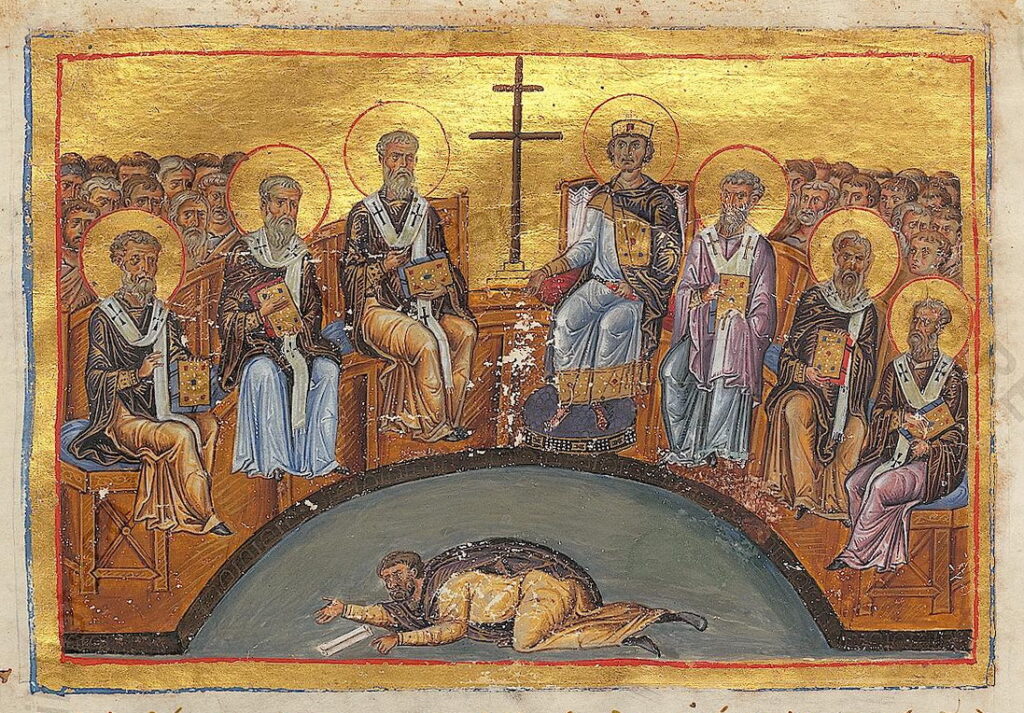
Second, the burden of proof was asymmetric. To win, Mr. Dyer had to show that one identifiable communion is "the true church." To avoid losing, Dr. Wood only needed to cast doubt on that exclusive claim. This is exactly what happened. Dr. Wood never argued that Protestantism is the true church. He argued that no body claiming that title can make its case without demanding an impossible amount of historical and theological expertise from the believer, and that the Orthodox claim in particular is undermined by the Second Council of Nicaea. A debate in which one side defends a thesis and the other defends a doubt rarely reaches a verdict.
Third, the phrase "true church" was never defined. Does it mean the only body in which salvation is possible? The body in which the fullness of the apostolic faith is kept? The church confessed in the Creed? The visible communion that has the authority to bind and loose? Each meaning calls for different evidence. Mr. Dyer shifted between the four marks of the Creed, "normative authority," canon law, liturgy and the Septuagint canon as criteria; Dr. Wood shifted between "the church" as the local congregation, the universal body of believers, and a set of "essentials" he declined to list. Neither was being evasive. The resolution simply gave them nothing firm to stand on.
2. "True church": the ecclesiological problem
The deeper difficulty is that the question "Which is the true church?" already assumes an ecclesiology, and it is not an Orthodox one.
2.1 The church is not a species within a genus
To ask which church is the true one is to imagine a genus called "churches," containing many species (Baptist, Lutheran, Roman Catholic, Orthodox), and then to ask which species is authentic. This is the ecclesiology of the denominational marketplace, and both debaters accepted it more than they realized. The Fathers did not think this way. For St. Ignatius of Antioch, the catholic church is wherever Christ is present in the eucharistic assembly gathered around its bishop: "where the bishop appears, there let the multitude be, just as where Jesus Christ is, there is the catholic church."1 The church is not one organization among others; it is the body of Christ made present in each local church, which is therefore not a part of the catholic church but the catholic church in full, in communion with all the others.2
2.2 Orthodox faith and catholic church
Here lies a category error that ran through the whole debate. "Orthodox" and "catholic" are not two names for the same thing. Orthodoxy is a quality of faith and worship: right confession, right glory. Catholicity is a quality of the church: its wholeness, kath’ holou, the fullness of Christ present in the local assembly. The Creed does not say "I believe in the Orthodox Church"; it says we believe in "one, holy, catholic and apostolic church." The Orthodox claim, rightly stated, is that the catholic church subsists wherever the Orthodox faith is confessed in a local church with its bishop, in communion with the other Churches that confess the same faith. In other words, Orthodoxy is the criterion of the catholic church; it is not a denomination competing for the title.
When Mr. Dyer concluded that "only the Orthodox Church is one, holy, catholic and apostolic," he said something true as a confession of faith. Presented as the winning entry in a contest of denominations, however, it invited Dr. Wood's natural reply: "How would anyone know?" The answer is not a checklist of marks to be verified by historical research, but the recognition of the same faith, the same Eucharist and the same apostolic ministry in the local church that one actually encounters.
2.3 The superstructure problem
Dr. Wood scored a point when he mentioned, almost in passing, that the Moscow Patriarchate had just decided that Ukrainians coming from the Orthodox Church of Ukraine must be received by baptism. He was correct. On October 22, 2026, the Holy Synod of the Russian Church approved guidelines requiring that persons baptized in the Orthodox Church of Ukraine and related Ukrainian bodies be received by baptism, while those originally baptized in its own Church and later joined to these bodies are received by confession.3 This is not a pan-Orthodox norm, and Constantinople and other Churches are in full communion with the Church of Ukraine that Moscow treats as schismatic.
The episode shows the weakness of identifying "the true church" with a single global institution. If the church were the sum of the patriarchates as administrative structures, the current schisms between them would mean that the true church had become unidentifiable, which is precisely Dr. Wood's suspicion. If the church is the local church confessing the Orthodox faith, the picture changes. The faith, the Mysteries and the episcopate of the parishes in Kiev, Moscow, Constantinople and Sandpoint are the same. Communion between ecclesial superstructures can be broken by politics while the catholic church remains whole in each place, and communion is never entirely severed, since these Churches remain in communion with common partners. A rebaptism of fellow Orthodox Christians, whose baptism is identical in faith and form, is therefore not a mark of the true church but a wound inflicted on it. Neither debater had the ecclesiological tools to say this, and the Orthodox side was the weaker for it.
2.4 Three further category errors
Anathema is not damnation. Dr. Wood read the anathemas of Nicaea II as meaning "unless you venerate icons, you cannot be saved." An anathema is a canonical act excluding from eucharistic communion those who teach against the faith; it is not a pronouncement on the eternal destiny of a confused believer. Mr. Dyer later supplied the correct distinction between "formal" heresy (the public teacher who persists in error) and "material" error (the believer who simply does not know better), but the distinction should have framed the whole discussion. The council's own text is directed against the iconoclast teaching and its teachers, not against the illiterate or the uninformed.
A dogmatic consequence is not an added condition. Dr. Wood's central argument compared Nicaea II to the Judaizers of Acts 15: both, he said, "added" a requirement to the Gospel. The analogy fails on its own terms. Circumcision was a precondition imposed on Gentiles before they could belong to Christ. The veneration of icons was defended by the council as a consequence of the Incarnation itself: because the Word truly became flesh, He can be depicted, and the honor given to the image passes to its prototype.4 The iconoclasts were condemned not for omitting a pious custom, but for a Christology that, in the council's judgment, divided or confused the natures of Christ. One may disagree with that judgment, yet it is not the same kind of claim as "unless you are circumcised you cannot be saved." It is closer to Nicaea I's homoousios, which Dr. Wood accepts and which was also an "addition" in exactly the sense he objects to. We should also note, as Mr. Dyer did, that Acts 15 itself bound the Gentile churches to "necessary things" in the name of the Holy Spirit (Acts 15:28-29).
Kerygma is not the whole of the faith. Dr. Wood's appeal to the "essentials" (Christ died for our sins, rose from the dead, and is Lord) is the apostolic proclamation, and every Orthodox Christian affirms it. The question is what happens when two people affirm the same words and mean different things. Arius confessed that Christ is Lord. Nestorius confessed that the Word took flesh. The dogmas of the councils are not additions to the kerygma; they are the church's guarding of its meaning against readings that would empty it. Mr. Dyer's question about whether the humanity of Christ is worshiped together with His divinity made this point well, and Dr. Wood's honest "how would I know?" was perhaps the most revealing moment of the evening.
3. The quality of the arguments
3.1 Jay Dyer
Mr. Dyer's opening was ambitious and, in its structure, sound. He argued from Old Testament prophecy (Gentile incense in Malachi 1:11, an altar in Egypt in Isaiah 19:19, a kingdom that cannot be destroyed in Daniel 2:44) that the messianic kingdom has a historical, visible, priestly form; from the New Testament that apostolic authority is transmitted by the laying on of hands; and from the earliest liturgical and canonical texts that this visible church believed in the real presence, baptismal regeneration, prayer for the departed, and a broader Old Testament than the Protestant one. His observation that liturgy is a better witness to the church's consensus than isolated patristic quotations is excellent and deserves to be heard more often. His use of Acts 1:20, where St. Peter applies Psalm 108:8 (LXX), "let another take his episkopê," to the apostolic office was apt.
The execution, however, suffered from imprecision that a careful opponent could have exploited. A short list of corrections follows:
| Claim | Correction |
|---|---|
| Gentiles taken as priests, Isaiah 65:21 and 61:5 | The text is Isaiah 66:21. In 61:5-6 the foreigners are shepherds and vinedressers; the "priests of the Lord" are Israel. |
| Twelve thrones, "Luke 20"; "I will not leave you orphans," John 16 | Luke 22:30; John 14:18 (with 16:13 for "guide into all truth"). |
| The Spirit passing from Moses by the laying on of hands | Numbers 11:25 (the seventy elders) involves no laying on of hands; the laying on of hands is Joshua's commissioning (Num 27:18-23; Deut 34:9). |
| Jerome included the deuterocanonical books "due to the authority of Pope Damasus" | Damasus died in 384, before Jerome's translation of the Old Testament. Jerome rendered Tobit and Judith at the request of other bishops, while maintaining his own view in the Prologus Galeatus.5 |
| Luther "did not want those books included" | Luther's 1534 Bible kept them in a separate section, as books "useful and good to read," though not equal to Scripture.6 |
| The Apostolic Canons give a canon that includes the deuterocanonical books | Apostolic Canon 85 does include several of them, yet it also includes 1-2 Clement and the Apostolic Constitutions and omits Revelation. Trullo (692) ratified several early lists together, which the later distinction between canonical and ecclesiastical books (see below) brings into agreement.7 |
| Justin Martyr: the Eucharist taken to the "sick and dying" | Justin says the deacons carry it to "those who are absent."8 |
| The anaphora of St. Hippolytus, about 200-230 | The attribution and date of the Apostolic Tradition are widely disputed; it remains a valuable witness, but not one to lean on without qualification.9 |
None of these errors damages his thesis. The canon question, however, deserves a clarification, since Dr. Wood's jab ("you don't have a canon") went unanswered, and Mr. Dyer's reply ("we don't make a big deal about it") conceded more than necessary. The Orthodox do have a settled canon. The key is that the concept of "canonical" does not completely coincide with the concept of Holy Scripture. The technical term goes back to St. Athanasius, who in his thirty-ninth Festal Letter distinguishes the books that are "canonized" (kanonizomena) from those "appointed by the Fathers to be read" (anaginōskomena).10 The canonical books number sixty-six: thirty-nine of the Old Testament and twenty-seven of the New. Alongside them, the corpus of Holy Scripture includes the books variously called the ecclesiastical, non-canonical or deuterocanonical books (Tobit, Judith, Wisdom, Sirach, the books of Maccabees and others). There is no disagreement that these books are part of the collection known as the Holy Bible, that they belong to the Old Testament, and that they are read in the services of the church. Because their witnessing authority is secondary, they are simply not designated by the specific term "canonical." In other words, there is agreement both on the scope of the canon and on the scope of Holy Scripture. The only open question is whether the appendix should include 4 Maccabees.
Protestants may indeed have a completely fixed number of books and an identity between canon and Scripture. That precision, however, does not resolve a question at least as consequential: which text of the Old Testament is Scripture? The Reformers adopted the Masoretic Text as their textual platform, while the apostles quoted the Old Testament predominantly in its Greek form. The Dead Sea Scrolls have shown that, before the Hebrew text was standardized, several Hebrew text-forms circulated, some of which stand behind readings of the Septuagint against the Masoretic Text: the shorter edition of Jeremiah (4QJerb,d), many readings of Samuel (4QSama), and "sons of God" in Deuteronomy 32:8 (4QDeutj), the reading the Septuagint presupposes.11 A fixed list of titles does not tell us which Jeremiah is Scripture. On this question, the Orthodox Churches, which received the Septuagint as the Old Testament of the apostolic church, are hardly at a disadvantage.
The weaker part of Mr. Dyer's performance was rhetorical. Remarks about "dumb Protestants," "evangelical slop" and a fictional strip-mall pastor, and the exchange about Andrew Tate and "masculine" Christianity, did not serve the Orthodox case. When an opponent has just told the story of his conversion in a prison cell, the Orthodox apologist has an opportunity to show what the church is like. We should hope for that in future encounters.
3.2 David Wood
Dr. Wood's strongest material was scriptural and pastoral. His use of Romans 14, 1 Corinthians 1, Mark 9:38-40 and Philippians 1:15-18 on bearing with differences and rejoicing whenever Christ is preached is a genuine and necessary corrective to a sectarian spirit that does exist among some converts, and we should receive it as such. His question about the man in the jail cell with nothing but a Bible ("How does he get to the one true church?") is the question every apologist for an exclusive claim must be able to answer with compassion. His historical facts about the empress Irene were largely accurate: Tarasios was indeed raised from layman to patriarch within days in 784, the first attempt at the council in 786 was broken up by iconoclast soldiers, and Irene had her son Constantine VI blinded in 797.12
His arguments were weaker than his testimony, for four reasons.
The genetic fallacy. The character of the empress who convened Nicaea II does not decide whether its teaching is true, any more than the character of Constantine decides the truth of Nicaea I, or the character of the German princes decides the truth of the Augsburg Confession, as Mr. Dyer rightly replied. Iconoclasm itself was imposed by emperors (Leo III and Constantine V, who convened the council of Hieria in 754). If imperial interference disqualifies a council, it disqualifies the iconoclast council first. What distinguishes Nicaea II from Hieria is not the absence of politics but reception: Nicaea II was received by Rome, whose legates signed it, and eventually by the whole communion of Churches, while Hieria was not.
The misreading he conceded. Dr. Wood had read the anathema against those who "communicate" with iconoclasts as forbidding conversation with them, and he graciously acknowledged the correction. It means eucharistic communion. The misreading, however, had shaped his picture of a church that forbids even dialogue.
Elders, deacons and bishops. His claim that the New Testament knows "elders and deacons, not bishops" overlooks Philippians 1:1, 1 Timothy 3:1-2 and Titus 1:7, where episkopos appears. It is true that presbyteros and episkopos overlap in the New Testament, and that the threefold ministry is clearly articulated by St. Ignatius. Still, an apostolic delegate such as Timothy, appointing elders and judging them (1 Tim 5:19-22), is already a figure of what the church came to call the bishop.
Apostolic succession and the Gnostics. Dr. Wood is right that some Gnostic teachers claimed secret chains of transmission (Basilides through Glaukias, the interpreter of Peter; Valentinus through Theudas, a disciple of Paul).13 St. Irenaeus answered them not by abandoning succession but by appealing to the public succession of bishops in the churches founded by the apostles, together with the "certain charism of truth" they received.14 The idea of succession, moreover, is already present in 1 Clement 44, before the major Gnostic systems. The Gnostics did not invent the argument; they counterfeited it, and Irenaeus restored the original.
On the Russian patriarch, Dr. Wood repeated claims about past intelligence connections and private wealth that have circulated in the press. Some are drawn from archival reporting; others are speculation. Even if all were true, they would illustrate the danger of state capture of church structures, a danger Orthodox Christians have long acknowledged, without telling us anything about whether the catholic church is identifiable.
3.3 What neither side said
As in the debate on sola Scriptura we reviewed recently, the missing element was the Holy Spirit. Dr. Wood's question, "How can anyone be sure?" and Mr. Dyer's answer, "normative authority," both treat certainty as the product of a mechanism: either the believer's reading or the church's decision. The Orthodox answer is neither. The same Spirit who inspired the Scriptures guides the church into all truth (John 16:13) and opens the mind of the believer to understand (Luke 24:45). The Eastern Patriarchs wrote in 1848 that the guardian of piety is "the very body of the church, that is, the people themselves."15 This is why Mr. Dyer could rightly say that the laity and the monks defeated iconoclasm, and why a council is recognized as the voice of the church not by the emperor who convened it, nor by the number of bishops who signed it, but by its reception in the Spirit by the Churches. This answer would have met Dr. Wood's legitimate fear of authoritarianism and Mr. Dyer's legitimate concern for a church that can actually decide.
4. A better question
We suggest that future debates between Orthodox and Protestant Christians would be more fruitful if the resolution named a single, testable thesis on which both sides hold a positive position. Three examples:
Possible resolutions
1. "The church confessed in the Nicene Creed is a visible communion of local churches in apostolic succession, not the invisible fellowship of all believers."
2. "The dogmatic definitions of the seven Ecumenical Councils, including Nicaea II, are binding on all Christians."
3. "Baptism and the Eucharist are means by which the Holy Spirit unites believers to Christ, not signs of a union already accomplished by faith."
Each of these places a clear burden on the affirmative, allows the negative to defend a real Protestant position rather than a mood of doubt, and keeps the discussion on the ground where the actual differences lie: the nature of the church, the authority of its councils, and the reality of its Mysteries.
Conclusion: the man in the cell
We return to Dr. Wood's question, because it deserves an answer that is neither a dodge nor a syllabus. How does a man in a prison cell with only a Bible come to the catholic church? He has, in a sense, already begun. The Bible in his hands was written, kept, copied and canonized by that church; the Christian who annoyed him into reading it was, in that moment, the church reaching out to him. St. Philip found the Ethiopian reading Isaiah and unable to understand without a guide (Acts 8:30-31); the reading led to a teacher, the teacher to baptism, and baptism to the life of the body. The path from the cell to the church is not a doctoral program in historical theology. It is the same path: Scripture, a living witness, and the Spirit who opens the heart, leading to a local church where the faith of the apostles is confessed and the Eucharist is celebrated.
Orthodox Christians should never deny what God has done in Dr. Wood. We may, and must, invite him further. If our apologists keep in mind that the catholic church is not a brand to be defended but the body of Christ to be encountered, our invitation will be heard more clearly, and our debates will look more like the church we are describing.
Notes
- Ignatius of Antioch, To the Smyrnaeans 8.2, in The Apostolic Fathers, ed. and trans. Michael W. Holmes, 3rd ed. (Grand Rapids: Baker Academic, 2007), 255.
- For a fuller development of this local ecclesiology, see Laurent Cleenewerck, His Broken Body: Understanding and Healing the Schism between the Roman Catholic and Eastern Orthodox Churches (Euclid University Press).
- "Russian Synod Codifies Long-Standing Practice of Receiving Ukrainian Schismatics by Baptism," OrthoChristian.com, October 26, 2026, https://orthochristian.com/181090.html; "Russian Orthodox Church Requires Laypeople Transferring to It from the OCU to Be Rebaptized," Ukrainian News, https://ukranews.com/en/news/1183332.
- Second Council of Nicaea (787), Definition, in Nicene and Post-Nicene Fathers, 2nd ser., vol. 14, ed. Henry R. Percival (New York: Charles Scribner's Sons, 1900), 549-50, citing Basil of Caesarea, On the Holy Spirit 18.45.
- Jerome, Prologus Galeatus; Jerome, Preface to Tobit and Preface to Judith, in Biblia Sacra iuxta Vulgatam Versionem, ed. Robert Weber and Roger Gryson, 5th ed. (Stuttgart: Deutsche Bibelgesellschaft, 2007).
- Martin Luther, "Preface to the Apocrypha" (1534), in Luther's Works, vol. 35, ed. E. Theodore Bachmann (Philadelphia: Muhlenberg, 1960), 337.
- Apostolic Canon 85; Council in Trullo (692), canon 2, in Nicene and Post-Nicene Fathers, 2nd ser., vol. 14, 359-61.
- Justin Martyr, First Apology 65 and 67, in Ante-Nicene Fathers, vol. 1, ed. Alexander Roberts and James Donaldson (Buffalo: Christian Literature, 1885), 185-86.
- Paul F. Bradshaw, Maxwell E. Johnson, and L. Edward Phillips, The Apostolic Tradition: A Commentary, Hermeneia (Minneapolis: Fortress, 2002), 1-17.
- Athanasius of Alexandria, Festal Letter 39.4-7, in Nicene and Post-Nicene Fathers, 2nd ser., vol. 4, ed. Philip Schaff and Henry Wace (New York: Christian Literature, 1892), 551-52.
- Emanuel Tov, Textual Criticism of the Hebrew Bible, 3rd ed. (Minneapolis: Fortress, 2012), esp. chap. 7 on the editions of Jeremiah; Eugene Ulrich, The Dead Sea Scrolls and the Developmental Composition of the Bible (Leiden: Brill, 2015).
- Theophanes the Confessor, Chronographia, AM 6277-6289, in The Chronicle of Theophanes Confessor, trans. Cyril Mango and Roger Scott (Oxford: Clarendon, 1997).
- Clement of Alexandria, Stromata 7.17, in Ante-Nicene Fathers, vol. 2; Ptolemy, Letter to Flora, in Epiphanius, Panarion 33.7.9, trans. Frank Williams, 2nd ed. (Leiden: Brill, 2009).
- Irenaeus of Lyons, Against Heresies 3.3.1-3 and 4.26.2, in Ante-Nicene Fathers, vol. 1.
- Encyclical of the Eastern Patriarchs (1848), §17.
Debate source: "Eastern Orthodox vs. Protestantism, Which Is the True Church? Jay Dyer vs. Dr. David Wood," Modern Day Debate, DebateCon 9, Orlando, October 2026.