
Image and Prototype
The Theology and Pastoral Reality of Icon Veneration, with the Biblical Evidence in Full
Fr. Laurent Cleenewerck
Introduction
In 2026, Craig Truglia and Dr. James White debated the resolution that icon veneration, as defined by the Second Council of Nicaea (787), is apostolic. Both men argued with courtesy and skill, and both persuaded their own audiences. As we observed in our reflections on that exchange, however, the debate turned almost entirely on the archaeological record and on a single sentence of St Basil, while the council's actual definition and the theology of the image that stands behind it were barely discussed.1 The material evidence matters, and we will consider it. Still, the accumulation of early images does not by itself establish a doctrine. The question is theological before it is archaeological: what is an image, what is honor, and to whom does the honor given to an image finally go?
This study attempts to supply what the debate left out. We will begin with what Nicaea II actually defined. We will then set out the biblical vocabulary of images and of worship in Hebrew and Greek, and give the relevant texts of Scripture in full, so that readers may weigh them for themselves. We will consider the biblical theology of the image, from the creation of humanity in the image of God to the Incarnation of the Son, who is "the image of the invisible God." We will examine the commandment against idols in its context, the images that the same Law commanded, the honor (proskynēsis) that Scripture gives to persons and holy things, and the biblical definition of idolatry. We will then turn to the Fathers, to the Christological debate with the iconoclasts, to the archaeological record, and to the authority of the council. The final part of the study describes the pastoral reality of icon veneration in Orthodox life, its purpose, its practice and its dangers.2
1. What Nicaea II Actually Defined
Any honest discussion must begin with the definition (horos) of the council. Its central section reads as follows:
We define with all exactness and care that, like the figure of the precious and life-giving cross, the venerable and holy images, whether painted or in mosaic or of any other suitable material, are to be set up in the holy churches of God, on sacred vessels and vestments, on walls and panels, in houses and by the roads: the image of our Lord and God and Savior Jesus Christ, of our undefiled Lady the holy Theotokos, of the honorable angels and of all holy and venerable people. For the more often they are seen through pictorial representation, the more those who behold them are lifted up to the remembrance of and longing for their prototypes, and to give them greeting and honorable veneration (aspasmon kai timētikēn proskynēsin), not the true worship (alēthinē latreia) which, according to our faith, belongs to the divine nature alone; so that, as with the figure of the precious and life-giving cross, the holy Gospels and the other sacred objects, the offering of incense and lights may be made in their honor, as was the pious custom of the ancients. For the honor given to the image passes over to the prototype, and the one who venerates the image venerates in it the hypostasis of the one depicted.3
Five points in this definition deserve emphasis, because most objections to icon veneration are aimed at something the council did not say.
First, the council distinguishes two kinds of honor with two different words. Latreia, adoring worship, "belongs to the divine nature alone." Proskynēsis timētikē, honorable veneration, may be given to images of Christ, the Theotokos, the angels and the saints. The council does not say that icons are worshiped; it explicitly denies it. Second, the purpose of the images is anamnetic and anagogical: they lift the beholder "to the remembrance of and longing for" the persons depicted. Third, the outward forms of honor named are specific and modest: greeting (aspasmos, the kiss of greeting), bowing, incense and lights. These are the same honors given to the cross and to the Book of the Gospels. Fourth, the council grounds its teaching in St Basil's principle that "the honor given to the image passes over to the prototype." Fifth, and most important, the council locates the term of veneration precisely: the one who venerates the icon venerates "in it the hypostasis of the one depicted." Veneration does not stop at wood and paint; it passes through the image to the person.
The question for debate, then, is not whether Christians may worship pictures. No Orthodox Christian believes that, and the council anathematized it. The real question is whether the apostolic faith permits, and indeed implies, a relative honor given to images of real persons, an honor that passes to those persons and through them to God. To answer it, we must turn to the language of Scripture.
2. The Biblical Vocabulary of Images and of Worship
Much of the controversy over icons comes from the fact that English uses the single word "worship" to translate several Hebrew and Greek words with different ranges of meaning. The following table gathers the principal terms.4
| Term | Meaning | Usage and significance |
|---|---|---|
| צֶלֶם tselem | Image, representation | Humanity made "in the image" of God (Gen 1:26-27; 9:6); also idols (Num 33:52; 4 Kgdms [2 Kgs] 11:18). LXX: eikōn. |
| דְּמוּת demut | Likeness | Humanity "according to the likeness" of God (Gen 1:26); Ezekiel's "likeness of the glory of the Lord" (Ezek 1:28). LXX: homoiōsis, homoiōma. |
| פֶּסֶל pesel | Carved image, idol | The object forbidden in the commandment (Exod 20:4; Deut 5:8). LXX: eidōlon. |
| תְּמוּנָה temunah | Form, visible shape | Israel "saw no form" at Horeb (Deut 4:12, 15); Moses beholds "the form of the Lord" (Num 12:8). LXX: homoiōma, doxa. |
| אֱלִילִים ʾelilim | "Nothings," worthless idols | "All the gods of the peoples are ʾelilim" (Ps 95 [96]:5); LXX renders "demons" (daimonia). |
| הִשְׁתַּחֲוָה hishtaḥawah | To bow down, prostrate oneself | Given to God, to idols, and also to kings, prophets, brothers and strangers (Gen 23:7; 33:3; 1 Par 29:20). LXX: proskyneō. |
| עָבַד ʿavad | To serve, to worship cultically | "You shall not serve them" (Exod 20:5). LXX: latreuō, also douleuō. |
| eikōn | Image | Christ is "the image of the invisible God" (Col 1:15; 2 Cor 4:4); also the emperor's image on a coin (Matt 22:20). |
| eidōlon | Idol, phantom, unreal image | "An idol is nothing in the world" (1 Cor 8:4). An image of what does not exist, or of a false god. |
| charaktēr | Exact imprint, stamp | The Son is "the exact imprint of His hypostasis" (Heb 1:3). |
| proskynēsis | Prostration, veneration | Physical bowing, kissing or prostration; given to God and, relatively, to persons and holy things. |
| latreia | Cultic service, adoration | Never given to any creature in Scripture (Matt 4:10; Rom 1:25). Reserved by Nicaea II for God alone. |
| aspasmos | Greeting, kiss | The kiss of greeting given to icons, the cross and the Gospel book. |
Two observations follow from this vocabulary. First, the Hebrew hishtaḥawah and the Greek proskynēsis describe a bodily act, bowing down, which takes its meaning from the person to whom it is directed and the intention of the one who bows. Scripture uses it without blame for honor given to human beings. Latreia, by contrast, is never given to a creature without condemnation. Second, the Greek of the New Testament and of the Fathers distinguishes eikōn, an image of something real, from eidōlon, an image of what is unreal or false. Origen already drew this distinction: an idol represents what does not exist, as Paul says, "an idol is nothing in the world," whereas a likeness (homoiōma) represents something that exists.5 The Fathers of Nicaea II inherited both distinctions.
3. The Biblical Theology of the Image
Humanity created in the image of God
The first image of God in Scripture is not made by human hands. It is humanity itself:
Then God said, "Let Us make man according to Our image (בְּצַלְמֵנוּ betsalmenu; LXX kat' eikona hēmeteran) and according to Our likeness (כִּדְמוּתֵנוּ kidmutenu; LXX kath' homoiōsin)...." So God made man; according to the image of God He made him; male and female He made them. (Gen 1:26-27)
Because the human person is God's image, the honor or dishonor shown to a human being passes to God. Scripture states this principle repeatedly, long before any council spoke of icons:
Whoever sheds the blood of man, by man shall his blood be shed; for in the image of God (בְּצֶלֶם אֱלֹהִים betselem ʾelohim; LXX en eikoni theou) He made man. (Gen 9:6)
With it we bless the Lord and Father, and with it we curse people, who are made according to the likeness (kath' homoiōsin) of God. (Jas 3:9)
The King will answer and say to them, "Truly I say to you, inasmuch as you did it to one of the least of these My brothers, you did it to Me." (Matt 25:40)
If anyone says, "I love God," and hates his brother, he is a liar; for whoever does not love his brother whom he has seen cannot love God whom he has not seen. (1 John 4:20)
Murder is an offense against God because it destroys His image. Cursing a person is incoherent because it dishonors the likeness of the One we bless. Charity to the least of Christ's brothers is charity to Christ. Love for God is tested by love for the visible brother. In each case, honor or dishonor directed to the image reaches the prototype. This is precisely the principle that St Basil and Nicaea II would later state in general form. We should notice that the human being is not consubstantial with God; the principle works across the distance between created image and uncreated prototype. This point will matter when we come to the objection raised in the debate concerning St Basil.
Christ, the image of the invisible God
The New Testament proclaims that the image of God has been fully revealed in the person of the Son:
He is the image (eikōn) of the invisible (aoratou) God, the firstborn of all creation. (Col 1:15)
...the light of the gospel of the glory of Christ, who is the image (eikōn) of God. (2 Cor 4:4)
He is the radiance of His glory and the exact imprint (charaktēr) of His hypostasis (hypostaseōs), and He upholds all things by the word of His power. (Heb 1:3)
The Word became flesh and dwelt (eskēnōsen, "tabernacled") among us, and we beheld His glory, glory as of the only-begotten from the Father, full of grace and truth.... No one has ever seen God; the only-begotten God, who is in the bosom of the Father, He has made Him known (exēgēsato). (John 1:14, 18)
Jesus said to him, "Have I been with you so long, and yet you do not know Me, Philip? Whoever has seen Me has seen the Father." (John 14:9)
That which was from the beginning, which we have heard, which we have seen with our eyes, which we have looked upon and our hands have handled, concerning the Word of life. (1 John 1:1)
The Son is the image of the Father by nature. In the Incarnation, this eternal Image became visible, audible and tangible. The Old Testament prohibition was grounded in the fact that Israel saw no form at Horeb:
The Lord spoke to you out of the midst of the fire; you heard the sound of words, but saw no form (תְּמוּנָה temunah; LXX homoiōma), only a voice.... Take careful heed to yourselves, for you saw no form on the day that the Lord spoke to you at Horeb out of the midst of the fire, lest you act corruptly and make for yourselves a carved image (פֶּסֶל pesel), the likeness of any figure, male or female. (Deut 4:12, 15-16)
The reasoning is explicit: no form was seen, therefore no form may be made to represent God. The Incarnation changes the premise. The apostles did see, look upon and handle the Word of life. St John of Damascus draws the conclusion:
In former times, God, who is without form or body, could never be depicted. Now, however, God has been seen in the flesh and has conversed with human beings, and so I make an image of the God whom I see. I do not venerate matter; I venerate the Creator of matter, who became matter for my sake, who willed to dwell in matter, and who worked out my salvation through matter.6
An icon of Christ, therefore, does not depict the divine nature, which remains invisible and uncircumscribable. It depicts the incarnate Son as He was seen, the One whom the apostles saw with their eyes. To refuse to depict Him is, in the end, to imply that the Incarnation did not make God visible.
4. The Commandment against Idols and the Images Commanded by God
The commandment in its context
I am the Lord your God, who brought you out of the land of Egypt, out of the house of slavery. You shall have no other gods before Me. You shall not make for yourself an idol (פֶסֶל pesel; LXX eidōlon), nor any likeness (תְּמוּנָה temunah; LXX homoiōma) of anything that is in heaven above, or that is on the earth beneath, or that is in the water under the earth. You shall not bow down to them (לֹא־תִשְׁתַּחֲוֶה לָהֶם lo'-tishtaḥaveh lahem; LXX ou proskynēseis autois), nor serve them (וְלֹא תָעָבְדֵם velo' taʿovdem; LXX oude mē latreusēs autois); for I the Lord your God am a jealous God. (Exod 20:2-6)
Read in isolation, the second sentence might seem to forbid every image of every created thing. Read in context, it is the application of the first: "You shall have no other gods before Me." The images forbidden are idols, objects made in order to be worshiped and served as gods, or as representations of the invisible God. The pronoun "them" in "you shall not bow down to them nor serve them" refers to these idols. That this is the correct reading appears from the fact that the same God, in the same book, commanded Moses to make images.
Images commanded by God
You shall make two cherubim of gold; of hammered work you shall make them, at the two ends of the mercy seat.... The cherubim shall spread out their wings above, covering the mercy seat with their wings, and they shall face one another; toward the mercy seat shall the faces of the cherubim be. You shall put the mercy seat on top of the ark.... There I will meet with you, and I will speak with you from above the mercy seat, from between the two cherubim that are upon the ark of the testimony. (Exod 25:18-22)
You shall make the tabernacle with ten curtains of fine twined linen, blue, purple and scarlet; with cherubim skillfully worked you shall make them.... You shall make a veil of blue, purple and scarlet, and fine twined linen; with cherubim it shall be made, skillfully worked. (Exod 26:1, 31)
In the inner sanctuary he made two cherubim of olivewood, each ten cubits high.... Around all the walls of the house he carved figures of cherubim, palm trees and open flowers, in the inner and outer rooms. (3 Kgdms [1 Kgs] 6:23, 29)
On the walls all around, inside and outside, were carved cherubim and palm trees, a palm tree between cherub and cherub. Every cherub had two faces: a human face toward the palm tree on one side, and a lion's face toward the palm tree on the other side; they were carved on the whole house all around. (Ezek 41:17-19)
The holiest place in Israel, where God promised to meet His people, was surrounded by images of heavenly beings. The prophet's vision of the restored temple is covered with carved faces. These images were not worshiped, but they were not mere decoration either: they surrounded the place of the divine presence and made the heavenly worship visible on earth. The fact that God commanded them proves that the commandment does not forbid images as such.
The bronze serpent: proper use and abuse
The Lord said to Moses, "Make a serpent and set it on a pole; and everyone who is bitten, when he looks at it, shall live." So Moses made a bronze serpent and set it on a pole; and if a serpent had bitten anyone, when he looked at the bronze serpent, he lived. (Num 21:8-9)
He removed the high places and broke the pillars and cut down the Asherah. He broke in pieces the bronze serpent that Moses had made, for until those days the people of Israel had burned incense to it; it was called Nehushtan. (4 Kgdms [2 Kgs] 18:4)
As Moses lifted up the serpent in the wilderness, so must the Son of Man be lifted up, that whoever believes in Him may have eternal life. (John 3:14-15)
Here, in a single object, we see the whole question. God commanded an image, and looking at it in faith brought healing. Christ Himself took it as a figure of His cross. Centuries later, the same object had become an idol, receiving the cultic worship of burnt incense as a god with its own name, and Hezekiah rightly destroyed it. The problem was not the image but its idolatrous use. The church has always distinguished between the two, and Nicaea II explicitly forbade giving latreia to any image.
The golden calf: depicting the invisible God
He received the gold from their hands, fashioned it with a graving tool and made a molten calf. They said, "These are your gods, O Israel, who brought you up out of the land of Egypt!" When Aaron saw this, he built an altar before it; and Aaron made a proclamation and said, "Tomorrow shall be a feast to the Lord (לַיהוָה la-YHWH)." (Exod 32:4-5)
We should notice what the sin of the golden calf was. Aaron proclaimed a feast "to the Lord," using the divine Name. The calf was offered as a representation of the God who had brought Israel out of Egypt, and it received sacrifice. The sin was twofold: to represent the invisible, unseen divine nature by the form of an animal, and to give that object the worship that belongs to God. Neither element is present in an Orthodox icon. The icon of Christ depicts the incarnate Son as He was actually seen, and it receives honor, not sacrifice or latreia.
5. Relative Veneration in Scripture
Proskynēsis given to persons
Scripture frequently records bowing down (hishtaḥawah, proskynēsis) before human beings, without any hint of blame:
Abraham rose and bowed down (וַיִּשְׁתַּחוּ vayyishtaḥu; LXX prosekynēsen) to the people of the land, the sons of Heth. (Gen 23:7)
He himself went on before them, and bowed himself (LXX prosekynēsen) to the ground seven times, until he came near to his brother. (Gen 33:3)
They told the king, "Here is Nathan the prophet." When he came in before the king, he bowed down (LXX prosekynēsen) before the king, with his face to the ground. (3 Kgdms [1 Kgs] 1:23)
He said, "No; I have come now as commander of the army of the Lord." Joshua fell on his face to the earth and bowed down (LXX prosekynēsen), and said to him, "What does my lord say to his servant?" (Josh 5:14)
Behold, I will make those of the synagogue of Satan, who say that they are Jews and are not, but lie, behold, I will make them come and bow down (proskynēsousin) before your feet, and they shall know that I have loved you. (Rev 3:9)
The most decisive text for our subject is the account of David's last assembly, where a single act of bowing is directed both to God and to the king:
David said to all the assembly, "Bless the Lord your God." All the assembly blessed the Lord, the God of their fathers, and bowed their heads and prostrated themselves (וַיִּשְׁתַּחֲווּ לַיהוָה וְלַמֶּלֶךְ vayyishtaḥavu la-YHWH velammelekh; LXX kampsantes ta gonata prosekynēsan tō kyriō kai tō basilei) before the Lord and before the king. (1 Par [1 Chr] 29:20)
The same verb, in the same sentence, describes the honor given to God and the honor given to the king, the Lord's anointed. No reader imagines that Israel gave David divine worship. The meaning of the bow depends on its recipient: to God, it is adoration; to the king, it is honor given to God's anointed and, through him, to the God who anointed him. This is exactly the distinction Nicaea II makes between latreia and relative proskynēsis.
Proskynēsis toward holy places and objects
Exalt the Lord our God, and worship at His footstool (וְהִשְׁתַּחֲווּ לַהֲדֹם רַגְלָיו vehishtaḥavu lahadom raglav; LXX proskyneite tō hypopodiō tōn podōn autou, "venerate the footstool of His feet"); for He is holy. (Ps 98:5 [99:5])
Let us go into His tabernacles; let us worship at the place where His feet have stood (LXX proskynēsomen eis ton topon hou estēsan hoi podes autou). (Ps 131:7 [132:7])
Joshua tore his clothes and fell to the earth on his face before the ark of the Lord until the evening, he and the elders of Israel; and they put dust on their heads. (Josh 7:6)
...that Thine eyes may be open night and day toward this house, the place of which Thou hast said, "My Name shall be there," that Thou mayest hear the prayer which Thy servant shall pray toward this place. Hear the supplication of Thy servant and of Thy people Israel, when they pray toward this place; hear Thou in heaven Thy dwelling place, and when Thou hearest, forgive. (3 Kgdms [1 Kgs] 8:29-30)
When Daniel knew that the document had been signed, he went into his house; his windows were open in his upper room toward Jerusalem; and he knelt on his knees three times a day, and prayed and gave thanks before his God, as he had done before. (Dan 6:10)
The footstool is the ark (1 Par 28:2). Israel bowed toward it and toward the temple, prayed facing it, and fell down before it. None of this was the worship of wood or gold; it was the worship of God, directed through a holy, material place to the One who had chosen to make His Name dwell there.
Jacob's staff and the Epistle to the Hebrews
By faith Jacob, when he was dying, blessed each of the sons of Joseph, and bowed in worship upon the top of his staff (prosekynēsen epi to akron tēs rhabdou autou). (Heb 11:21)
Hebrews here quotes the Septuagint of Genesis 47:31, where the Masoretic text reads "upon the head of the bed" (mittah) and the Greek, reading the same consonants as matteh, "staff," reads "upon the top of his staff." Many patristic interpreters, and the Fathers of the iconophile period, understood Jacob to have bowed in honor toward the staff of Joseph, the symbol of the authority God had given him. We need not insist on this reading. It is enough to note that the Epistle to the Hebrews counts as an act of faith a prostration made "upon" a material object.
Is all proskynēsis to creatures forbidden? Revelation 19 and 22, Acts 10
I fell at his feet to worship (proskynēsai) him, but he said to me, "See that you do not do that! I am your fellow servant, and of your brothers who hold the testimony of Jesus. Worship God." (Rev 19:10)
When Peter entered, Cornelius met him and fell down at his feet and worshiped (prosekynēsen) him. Peter lifted him up, saying, "Stand up; I myself am also a man." (Acts 10:25-26)
These texts are often cited against icons. They show that proskynēsis can be misdirected when it carries the meaning of divine worship. Cornelius, a Gentile, prostrated himself before Peter as before a heavenly being; John, overwhelmed by the glory of the revelation, fell before the angel as before the Lord who speaks through him. In both cases, the one honored corrects a confusion about his own nature. They do not show that every bow to a creature is idolatry, since Scripture records many such bows without censure, as we have seen, and since the Lord Himself promises that others will bow "before the feet" of the faithful (Rev 3:9). The rule is the one the council stated: honor to creatures, latreia to God alone.
6. What Scripture Calls Idolatry
If icons are not idols, we must state clearly what an idol is. Scripture provides a precise account.
Professing to be wise, they became fools, and exchanged the glory of the incorruptible God for the likeness of an image (en homoiōmati eikonos) of corruptible man and of birds and four-footed beasts and creeping things.... They exchanged the truth of God for the lie, and venerated and served (esebasthēsan kai elatreusan) the creature rather than the Creator, who is blessed forever. Amen. (Rom 1:22-23, 25)
As to the eating of food offered to idols, we know that an idol is nothing in the world (ouden eidōlon en kosmō), and that there is no God but one. For although there may be so-called gods in heaven or on earth, as indeed there are many gods and many lords, yet for us there is one God, the Father, from whom are all things and for whom we exist, and one Lord, Jesus Christ, through whom are all things and through whom we exist. (1 Cor 8:4-6)
What do I imply, then? That food offered to idols is anything, or that an idol is anything? No, I imply that what the pagans sacrifice they offer to demons and not to God. I do not want you to be participants with demons. (1 Cor 10:19-20)
Being then God's offspring, we ought not to think that the divine nature (to theion) is like gold or silver or stone, an image formed by the art and imagination of man. (Acts 17:29)
The deuterocanonical Wisdom of Solomon, which the church reads as Old Testament Scripture, gives a remarkable account of how idolatry began:
A father, consumed with untimely grief, made an image of his child, who had been suddenly taken from him; he now honored as a god what was once a dead human being, and handed on to his household secret rites and initiations. Then the ungodly custom, grown strong with time, was kept as a law.... The multitude, attracted by the charm of the work, now regarded as an object of worship the one whom shortly before they had honored as a man. This became a trap for humanity, because people, in bondage to misfortune or to royal authority, bestowed on objects of stone or wood the Name that ought not to be shared (to akoinōnēton onoma). (Wis 14:15-16, 20-21)
The idols of the nations are silver and gold, the work of human hands. They have mouths, but do not speak; eyes they have, but do not see; they have ears, but do not hear; noses they have, but do not smell; they have hands, but do not feel; feet they have, but do not walk; they make no sound in their throats. Those who make them become like them, and so do all who trust in them. (Ps 113:12-16 [115:4-8])
These texts allow us to define idolatry with precision. An idol is an image of a false god or of a creature treated as divine; it receives the latreia that belongs to God, sacrifice above all; it bears the incommunicable Name of God given to a creature; and its worshipers trust in the object itself as though it could see, hear and act. Behind it stand demons. The Wisdom of Solomon even shows the decisive step: not the making of an image of a beloved dead person, but the moment when the image is "honored as a god" and given the divine Name.
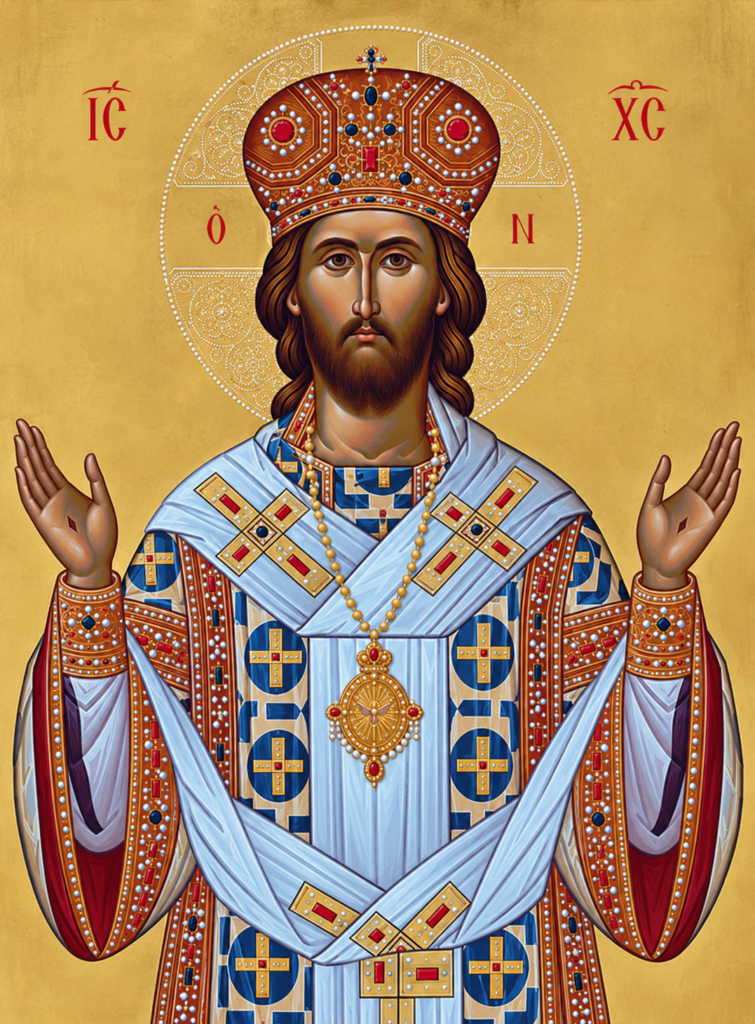
An Orthodox icon fulfills none of these conditions. It depicts a real person: the incarnate Son, or a saint who lived and died in Christ. It receives no sacrifice and no latreia. The divine Name is inscribed only on the icon of Christ, who is truly God ("ὁ ὤν," ho ōn, "He who is," in His halo), while every saint is named as a creature and servant of God. No Orthodox Christian believes that the wood sees, hears or acts by itself. The icon is, in the strict biblical sense, the opposite of an idol: the idol is an image of what is not, the icon an image of One who is.
7. The Patristic Principle: The Honor Passes to the Prototype
St Basil and the debate over consubstantiality
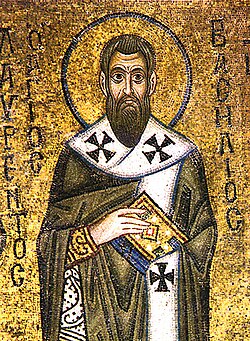
The council's key principle comes from St Basil the Great, writing against those who denied the divinity of the Holy Spirit:
The image of the emperor is also called the emperor, and yet there are not two emperors; neither is the power divided, nor the glory parted. As the authority and power that rule us is one, so also the glorification we offer is one and not many, because the honor given to the image passes over to the prototype (hē tēs eikonos timē epi to prōtotypon diabainei). What the image is there by imitation (mimētikōs), the Son is here by nature (physikōs); and as in works of art the likeness is according to the form, so in the divine and uncompounded nature the union is in the communion of the Godhead.7
In the debate, Dr. White argued that Basil's principle works only where image and prototype are consubstantial, as the Son is with the Father, so that Nicaea II misused it. The text itself answers the objection. Basil's next sentence explicitly distinguishes two kinds of image: the image by imitation (mimētikōs), as in works of art, and the image by nature (physikōs), as the Son is to the Father. The analogy works precisely because honor passes through an image that is not consubstantial with its prototype: the painted or sculpted image of the emperor is not of the emperor's substance, yet honor given to it reaches him. Basil argues from the lesser case, the imitative image, to the greater, the natural Image. If honor did not pass through a non-consubstantial image, the analogy would have no force.
St Athanasius used the same analogy a generation earlier: in the emperor's image are his form and features, so that one who sees the image sees the emperor in it, and one who venerates the image venerates the emperor in it.8 We have already seen that Scripture itself applies this principle to humanity, which is not consubstantial with God, in Genesis 9:6 and James 3:9.
We should concede what Basil does not prove. His principle establishes that relative honor is intelligible and that it reaches the prototype. It does not, by itself, establish that the church should venerate icons. That obligation rests on the theology of the Incarnation and on the authority of the church gathered in council, to which we will return.
Relative veneration and the one hypostasis
The Fathers of the iconophile period clarified that the veneration given to an icon is "relative" (schetikē): it exists in relation to the person depicted, not to the material. St Theodore the Studite explains that the icon is one with its prototype not in essence but in likeness and in name, so that the veneration of the icon and of the prototype is one, ending in the person depicted.9 This is why an icon is always inscribed with the name of its subject: the name identifies the hypostasis to whom the honor goes.
The Fifth Ecumenical Council provides an important parallel. It anathematized those who introduce "two adorations" of Christ, one to the Word and another to the man, and confessed that the incarnate Word is worshiped "with His own flesh" in one adoration.10 The flesh of Christ is created, not consubstantial with the Father, yet it receives the one adoration given to the person of the Word, because it is His flesh. Honor can therefore pass across the boundary of natures when it is directed to the one hypostasis. This is exactly what Nicaea II affirms of the icon, in a relative and not an absolute mode.
8. The Christological Debate with the Iconoclasts
The most serious argument against icons was not the one usually made today. The iconoclast council of Hieria (754) argued Christologically: an icon of Christ either claims to depict His divinity, which is uncircumscribable, and so confuses the natures like the Monophysites, or it depicts His humanity alone, and so divides the natures like the Nestorians.11 This is a far stronger argument than the appeal to the second commandment, and it deserves a careful answer.
The answer of St Theodore the Studite and St Nikephoros of Constantinople rests on the distinction between nature and hypostasis. An icon does not depict a nature; natures are not seen. It depicts a person, a hypostasis, as that person appears. The person of the Word, having become flesh, is circumscribable according to His humanity and uncircumscribable according to His divinity. When we paint Christ, we depict the one person of the Word as He made Himself visible in the flesh, without claiming to circumscribe His divinity and without separating His humanity from Him. Hieria's dilemma fails because it assumes that an image represents a nature, when in fact it represents a person.12
This is why the definition of Nicaea II insists that the one who venerates the icon venerates "the hypostasis of the one depicted." The theology of the icon is not a devotional appendix to the faith; it is an application of the Christology of Chalcedon. To deny that Christ can be depicted is, at least implicitly, to deny that the Word truly became visible flesh.
9. The Historical and Archaeological Record
The material record is not the foundation of the doctrine, but it is relevant to the claim of apostolicity, and it is considerably richer than older Protestant scholarship assumed. The older thesis that the earliest Christians were hostile to all art has been seriously challenged.13
Judaism itself was not uniformly aniconic. The synagogue at Dura-Europos on the Euphrates, decorated around 244, is covered with painted scenes from the Old Testament: the sacrifice of Isaac, Moses at the burning bush, the crossing of the sea, Ezekiel's vision of the dry bones. In the same city, the Christian house church, dated around 232, contains a baptistery painted with the Good Shepherd, the healing of the paralytic, Christ and Peter walking on the water, and the women approaching the tomb.14 The Roman catacombs, from the third century onward, contain images of Christ, of the Theotokos with the Child, of the apostles and of biblical scenes, together with many inscriptions asking the departed to pray for the living. Eusebius of Caesarea records that he saw at Caesarea Philippi a bronze statue of Christ said to have been set up by the woman healed of the flow of blood, and that he had seen painted images of Peter, Paul and Christ himself.15
Honesty requires us to note the counterevidence. The Council of Elvira in Spain (c. 305) decreed that there should be no pictures in churches, "lest what is worshiped and adored be painted on the walls."16 Eusebius himself, in a letter to Constantia, discouraged images of Christ, and a few texts attributed to St Epiphanius oppose images, though their authenticity is disputed. These witnesses show that the use of images was not uniform in every place and that some bishops feared abuse. They do not show a universal apostolic prohibition. A local canon forbidding paintings on church walls presupposes that Christians were making them. The church did not decide the question by counting early texts on either side; it decided it in council, on theological grounds, as it had done at Nicaea I.
Two overclaims, sometimes made in defense of icons, should be set aside. The Dionysian corpus cannot be dated to the apostolic age with any confidence, and the reading of Galatians 3:1, where Christ was "publicly portrayed" (proegraphē) as crucified before the Galatians' eyes, as a reference to a literal painted crucifix is a minority view. Most interpreters read it as a vivid description of apostolic preaching. Arguments of this kind weaken the strong evidence by associating it with weak claims.
10. The Authority of the Council
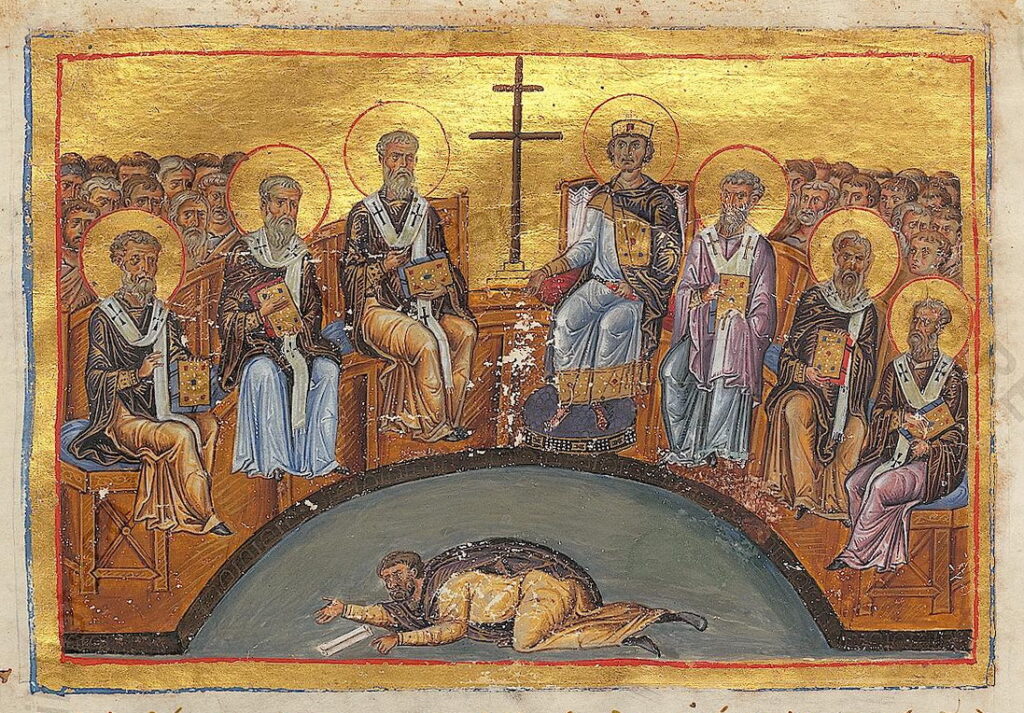
Ultimately, the question of whether icon veneration is apostolic is a question about how the church receives and articulates the apostolic faith. The word homoousios, "of one essence," does not appear in Scripture, yet Nicaea I defined it as the faithful expression of what Scripture teaches about the Son. Nicaea II claims to do the same with respect to images: to articulate, against a specific denial, a truth implied by the Incarnation and by the apostolic tradition.
Truly I say to you, whatever you bind on earth will be bound in heaven, and whatever you loose on earth will be loosed in heaven. (Matt 18:18)
It has seemed good to the Holy Spirit and to us to lay upon you no greater burden than these necessary things. (Acts 15:28)
So then, brothers, stand firm and hold fast to the traditions (paradoseis) that you were taught by us, whether by word of mouth or by our letter. (2 Thess 2:15)
St Basil, in the same treatise from which the council drew its principle, lists among the unwritten apostolic traditions the sign of the cross, praying toward the east and the words of the epiclesis, which the church keeps although Scripture does not command them in writing.17 The council of 787 was received by the whole church, East and West, and the restoration of the icons in 843 is still celebrated each year on the first Sunday of Great Lent as the Triumph of Orthodoxy. For the Orthodox, the obligation to venerate icons rests on the same authority that guarantees the homoousios of the Son. Those who accept Nicaea I as a faithful interpretation of Scripture should at least consider why they reject Nicaea II, which reasoned in the same way and was received by the same churches.18
11. Common Objections and Brief Answers
| Objection | Answer | Key texts |
|---|---|---|
| The second commandment forbids all images. | It forbids idols, images made to be worshiped as gods. The same Law commands the cherubim and the bronze serpent. | Exod 20:3-5; 25:18-22; Num 21:8-9 |
| Bowing down is worship, and worship belongs to God alone. | Proskynēsis is given in Scripture to kings, prophets and strangers. Latreia is reserved for God, as Nicaea II teaches. | Gen 23:7; 1 Par 29:20; Rev 3:9; Matt 4:10 |
| Angels and apostles refused proskynēsis. | They refused honor offered as to a divine being. Scripture records many bows to creatures without censure. | Acts 10:25-26; Rev 19:10; Josh 5:14 |
| God is invisible and cannot be depicted. | The divine nature cannot be depicted. The Son became flesh, was seen and handled, and it is He who is depicted. | Deut 4:12-16; John 1:14, 18; 1 John 1:1 |
| Honor to the image cannot reach the person. | Scripture applies this principle to the human image of God; Basil and Athanasius apply it to the emperor's image. | Gen 9:6; Jas 3:9; Matt 25:40 |
| The early church was hostile to images. | The record includes Dura-Europos, the catacombs and Eusebius, alongside a few local objections. There was no universal prohibition. | Eusebius, Eccl. Hist. 7.18 |
| Icons are a later development. | The explicit definition is later, as is homoousios. The theology rests on the Incarnation and the use of images is early. | Col 1:15; Heb 1:3; Acts 15:28 |
| Icons lead to superstition. | Abuse is possible, as with the bronze serpent. The remedy is right teaching, not the abolition of the image. | 4 Kgdms 18:4; John 3:14 |
12. The Pastoral Reality of Icon Veneration
What Orthodox Christians actually do
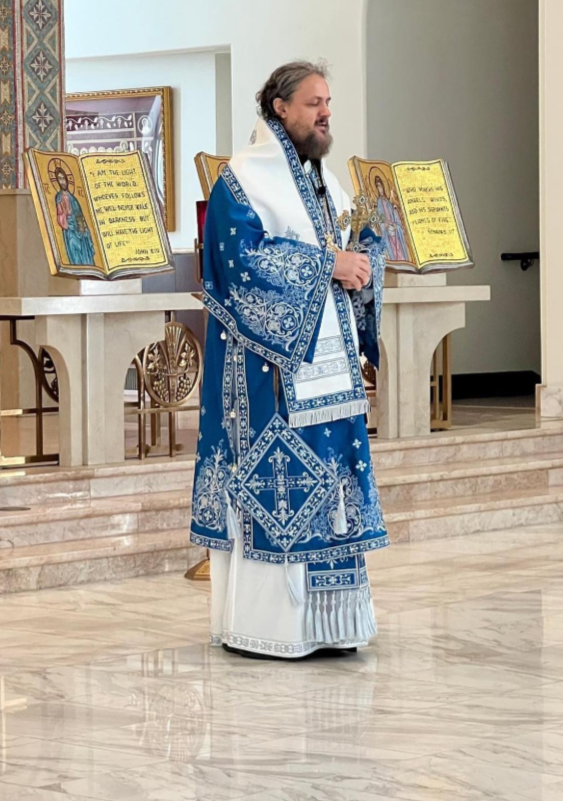
The doctrine of the council takes concrete form in the daily life of Orthodox Christians. On entering a church, the faithful usually go first to the icon of the feast or of the church's patron on the central stand. They make the sign of the cross, bow, kiss the icon (the aspasmos of the council), light a candle and offer a short prayer. The iconostasis, the screen of icons before the altar, shows Christ and the Theotokos on either side of the Royal Doors, with the forerunner, the patron saint, the archangels, and above them the feasts, the apostles and the prophets. The clergy cense the icons during Vespers and Matins, as they cense the people, who are also living images of God. In their homes, Orthodox families keep an icon corner, often facing east, where they pray morning and evening, before which a vigil lamp burns, and where a child learns to pray before the faces of Christ and the saints.
These gestures are exactly those named by the council: greeting, bowing, incense and lights. They are also the gestures of affection and respect shown in many cultures to the photographs of loved ones or to a national flag, which no one confuses with worship. The difference is that the persons whose images Orthodox Christians honor are alive in Christ, and the honor given to them rises, through them, to God, who is "wonderful in His saints" (Ps 67:36 [68:35]).
The purposes of the icon
The council named the first purpose: remembrance and longing. Icons place before our eyes the events of salvation and the persons who have been saved, so that we remember them and desire to be with them. St Gregory the Great, writing to Bishop Serenus of Marseilles, who had destroyed images in his church, observed that what writing offers to those who can read, a picture offers to those who cannot, and he urged him to teach the people rather than destroy the images.19 The icon is Scripture in color, a catechesis for the eyes.
The second purpose is communion. Icons are not illustrations to be studied from a distance but presences before which we pray. The saints are not absent, and the icon reminds us that we stand "surrounded by so great a cloud of witnesses" (Heb 12:1). The third purpose is transformation. The icon shows the human person transfigured by grace: the faces are calm, the eyes large, the bodies light, the backgrounds golden with the uncreated light. In this sense, the icon is a theology of deification in line and color, showing what we are called to become: "We all, with unveiled face, beholding as in a mirror the glory of the Lord, are being transformed into the same image (eikona) from glory to glory" (2 Cor 3:18). The kontakion of the Sunday of Orthodoxy expresses the whole mystery: the uncircumscribed Word of the Father became circumscribed when He took flesh from the Theotokos, and restored the defiled image to its ancient beauty.20
Canonical iconography
Because icons are theological statements, the church does not leave their content to private imagination. Icons follow established types, carry inscriptions that identify their subjects, and are painted (or, as iconographers say, "written") in prayer and fasting. The church has also set limits. The Great Council of Moscow (1666-1667), for example, forbade depicting God the Father as an old man, since the Father has not become incarnate and has not been seen; the "Ancient of Days" of Daniel's vision is understood as the Son.21 These limits apply the same logic as the council: what has been seen may be depicted, and what has not been seen may not.
Miracle-working icons and the danger of superstition
Orthodox Christians venerate certain icons as "wonder-working," through which God has granted healings and protection. This belief rests on a biblical principle: God freely works through material things connected with His saints.
As a man was being buried, behold, a marauding band was seen, and the man was thrown into the grave of Elisha; and as soon as the man touched the bones of Elisha, he revived and stood on his feet. (4 Kgdms [2 Kgs] 13:21)
God did extraordinary miracles by the hands of Paul, so that even handkerchiefs or aprons that had touched his skin were carried away to the sick, and their diseases left them, and the evil spirits came out of them. (Acts 19:11-12)
Behold, a woman who had suffered from a flow of blood for twelve years came up behind Him and touched the fringe of His garment, for she said to herself, "If I only touch His garment, I will be made well." Jesus turned, and seeing her He said, "Take heart, daughter; your faith has made you well." Instantly the woman was made well. (Matt 9:20-22)
The last text also contains the pastoral safeguard. The Lord attributes the healing to faith, not to the cloth. God works through matter, but always as God, and always in response to faith directed to Him. The history of the bronze serpent warns us that a holy object can become an idol when it is treated as a source of power in itself. Pastors must therefore teach that icons are not amulets, that the grace is God's, that veneration is always offered through the person depicted to God, and that devotion to icons is never a substitute for repentance, the sacraments, love of neighbor and obedience to the Gospel. A Christian who kisses the icon of Christ and then despises the living image of God in a neighbor has misunderstood the icon entirely (1 John 4:20).
Pastoral guidance for those coming from Protestant traditions
Converts and inquirers from Protestant backgrounds often find icon veneration the most difficult aspect of Orthodox practice. We may offer them three pastoral counsels. First, there is no need to force gestures that the conscience does not yet understand; understanding and love grow with time, and the church does not ask for theatrical devotion. Second, it helps to begin with the icon of Christ, since every Christian already loves the One depicted, and to notice that a kiss given to His image is a kiss of love given to Him. Third, it helps to remember that Protestant Christians already practice a form of relative honor: they handle the Bible with reverence and would not throw it on the floor, they treasure photographs of departed parents, and they honor the empty cross. The Orthodox simply extend this instinct, consistently and with theological precision, to the faces of Christ and of His saints.
Conclusion
The debate between Craig Truglia and Dr. James White showed how much can be argued about early catacomb paintings and a single sentence of St Basil, and how little was said about the theology that Nicaea II actually defined. That theology rests on the biblical teaching that humanity is God's image, that honor given to the image reaches the prototype, and that the invisible God has made Himself visible in His incarnate Son, "the image of the invisible God." It rests on the distinction, present in the vocabulary of Scripture itself, between the bodily honor of proskynēsis, which may be given to persons and holy things, and the latreia that belongs to God alone. It rests on the biblical definition of the idol as an image of what is not, given the worship and the Name that belong to God. The icon is the opposite: an image of One who is, given an honor that passes through it to the person depicted and, through that person, to God.
This doctrine was not invented in 787. The council articulated, against a specific denial, what the church had long practiced and what the Incarnation implies, just as Nicaea I articulated the homoousios. In the life of the church, icons teach, remind, console and transform; they surround the faithful with the cloud of witnesses and hold before their eyes the goal of the Christian life, the restoration of the divine image in us. As the church sings on the Sunday of Orthodoxy, we confess our salvation "in word and deed, and depict it in images."